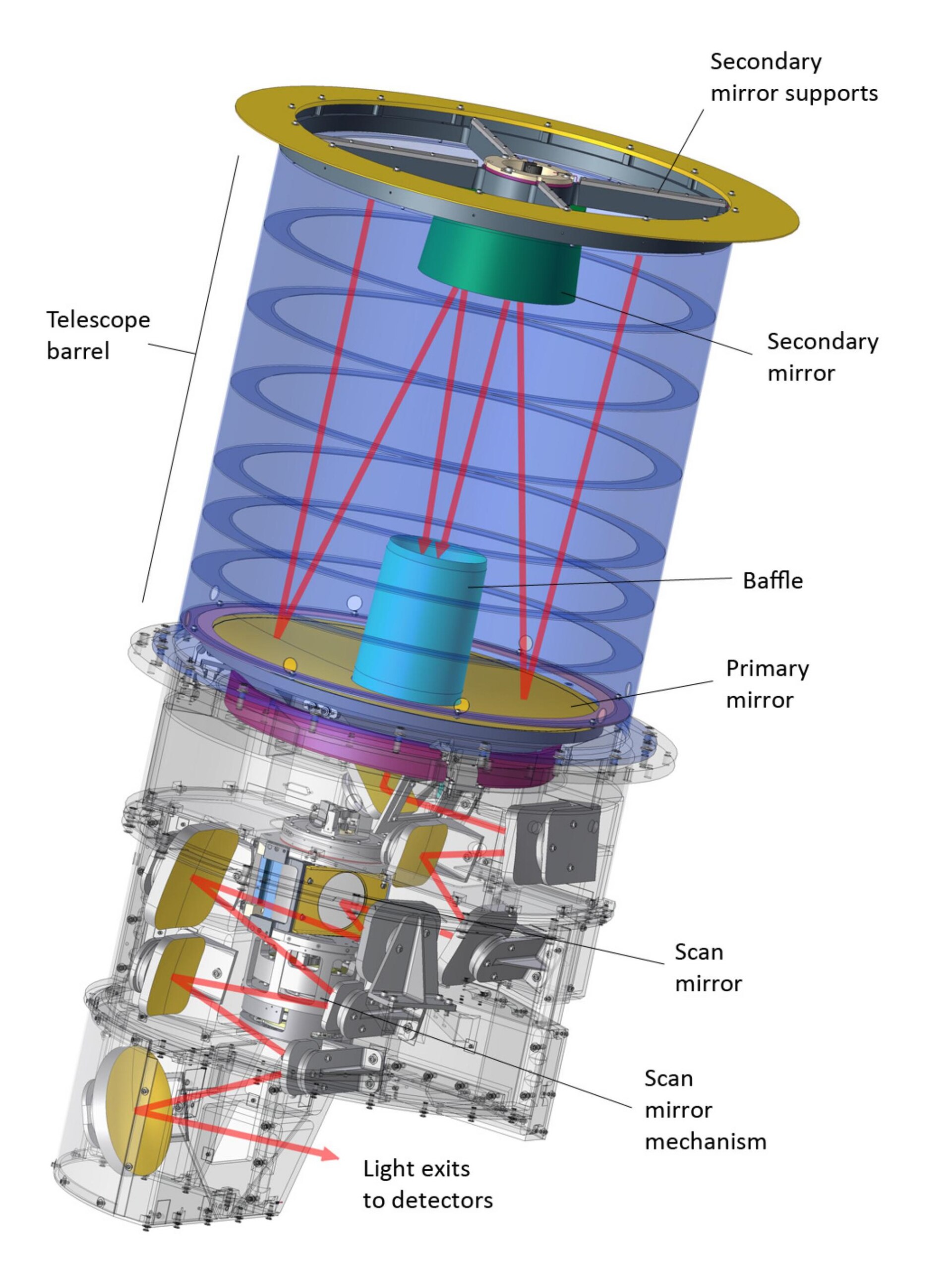
Infrared optics assembly for NASA's WISE mission, illustrating the type of precision infrared optics LightPath produces. Source: Wikimedia Commons, NASA/JPL; license: Public domain.
Quick Answer: Orlando-based LightPath Technologies (Nasdaq: LPTH) reported fiscal first-quarter 2027 revenue of $20.8 million for the three months ended Sept. 30, 2026, up 38% from a year earlier, with gross margin rising to 41.4% and the net loss narrowing to $1.7 million. Counter-drone and infrared camera orders pushed the company’s backlog to a record $132.9 million.
LightPath Technologies has spent decades as a small Orlando lens maker. Its latest quarter shows it becoming a defense-focused infrared imaging supplier. The company released fiscal first-quarter 2027 results on Nov. 10, 2026, and filed its Form 10-Q with the Securities and Exchange Commission. The filings show more revenue, orders and engineering spending, along with supply-chain limits, a large inventory build and an exit from China.
How much did LightPath Technologies earn in fiscal Q1 2027?
LightPath’s fiscal year ends June 30, so fiscal Q1 2027 is the July-through-September 2026 quarter. Revenue was $20.8 million, compared with $15.1 million a year earlier, an increase of 37.9%. Gross profit almost doubled, rising 91.9% to $8.6 million. Gross margin was 41.4%, up from 29.8%, an improvement of about 1,160 basis points.
The company still lost money on a GAAP basis. Operating expenses rose 54.1% to $10.8 million and exceeded gross profit, leaving an operating loss of $2.2 million, compared with $2.5 million a year earlier. The net loss was $1.7 million, or $0.02 per share, compared with $2.9 million, or $0.07 per share. The per-share loss fell more than the dollar loss because the weighted share count rose to about 70.0 million from about 43.3 million after a year of equity raises.
Adjusted EBITDA, a non-GAAP measure, was $1.3 million, or 6% of revenue, compared with $0.4 million, or 2%, a year earlier. The company said this was its fifth consecutive quarter of positive adjusted EBITDA.
| Metric | Q1 FY2027 (Jul–Sep 2026) | Q1 FY2026 (Jul–Sep 2025) | Change |
|---|---|---|---|
| Revenue | $20.8M | $15.1M | +37.9% |
| Gross profit | $8.6M | $4.5M | +91.9% |
| Gross margin | 41.4% | 29.8% | +11.6 pts |
| Operating expenses | $10.8M | $7.0M | +54.1% |
| Net loss | $(1.7)M | $(2.9)M | Narrowed |
| Loss per share | $(0.02) | $(0.07) | Narrowed |
| Adjusted EBITDA (non-GAAP) | $1.3M | $0.4M | +252% |
| Backlog (end of quarter) | $132.9M | $86.0M | +54% |
Source: LightPath Technologies fiscal Q1 2027 earnings release and Form 10-Q.
How does the quarter compare with the rest of 2026?
Revenue was slightly lower than in the prior quarter. LightPath reported $21.2 million in fiscal Q4 2026, which ended June 30, so the September quarter was down about 2% sequentially. On the earnings call, CEO Sam Rubin said revenue came in below the company’s internal expectations, mostly because of supply-chain delays involving motors, outside optics for G5 Infrared cameras, electronics and detectors. He said the company was in a better position for the current quarter, but he also said, “I cannot guarantee it will not be a problem.”
For the full fiscal year 2026, LightPath’s revenue rose 93% to $71.7 million from $37.2 million, and gross margin rose to 36.0% from 27.2%. The net loss widened to $20.5 million from $14.9 million, mainly because of non-cash earnout fair-value changes. Adjusted EBITDA for the year was a positive $4.2 million, compared with a loss of $5.1 million in fiscal 2025.
Where is LightPath’s revenue growth coming from?
The growth came mostly from finished assemblies, modules and cameras, which carry higher margins than individual lenses. Assemblies and modules revenue rose 76% to $10.5 million and accounted for 51% of total revenue, up from 40% a year earlier. In its 10-Q, the company said the increase came mainly from G5 Infrared cameras and modules used in surveillance and counter-unmanned aircraft systems (C-UAS). It said these higher-margin products were the main reason gross margin improved.
| Product group | Q1 FY2027 | Q1 FY2026 | Change |
|---|---|---|---|
| Assemblies and modules | $10.5M | $6.0M | +76% |
| Infrared components | $4.7M | $4.1M | +15% |
| Visible components | $4.6M | $3.8M | +19% |
| Engineering services | $0.9M | $1.1M | -18% |
Source: LightPath fiscal Q1 2027 earnings release. Fiscal 2026 amounts were reclassified from infrared components to assemblies and modules.
Infrared components revenue included $1.1 million from Amorphous Materials, a Texas maker of infrared glass that LightPath acquired in January 2026.
Which countries buy LightPath’s products?
The 10-Q shows most of the growth came from U.S. customers. U.S. revenue rose to $12.09 million from $7.43 million, a gain of about 63%, and accounted for about 58% of total sales. The United Kingdom was the second-largest market at $3.86 million, up from $3.19 million. Revenue from Israel fell to $1.21 million from $1.57 million. China was roughly flat at $1.23 million. Other European countries contributed $1.51 million.
Why are counter-drone systems driving LightPath’s orders?
Militaries increasingly need to detect and defeat small drones, and infrared cameras and optical assemblies are central to the systems that do it. LightPath said it received more than $30 million in follow-on C-UAS orders from July through October 2026. That total included more than $19 million in optical assembly orders from one leading C-UAS and defense systems supplier, about twice what that customer ordered in all of fiscal 2026. Management said $6.3 million of those orders arrived in October.
The company also reported an $11 million follow-on order for infrared cameras from what it called a leading global technology customer. Management linked it to counter-drone applications. In October, a defense customer ordered more than 50,000 optical assemblies for drone camera systems. None of these customers were named.
How fast can LightPath scale drone camera production?
On the earnings call, management said current capacity for drone camera assemblies is just under 10,000 units a month. The company plans to raise that to several tens of thousands of units a month over the next 12 months, and it said potential demand could eventually require 100,000 assemblies a month. Those figures are management targets, not reported results. Meeting them depends on hiring, equipment and the same supply chain that held back revenue in the September quarter.
How big is LightPath’s backlog?
Backlog reached a record of about $132.9 million at Sept. 30, 2026. That was up 20% from $110.9 million at June 30 and up 54% from $86.0 million a year earlier. Customers have asked for about $110.8 million of it to be delivered within the next 12 months, an increase of about 30% from the prior quarter. That near-term portion is more than five times the company’s latest quarterly revenue. LightPath did not give numerical revenue guidance. Rubin called backlog “a key indicator of our expected future revenue trends.”
What does LightPath do in Orlando?
LightPath’s headquarters is at 2603 Challenger Tech Court in Orlando, in the research corridor next to UCF. The company calls Orlando its primary manufacturing footprint. According to its fiscal 2025 annual report, the Orlando operations have a combined 58,500 square feet of production space. The site handles chalcogenide glass melting for the company’s BD6 material, molded glass aspheres, anti-reflective and wear-resistant coatings, diamond turning, machining, fabrication of precision glass molding machines and clean-room work. Most of the company’s custom lens assemblies are made there. The 10-Q says the Orlando lease has been extended to March 31, 2034.
The annual report listed 350 employees as of June 30, 2025, including 153 in the United States, 98 in Riga, Latvia, and 99 in Zhenjiang, China. The China staff left the company with the divestiture described below. LightPath has not published an updated headcount in the releases reviewed for this article, but it said it added engineering staff for cameras, infrared assemblies and BlackDiamond glass during the quarter, along with a supply-chain director.
How does Orlando fit with LightPath’s other sites?
The company’s network now includes G5 Infrared in Hudson, New Hampshire, which makes cameras and was acquired in February 2025; Amorphous Materials and the Visimid subsidiary in Texas; and ISP Optics Latvia in Riga, which has about 29,000 square feet of production space. In announcing the Amorphous Materials deal, LightPath said the Texas site would serve as a backup for Orlando’s BlackDiamond glass manufacturing. It also said new glass-melting capability would be duplicated between Florida and Texas. Capital spending in the quarter was $2.5 million, compared with about $0.08 million a year earlier. The 10-Q said the money went mostly to expanding manufacturing capacity, including glass fabrication and metrology.
| LightPath snapshot | Detail |
|---|---|
| Headquarters | 2603 Challenger Tech Ct., Orlando (lease through March 2034) |
| Ticker | Nasdaq: LPTH |
| Leadership | Sam Rubin, President and CEO; Al Miranda, CFO |
| Other sites | Hudson, N.H. (G5 Infrared); Texas (Amorphous Materials, Visimid); Riga, Latvia |
| Fiscal 2026 revenue | $71.7M (up 93%) |
| Cash (Sept. 30, 2026) | $82.9M |
| Stockholders’ equity | $151.3M |
| Shares outstanding (Nov. 6, 2026) | 70,088,026 |
Why does germanium matter to LightPath’s Orlando glass business?
Germanium is the traditional material used for infrared lenses, and China is a major source. The 10-Q notes that China suspended its U.S.-specific restrictions on gallium and germanium exports through Nov. 27, 2026, but could reinstate or change them. It also says export-license requirements and limits on U.S. military end uses remain in place. LightPath says it is limiting germanium orders and working with customers to redesign systems around its own BlackDiamond chalcogenide glass, which it sells under an exclusive license from the U.S. Naval Research Laboratory.
The quarter brought two developments related to that strategy. First, LightPath signed a funded prototype agreement under the Department of War’s CLEAR program to develop BlackDiamond glass and optics as alternatives to germanium in electro-optical and infrared systems. Rubin described it as “direct government support for the materials at the center of our platform.” Second, management said the camera program for its global technology customer includes a planned shift, over the program’s life, from germanium optics to BlackDiamond. When it announced the Amorphous Materials acquisition, LightPath said the Texas operation’s melting technology could eventually produce BlackDiamond glass up to 17 inches in diameter, compared with 5 inches today.
Why did LightPath leave China?
On Oct. 30, 2026, LightPath completed the sale of its Zhenjiang subsidiary, LightPath Optical Instrumentation (Zhenjiang) Co., to Hengtu Optical Technology, which is owned by the unit’s management team. The fiscal 2026 results release put the price at $4.5 million, payable over five years. The Zhenjiang operation will continue supplying commercial products to LightPath as an outside vendor. Rubin said on the call that exiting China was a requirement for certain U.S. government programs. LightPath now has no operations in China.
How strong is LightPath’s balance sheet?
Cash fell to $82.9 million at Sept. 30 from $93.2 million at June 30. Operations used $8.3 million in cash, mainly because inventory rose to $31.5 million from $18.0 million. The company said much of that working-capital investment went to buying critical materials in advance. Total assets were $197.0 million and total liabilities were $36.8 million. Loans payable were only about $0.2 million. Series G convertible preferred stock of $8.9 million is recorded outside stockholders’ equity.
The cash balance reflects heavy equity fundraising. In fiscal 2026, LightPath received $112.3 million in net proceeds from public offerings, including a $50 million offering at $14.00 per share in June 2026, plus $7.9 million from a private placement. One known payment is coming soon. The final G5 Infrared earnout of $9 million, made up of $6.3 million in cash and $2.7 million in stock, is due in January 2027.
Costs are also rising. Selling, general and administrative expense nearly doubled to $8.0 million. That increase included $1.4 million in higher non-cash stock compensation, costs from the Amorphous Materials operation and IT spending to meet defense cybersecurity standards. New product development spending more than doubled to $2.0 million.
What does LightPath’s quarter mean for Orlando’s economy?
LightPath’s Orlando headquarters melts glass, molds and coats lenses, and assembles finished products, and the company is directing new orders, engineers and capital spending to that base. The limits are also clear: LightPath remains unprofitable on a GAAP basis, revenue slipped sequentially because of supply-chain delays, and much of the growth depends on a few unnamed defense and technology customers.
Brian’s Take
I care most about the margin line. Gross margin above 41%, up from under 30% a year ago, means LightPath is selling more finished systems and fewer individual lenses, and the CFO said margins should stay in the 40s. Losses are getting smaller, but operating costs still exceed gross profit. Until that changes, the large cash balance is paying for growth, not coming from it.
For Central Florida, I think the most important facts are the 2034 lease extension and the decision to duplicate glass melting in Orlando and Texas. Supply-chain security has become a buying requirement for defense customers. A company that melts its own germanium-replacement glass in Orlando, and has sold its China operations to qualify for government programs, is building jobs that are hard to relocate. The weaker sequential revenue is a reminder that a backlog only turns into revenue when parts show up and products ship.
Frequently Asked Questions
When did LightPath report fiscal Q1 2027 results?
LightPath released results on Nov. 10, 2026, and held its earnings call at 5 p.m. Eastern that day. The quarter ended Sept. 30, 2026.
What is LightPath’s backlog?
Backlog was a record of about $132.9 million at Sept. 30, 2026. About $110.8 million of it is scheduled for delivery within 12 months.
Where does LightPath manufacture?
Its primary manufacturing site is its Orlando headquarters. It also has facilities in Hudson, New Hampshire; Texas; and Riga, Latvia. It sold its China subsidiary on Oct. 30, 2026.
What is BlackDiamond glass?
BlackDiamond is LightPath’s chalcogenide infrared glass, sold under an exclusive license from the U.S. Naval Research Laboratory. The company is offering it as an alternative to germanium, which is subject to Chinese export controls.
Sources and Further Reading
- LightPath Technologies Reports Fiscal 2027 First Quarter Financial Results — LightPath Technologies via Newswire
- LightPath Technologies Form 10-Q for the quarter ended September 30, 2026 — U.S. Securities and Exchange Commission
- LightPath Technologies Q1 Earnings Call Highlights — Nasdaq
- LightPath Technologies Reports Fiscal 2026 Fourth Quarter and Full Year Financial Results — LightPath Technologies via Newswire
- LightPath Technologies Form 10-K for fiscal year ended June 30, 2025 — U.S. Securities and Exchange Commission
- LightPath Technologies Acquires Amorphous Materials, Inc. — LightPath Technologies via Nasdaq