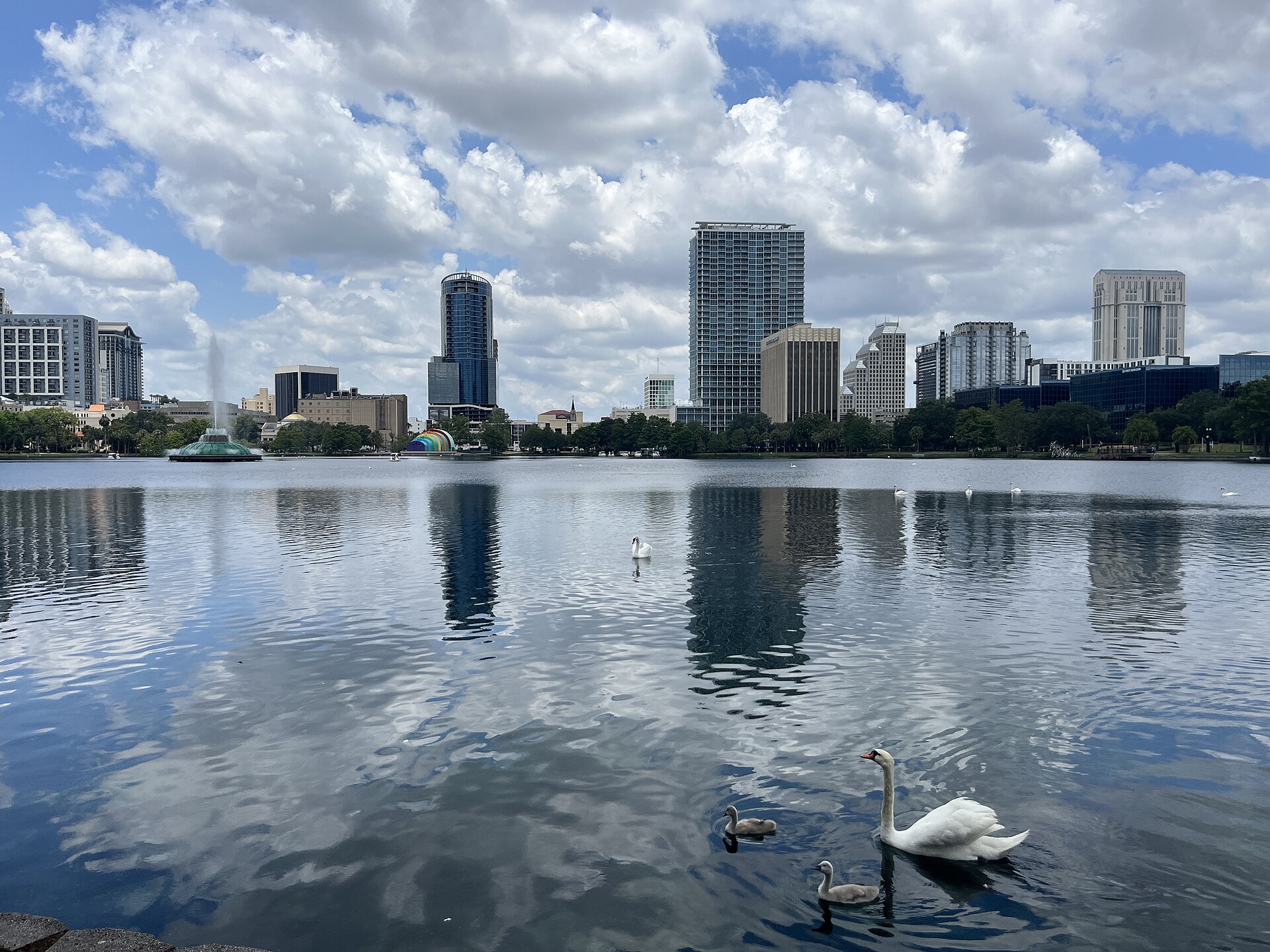
Downtown Orlando high-rises seen from Lake Eola Park, May 2023. Source: Benoît Prieur, via Wikimedia Commons. License: CC0 1.0.
Quick Answer: Orlando-based Hilton Grand Vacations reported third-quarter 2026 revenue of $1.961 billion and net income attributable to stockholders of $291 million. Most of that jump came from a one-time $296 million recognition of deferred revenue tied to its new Ka Haku tower in Waikiki. Underneath, contract sales fell 11.0% to $807 million, and the company cut its full-year 2026 adjusted EBITDA guidance to $1.165 billion to $1.180 billion.
Hilton Grand Vacations Inc. (NYSE: HGV), the timeshare company headquartered in Orlando, released its third-quarter 2026 results on October 29, 2026, in an earnings release filed with the U.S. Securities and Exchange Commission on Form 8-K. The headline numbers look like a record: revenue rose about 51% from a year earlier and diluted earnings per share went from $0.28 to $3.70. The rest of the release points the other way. Sales of new vacation ownership contracts fell by double digits, revenue per tour dropped sharply, and management lowered its annual profit outlook.
What did Hilton Grand Vacations report for the third quarter of 2026?
For the three months ended September 30, 2026, HGV reported total revenues of $1,961 million, compared with $1,300 million in the third quarter of 2025. Net income attributable to stockholders was $291 million, up from $25 million, and diluted EPS was $3.70, up from $0.28. Net income attributable to noncontrolling interest was $6 million in the quarter.
On the adjusted measures the company uses, adjusted net income attributable to stockholders was $317 million, or $4.03 per diluted share, compared with $54 million, or $0.60 per share, a year earlier. Adjusted EBITDA attributable to stockholders was $609 million, compared with $245 million.
| Metric | Q3 2026 | Q3 2025 | Nine months 2026 | Nine months 2025 |
|---|---|---|---|---|
| Total revenues | $1,961M | $1,300M | $4,604M | $3,714M |
| Net income attributable to stockholders | $291M | $25M | $369M | $33M |
| Diluted EPS | $3.70 | $0.28 | $4.54 | $0.36 |
| Adjusted diluted EPS | $4.03 | $0.60 | $5.80 | $1.22 |
| Adjusted EBITDA attributable to stockholders | $609M | $245M | $1,123M | $658M |
| Contract sales | $807M | $907M | $2,336M | $2,462M |
| Tours | 235,991 | 232,035 | 664,501 | 631,782 |
| Volume per guest (VPG) | $3,406 | $3,891 | $3,500 | $3,880 |
| Free cash flow | $52M | $(4)M | $273M | $29M |
Source: Hilton Grand Vacations third-quarter 2026 earnings release (Form 8-K exhibit), October 29, 2026.
Why did revenue and earnings jump so much?
Most of the increase came from accounting timing, not from new sales activity. Under its revenue recognition rules, HGV defers revenue on timeshare intervals sold in projects still under construction and recognizes it once the project is finished. The release says third-quarter results “included a net construction recognition of $296 million relating to a project in Hawaii,” equal to $3.76 per diluted share. In the third quarter of 2025, the company instead recorded a net deferral of $57 million.
On the earnings call, Mark Melnyk, senior vice president of investor relations, said the project was Ka Haku. Its certificate of occupancy in the third quarter triggered recognition of $536 million of previously deferred net contract sales and $240 million of related direct expenses. Melnyk said that removing these items would bring the adjusted EBITDA in the press release down by $296 million, to $313 million. For the nine months, the release reports net recognitions of $250 million.
Because of this, year-over-year comparisons of revenue, net income and EPS overstate the third quarter’s underlying performance. The company’s own full-year guidance excludes deferrals and recognitions for the same reason.
How did the allowance change affect profit?
A second item also helped reported earnings. During the quarter, HGV changed the methodology behind its allowance for losses on timeshare financing receivables, the loans it makes to buyers. The release says the change reflects the continued integration of previously acquired businesses and combines the historical performance of their receivables into a single static pool model that stratifies loans by FICO score and equity percentage at the time of sale.
The result was a $55 million decrease in the allowance for originated timeshare financing receivables. That cut the provision for financing receivable losses, which increased Sales of VOIs (vacation ownership intervals), net. The provision came to 12.5% of owned contract sales in the quarter. President and Chief Financial Officer Daniel Mathewes told analysts this compared with 16.8% a year earlier, and said “the provision benefit more than offset the sales deleverage.” He also said the company expects the provision “will center around the mid-teens going forward.”
Why did Hilton Grand Vacations’ contract sales fall?
Contract sales measure the value of new timeshare purchase agreements. They fell 11.0% to $807 million from $907 million in the third quarter of 2025. Tour flow, the number of sales presentations given to prospective buyers, rose 1.7% to 235,991. The decline came from volume per guest (VPG), which fell 12.5% to $3,406 from $3,891.
For the first nine months of 2026, contract sales totaled $2,336 million, about 5% below the $2,462 million of the year-earlier period. Tours rose about 5% to 664,501, and VPG fell to $3,500 from $3,880.
What did CEO Mark Wang say about the sales shortfall?
In the release, Chief Executive Officer Mark Wang said the company’s recurring revenue streams and cash generation “remained resilient in the third quarter, but our sales results fell short of our expectations.” He said initiatives introduced over the summer to improve execution “are taking longer to ramp than we anticipated.”
On the call, Wang said tour flow was in line with expectations, but that “we didn’t convert those tours into transactions at the level we should have.” He pointed to closing rates, misaligned sales incentives and a more dynamic headcount environment. He also cited a difficult comparison with the prior-year launch of the Bluegreen version of the company’s HGV Max membership program, and said consumer pressure weighed slightly more on purchase decisions than it had a quarter earlier.
Mathewes said Bluegreen had the steepest VPG decline and that results in the legacy business were inconsistent, particularly in August. New buyers made up 28% of sales volume, he said, up 30 basis points.
Is there an Orlando angle to the sales turnaround effort?
Yes. Wang said on the call that a new leader at Bluegreen’s Orlando property had rebuilt the sales team and returned it to growth in September. He said leadership changes in Myrtle Beach had stabilized that business and that updated incentive plans were being rolled out in other key markets. HGV also promoted Mike Riley to executive vice president and chief sales and marketing officer, according to the release.
Wang said August was the low point for the quarter, that several key sales centers returned to positive growth in September, and that the improvement continued into October.
How much did HGV lower its 2026 guidance?
The company reduced its full-year 2026 guidance for adjusted EBITDA, excluding deferrals and recognitions, to a range of $1.165 billion to $1.180 billion, down from $1.225 billion to $1.265 billion. At the midpoints, that is a cut of about $72.5 million, or roughly 6%. Wang said the new outlook reflects year-to-date performance and “a more realistic view on the timing and ramp of our initiatives.”
On the call, Mathewes guided to fourth-quarter contract sales declining by a low to mid single-digit percentage, and full-year contract sales declining by a mid single-digit percentage. The release does not include free cash flow guidance.
What did management say about 2027?
Wang said the company’s long-term growth algorithm looks achievable once this year’s difficult comparisons are past, and that he expects low to mid single-digit tour growth along with low single-digit VPG growth. Mathewes said inventory spending in 2027 should be below $300 million and that the 2026 reduction is not simply being pushed into future years. He also said the ramp of the Bluegreen license fee finishes on January 1, after which the rate normalizes at 5%. These are management expectations, not reported results.
How did HGV’s business segments perform?
HGV reports two segments. The Real Estate Sales and Financing segment, which includes Ka Haku’s revenue recognition, grew sharply. The Resort Operations and Club Management segment, which collects recurring fees from owners and club members, was roughly flat.
| Segment measure | Q3 2026 | Q3 2025 |
|---|---|---|
| Real Estate Sales and Financing revenue | $1,418M | $789M |
| Real Estate Sales and Financing adjusted EBITDA (margin) | $557M (39.3%) | $184M (23.3%) |
| Real estate profit (margin) | $478M (40.5%) | $121M (21.3%) |
| Financing revenue | $149M | $128M |
| Financing profit (margin) | $94M (63.1%) | $75M (58.6%) |
| Resort Operations and Club Management revenue | $416M | $406M |
| Resort Operations and Club Management adjusted EBITDA (margin) | $158M (38.0%) | $159M (39.2%) |
Source: Hilton Grand Vacations third-quarter 2026 earnings release.
How many members does Hilton Grand Vacations have?
HGV reported 715,888 club members at September 30, 2026, compared with 721,488 a year earlier, a decline of about 0.8%. Wang said on the call that membership in HGV Max, the company’s premium membership program, grew 20% and passed 300,000 members.
How did the financing business do?
Financing revenue rose about 16% to $149 million, and financing profit rose to $94 million. Net timeshare financing receivables were $3,676 million at September 30, 2026, up from $3,115 million at December 31, 2025. Mathewes said 31-to-60-day delinquencies were stable, Bluegreen delinquencies were back at 2022 levels, and delinquencies in the Diamond portfolio were at a five-year low.
How much stock did HGV buy back, and how much debt does it carry?
HGV repurchased 2.4 million shares for $110 million in the third quarter and $410 million worth through the first nine months of 2026. As of October 22, 2026, it had $617 million remaining under its repurchase authorizations. Shares outstanding fell to 75,818,689 at September 30, 2026, from 83,133,678 at the end of 2025, a reduction of about 8.8% in nine months. On the call, Wang said the company still expects about $600 million of buybacks for the year. Mathewes said no acquisitions are in view, buybacks are the best use of capital, and the company will not take on more leverage to repurchase shares.
| Balance sheet item (Sept. 30, 2026) | Amount |
|---|---|
| Unrestricted cash | $227M |
| Restricted cash | $275M |
| Remaining revolver capacity | $457M |
| Corporate debt, net (weighted average rate) | $4,885M (5.751%) |
| Non-recourse debt, net (weighted average rate) | $2,891M (5.054%) |
| Total net leverage, trailing 12 months | About 3.9x |
| Current notes not yet securitized | $1.3B |
Source: Hilton Grand Vacations third-quarter 2026 earnings release.
The release says about $851 million of the unsecuritized notes could be monetized through warehouse facilities or securitization, and another $383 million is expected to become eligible after customary milestones. HGV also reported $450 million remaining on its timeshare warehouse facility and $175 million on its Big Cedar timeshare facility. Year-to-date operating cash flow was $349 million, compared with $133 million a year earlier. Adjusted free cash flow was $206 million, compared with $342 million.
What does the quarter mean for Orlando’s business community?
HGV’s results reach well beyond its own stock. The company is headquartered in Orlando, describes itself in the release as “the exclusive vacation ownership partner of Hilton,” and has about 715,000 club members. Its sales performance affects corporate jobs in the region and on-site sales operations in Central Florida, including the Bluegreen Orlando property that Wang singled out on the call.
The quarter separates two parts of the business. The recurring side, made up of resort management fees, club dues and loan interest, held steady: segment revenue for resort operations rose about 2.5%, and financing revenue rose about 16%. The transactional side, selling new ownership interests, is where the company is struggling, and HGV attributes that mainly to its own execution rather than to a lack of customer traffic, since tours rose. For Orlando’s hospitality and leisure economy, the figures show visitors are still showing up for sales presentations, but fewer of them are signing contracts at the prices seen a year ago.
Things to watch next: whether fourth-quarter contract sales land within management’s guided decline, and whether the September and October improvement at key sales centers holds.
| Company snapshot | Detail |
|---|---|
| Company | Hilton Grand Vacations Inc. |
| Ticker | NYSE: HGV |
| Headquarters | Orlando, Florida |
| Chief Executive Officer | Mark Wang |
| President and CFO | Daniel Mathewes |
| Club members (Sept. 30, 2026) | 715,888 |
| Brands referenced | Hilton Grand Vacations, Bluegreen, Diamond, HGV Max; 51% interest in Big Cedar Vacations |
| Q3 2026 results released | October 29, 2026 |
Frequently Asked Questions
How much revenue did Hilton Grand Vacations make in Q3 2026?
Total revenues were $1.961 billion for the quarter ended September 30, 2026, up from $1.300 billion a year earlier. The figure includes a $296 million net recognition of deferred revenue tied to a Hawaii project, which executives identified as Ka Haku.
Why did HGV’s earnings per share rise to $3.70?
Diluted EPS rose from $0.28 mainly because of the Ka Haku construction recognition, worth $3.76 per share, and a $55 million reduction in the loan loss allowance after a methodology change. A smaller share count from buybacks also contributed.
Did Hilton Grand Vacations sell more timeshares in the quarter?
No. Contract sales fell 11.0% to $807 million, even though tours rose 1.7%. Volume per guest fell 12.5% to $3,406, which management attributed mainly to weaker sales execution and lower closing rates.
What is HGV’s 2026 guidance now?
HGV expects full-year 2026 adjusted EBITDA, excluding deferrals and recognitions, of $1.165 billion to $1.180 billion, down from its prior range of $1.225 billion to $1.265 billion.
Is Hilton Grand Vacations still buying back stock?
Yes. It repurchased $110 million of stock in the third quarter and $410 million so far in 2026, and had $617 million of remaining authorization as of October 22, 2026. Management said it still expects about $600 million of repurchases for the year.
Where is Hilton Grand Vacations based?
The company is headquartered in Orlando, Florida, according to its earnings release, and trades on the New York Stock Exchange under the symbol HGV.
Sources and Further Reading
- Hilton Grand Vacations Reports Third Quarter 2026 Results, Form 8-K Exhibit 99.1 — Hilton Grand Vacations Inc., filed with the U.S. Securities and Exchange Commission
- Hilton Grand Vacations Q3 2026 Earnings Conference Call Transcript, October 29, 2026 — Hilton Grand Vacations Investor Relations