By Brian French | OrlandoBusinessNews.com | October 10, 2026
Quick Answer
LEED certification pays off in Orlando when it is built on energy upgrades that stand on their own: efficient HVAC, reflective roofs and lighting that cut real utility bills. The plaque alone has historically been tied to roughly a 3% to 4% U.S. office rent premium, with no proven extra pay for higher LEED levels. With the federal 179D deduction closed to projects that began construction after June 30, 2026, today’s math rests on utility rebates, operating savings and tenant demand.
Key Takeaways
- The One Big Beautiful Bill Act ended Section 179D for property whose construction begins after June 30, 2026. Projects that broke ground earlier can still claim it.
- Commercial solar started after July 4, 2026 must be placed in service by December 31, 2027 to earn the federal clean electricity credit.
- OUC pays commercial rebates for cool roofs ($0.12 per square foot), LED lighting ($250 per kW) and custom projects, up to $200,000 per customer each year.
- Orlando’s BEWES ordinance requires private buildings over 50,000 square feet to report energy and water use every year by May 1.
- Underwrite payback and value lift without counting any green premium.
What Changed for Green Building Incentives in 2026?
The biggest change is federal. The One Big Beautiful Bill Act, signed July 4, 2025, added a sunset to Section 179D, the energy-efficient commercial buildings deduction. The statute now says the section does not apply to property whose construction begins after June 30, 2026.
So the date that counts is when construction started, not when the building opened. Tax advisers say projects that began construction by the cutoff stay eligible even if they are placed in service later. For 2026, the deduction ranges from about $0.59 to $1.19 per square foot. Projects that meet prevailing wage and apprenticeship rules can claim about $2.97 to $5.94.
Two openings remain. A lookback study can find buildings that qualified in earlier years but never claimed the deduction. Advisers say it can often be claimed through an accounting-method change rather than an amended return. Government and nonprofit owners can assign the deduction to the architect or engineer of record, but only for projects started before the cutoff.
For any project starting construction in Orlando today, plan as if 179D is not available.
What Happened to Solar Tax Credits for Commercial Buildings?
The law also cut short the technology-neutral clean electricity credits, Sections 48E and 45Y, for wind and solar. Solar projects that began construction by July 4, 2026 keep the original timeline. Projects that start later must be placed in service by December 31, 2027, or they get nothing.
The begin-construction rules have shifted. IRS Notice 2025-42 dropped the 5% cost safe harbor for most solar projects larger than 1.5 MW and required a physical work test instead. Rooftop systems at or below 1.5 MW kept the 5% test. On June 6, 2026, a federal court in Washington, D.C., threw out that notice in Oregon Environmental Council v. IRS. The government may appeal or issue new guidance, so owners should keep careful records either way.
For an Orange County rooftop that has not started, the practical deadline is energizing before the end of 2027.
Florida’s own solar incentives are more lasting. State law exempts 80% of the assessed value of renewable energy devices installed on or after January 1, 2018 from property tax. That exemption runs through December 31, 2037. Florida also exempts solar energy systems certified by the Florida Solar Energy Center (FSEC) from sales tax.
Which Utility Rebates Are Available in Orlando?
Your rebates depend on your utility. Most of the city of Orlando is served by OUC (Orlando Utilities Commission), while Duke Energy Florida covers much of the surrounding region.
OUC’s 2025 report to the Florida Public Service Commission lists these commercial rebates:
| OUC Measure | Rebate |
|---|---|
| Cool roof (SR 0.70+) | $0.12/sq ft |
| LED lighting | $250/kW |
| Ceiling insulation (R-38+) | $0.12/sq ft |
| Window film | $0.55/sq ft |
| Heat pump water heater | $500 |
| Custom, non-lighting | $550/kW + $0.032/kWh |
Custom incentives are capped at 50% of project cost and $200,000 per customer per year. OUC raised that cap from $100,000 in August 2025. OUC also offers free commercial energy audits.
Duke Energy Florida runs a free Business Energy Check, either online or on-site. Its business rebates cover chillers, energy recovery ventilation, and unitary air conditioners and heat pumps. Check Duke’s current rebate chart before budgeting.
What Does Orlando Require of Large Buildings?
Orlando passed its Building Energy and Water Efficiency Strategy (BEWES) in 2016. Privately owned commercial and multifamily buildings over 50,000 square feet must report 12 months of energy and water data through ENERGY STAR Portfolio Manager by May 1 each year. City-owned buildings over 10,000 square feet must do the same. Buildings that perform below the city’s benchmark must complete an energy audit or retro-commissioning every five years. The city publishes the results, and owners can use OUC’s free ASHRAE Level 1 audits.
That disclosure matters: a low ENERGY STAR score is a public number brokers and tenants can find.
Orlando has committed to LEED standards for all new city buildings since 2007 and built Florida’s first LEED-certified fire station. In January 2020, it earned LEED for Cities Gold.
Florida law sets limits on local governments. A 2023 law (HB 1281) bars them from restricting which energy sources utilities use and from banning appliances that run on those fuels, except to enforce the building and fire codes. Building energy standards come from the statewide Florida Building Code. In practice, LEED is a market choice for private Orlando developers, not a mandate.
Is LEED Certification Worth the Cost?
USGBC opened certification under LEED v5 in 2025 and promoted it at Greenbuild that November. The new version is organized around decarbonization, quality of life, and ecological conservation and restoration. Platinum now requires minimum carbon reductions.
USGBC’s own fees are modest compared with design and construction costs. Published schedules show registration of about $1,350 to $1,700. Combined review for a new building under 250,000 square feet runs about 6.4 to 7.6 cents per square foot, so a 100,000-square-foot office pays roughly $6,400 to $7,600 in certification fees. The bigger costs are modeling, commissioning, consultants and above-code upgrades.
What the research says about the payoff:
- CBRE’s 2022 analysis compared about 2,800 LEED office buildings with 17,700 non-LEED buildings. After adjusting for location, age and size, LEED buildings earned about a 4% rent premium, down to about 3% after the pandemic.
- In the same CBRE work, LEED Class B buildings earned about 4% more rent, compared with 2% for Class A. Gold buildings earned no more than Silver.
- A widely cited Berkeley study of Energy Star and LEED offices found rents about 3% higher, effective rents more than 6% higher and sale prices about 16% higher.
- Aviva Investors’ 2024 review warns that green premiums may fade as certification becomes standard. It argues the bigger risk may be a discount on buildings that are not green.
These figures show correlation, not cause, and come mostly from big-city offices, not suburban Orlando retail.
How Do You Calculate Payback and Value Lift?
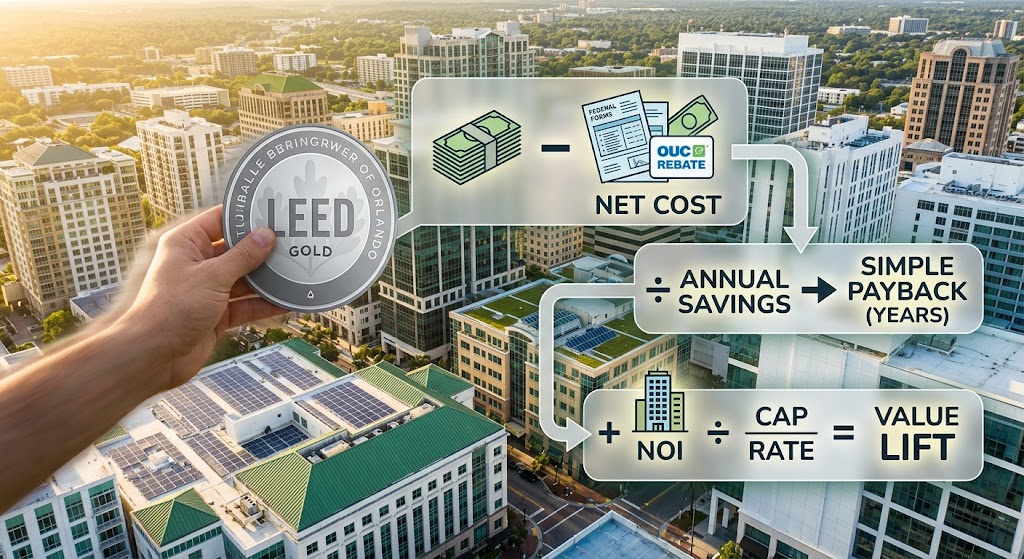
Two formulas cover most decisions:
- Simple payback (years) = net installed cost after incentives ÷ annual savings
- Value lift = annual savings added to net operating income (NOI) ÷ cap rate
Use the extra cost over a like-for-like replacement, and check who keeps the savings. Under a triple-net lease, tenants pay the utilities, so lower bills go to them unless rents or lease terms change.
For the rate, Florida’s average commercial electricity price was about 11.4 cents per kWh in July 2026, according to EIA data compiled by Outage-Pro. Your rate will differ.
Hypothetical Example 1: HVAC Upgrade, 100,000-Square-Foot Office
Assumptions (illustrative only):
- Extra cost of high-efficiency equipment over standard units: $250,000
- Electricity saved: 300,000 kWh per year at $0.114, so $34,200 per year
- Peak demand reduction: 80 kW
- OUC custom rebate: (80 × $550) + (300,000 × $0.032) = $53,600, within the 50% and $200,000 caps
- Construction starts after June 30, 2026, so no 179D deduction
- Cap rate: 7.5%
Results:
- Net cost: $250,000 − $53,600 = $196,400
- Payback: $196,400 ÷ $34,200 = about 5.7 years
- Value lift if the owner keeps the savings: $34,200 ÷ 0.075 = about $456,000
Hypothetical Example 2: Cool Roof on a 60,000-Square-Foot Retail Center
Assumptions (illustrative only):
- The roof is being replaced anyway. A reflective membrane with solar reflectance of 0.70 or higher adds $0.40 per square foot, or $24,000.
- OUC cool-roof rebate: 60,000 × $0.12 = $7,200
- Cooling savings: 60,000 kWh per year at $0.114, so $6,840 per year
- Cap rate: 7.0%
Results:
- Net cost: $24,000 − $7,200 = $16,800
- Payback: $16,800 ÷ $6,840 = about 2.5 years
- Value lift: $6,840 ÷ 0.07 = about $97,700, but only if the landlord captures the savings
The savings estimate is in line with real-world evidence. A Florida Solar Energy Center study of a Cocoa strip mall found that whitening the roof cut summer cooling energy by about 25% on average, with individual shops ranging from 13% to 48%.
What Are the Pros and Cons of LEED in Central Florida?
Pros
- Lower operating costs in a cooling-heavy climate, where HVAC and roofs drive the bills
- Evidence of modest rent premiums and stronger sale prices, especially for Class B office
- Easier marketing to corporate tenants with sustainability goals
- Third-party proof of commissioning, which tends to catch costly construction defects
Cons
- No 179D deduction for projects starting construction now, and solar credits face a 2027 deadline
- Consultant, modeling and documentation costs on top of USGBC fees
- Triple-net leases send most energy savings to tenants
- Little proof that Gold or Platinum earns more rent than Silver
Brian’s Take
As a former money manager, I discount any return that depends on someone paying more later. That is how I view LEED in Orlando.
The green premium is real, but it is small, it has been shrinking and it may disappear once certification becomes standard. I would not put a dollar of it into a pro forma. What I would underwrite is the electricity a building does not use. In a market where cooling runs most of the year, a reflective roof that pays back in under three years and an HVAC upgrade that pays back in under six are good investments with or without a plaque.
The federal picture has gotten worse. Losing 179D for new starts removes a meaningful subsidy, and the solar deadline means hesitation now costs real money. If you have a building that began construction before July 1, have a tax adviser review it. Lookback claims on buildings that are already operating are where I see money being left on the table.
My rule is simple. Do the energy work first, take every OUC or Duke rebate available, and pursue LEED Silver if your tenants want it. Pay for Gold or Platinum only if a specific tenant or lender will pay for it. Fix lease structures so you actually keep the savings you paid for. Otherwise, you are funding your tenants’ utility bills.
Frequently Asked Questions
Can I still claim the 179D deduction in 2026?
Only for property whose construction began on or before June 30, 2026. Those projects remain eligible even if they are placed in service later, so record the start date carefully. Owners of existing buildings that qualified in past years but never claimed the deduction may still recover it through a lookback study. Projects starting construction now do not qualify.
Is LEED required for private buildings in Orlando?
No. Orlando requires LEED standards for its own new buildings, but private developers choose whether to certify. Private buildings over 50,000 square feet must benchmark their energy and water use under BEWES and report by May 1 each year. Underperforming buildings must complete an audit or retro-commissioning every five years.
What LEED level should an Orlando office target?
For most projects, Silver offers the best value. CBRE found that higher certification levels showed no significant extra rent, and Gold buildings earned no more than Silver. Go higher only when a tenant, lender or investor specifically requires it.
How much does OUC pay for a cool roof?
OUC’s 2025 filing lists $0.12 per square foot for reflective roofs with solar reflectance of 0.70 or higher. On a 60,000-square-foot roof, that comes to $7,200. Custom projects can earn $550 per kW plus $0.032 per kWh saved, capped at 50% of project cost and $200,000 per customer annually.
Do Florida tax breaks apply to commercial solar?
Florida exempts 80% of the assessed value of qualifying renewable energy devices installed since January 1, 2018 from property tax, through 2037. Solar equipment certified by the Florida Solar Energy Center is exempt from sales tax. The federal credit requires projects started after July 4, 2026 to be placed in service by December 31, 2027.
Does LEED raise property value?
Studies link green certification to higher sale prices. A Berkeley study found about 16% for certified offices. But much of that may come from location, building quality and lower operating costs. For underwriting, value the measurable NOI gain: annual savings divided by the cap rate. Treat any certification premium as upside.
This article is for general information and is not tax, legal or investment advice. Consult a qualified tax professional about your specific project.
Sources and Further Reading
- How Will Your Business Benefit from the One Big Beautiful Bill?
- 179D Tax Credit Update: The Deadline Has Passed
- The 179D Deduction Ends Soon, but Savings Are Still Possible
- 179D Deduction Window Closes