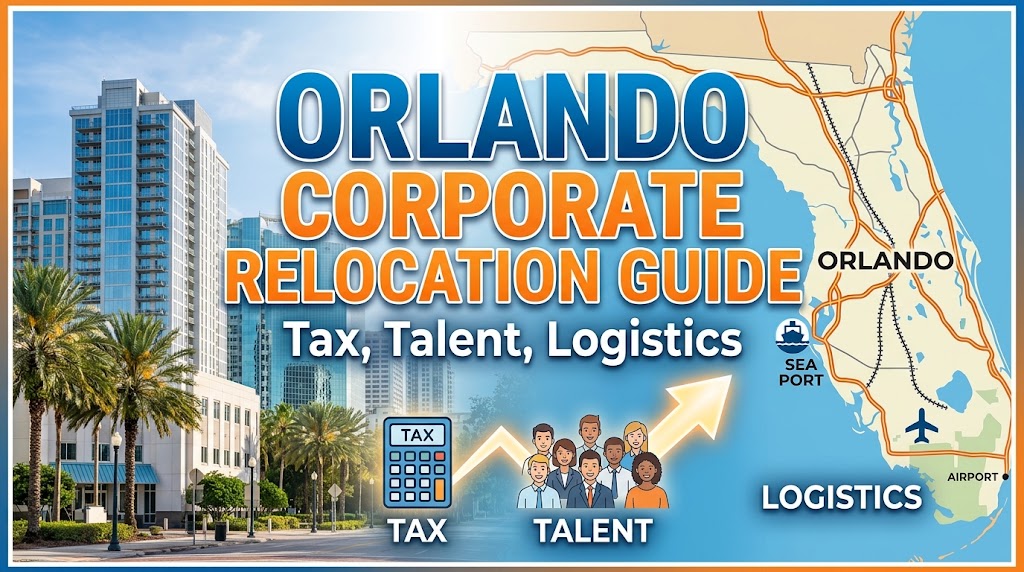
By Brian French | OrlandoBusinessNews.com | October 12, 2026
Quick Answer
For many companies, yes. Orlando costs less to run than Tampa on office rent and average wages, it has the largest university in Florida feeding its labor pool, and Florida charges no personal income tax and a 5.5% corporate income tax. Jacksonville is cheaper on rent, and the state’s best-known job-creation refund, QTI, was repealed in 2023. That means incentives now come from a smaller set of state programs plus city and county deals.
Key Takeaways
- Florida has no personal income tax and a 5.5% corporate income tax. Since October 1, 2025, it has also charged no state sales tax on commercial rent.
- The Qualified Target Industry (QTI) tax refund was repealed effective July 1, 2023. Relocation packages now lean on HIPI grants, the Capital Investment Tax Credit, job tax credits and local programs such as the City of Orlando’s STRIVE incentive.
- CBRE puts Orlando’s average office asking rent at $29.67 per square foot in Q3 2026. That is below Tampa’s $31.63 (Q2 2026) and above Jacksonville’s $23.56 (Q3 2026).
- In May 2025, Orlando’s average hourly wage was $29.76, the lowest of the three metros compared here. That helps on payroll, but it also says something about the region’s occupation mix.
- UCF enrolled 70,674 students in fall 2025, and Valencia College’s DirectConnect program guarantees qualifying graduates admission to UCF. The result is a large, steady pipeline of early-career workers.
Should My Company Relocate to Orlando, Florida?
Most relocation coverage pits Miami against Orlando. Site selectors frame it differently: once a company has chosen Florida for tax reasons, it is usually deciding among Orlando, Tampa and Jacksonville, three metros with different cost structures.
Orlando’s case is momentum. The Orlando Economic Partnership (OEP) reported that the metro added 20,600 jobs in the 12 months ending June 2026. By OEP’s count, that was more than Miami, Tampa and Jacksonville added combined, and about half of Florida’s total job growth for the period. OEP’s survey did show business confidence at a two-year low.
The real question is whether Orlando’s mix of rent, wages, power and incentives fits your cost structure better than the alternatives.
What Florida Tax Advantages Apply to a Relocating Company?
No personal income tax, 5.5% corporate rate
Florida has no individual income tax. The Tax Foundation lists the state’s corporate income tax rate at 5.5%. For executives moving from high-tax states, that saving often wins internal support for a move. The Tax Foundation ranks Florida 5th overall on its 2026 State Tax Competitiveness Index.
Owners of pass-through businesses pay no state income tax on profits, while C corporations file a state return on income apportioned to Florida.
The business rent tax is gone
Florida’s sales tax on commercial leases dated to 1968. Lawmakers cut the state rate from 6% down to 2% over several years, and House Bill 7031, signed June 30, 2025, ended the tax altogether for occupancy beginning October 1, 2025. Rent for occupancy before that date is still taxable, even if it is billed later.
Coverage at the time estimated statewide tenant savings of about $1.15 billion in the first fiscal year. For a company leasing 50,000 square feet at Orlando’s average asking rate, removing a 2% levy on top of rent works out to roughly $30,000 a year, before any local surtax that previously applied.
What Corporate Tax Incentives Does Orlando Offer Relocating Businesses?
QTI no longer exists
Many older relocation guides still mention the Qualified Target Industry tax refund. It is gone. House Bill 5, signed May 31, 2023, repealed QTI effective July 1, 2023, together with the Quick Action Closing Fund, the state New Markets tax credit and several other programs. Agreements signed before that date continue. The same law folded Enterprise Florida into the state agency now called FloridaCommerce.
State programs still in play
The remaining state toolkit favors large projects:
- High Impact Performance Incentive (HIPI) grants: These are negotiated grants. Half is paid when operations begin and half when job and investment targets are met. Projects generally need at least 50 new full-time jobs and $50 million in investment over three years. For R&D facilities, the bar is 25 jobs and $25 million.
- Capital Investment Tax Credit (CITC): An annual corporate income tax credit of up to 5% of eligible capital costs, for up to 20 years, aimed at capital-intensive projects in high-impact sectors. Projects investing at least $100 million qualify for the full credit.
- Urban and Rural Job Tax Credits: Credits of $500 to $2,000 per qualified employee in designated areas, usable against corporate income tax or sales and use tax. The City of Orlando advertises up to $2,000 per new job for eligible locations.
- Semiconductor, space and defense exemption: A sales and use tax exemption on qualifying machinery and equipment.
City of Orlando: STRIVE and site programs
For a typical office relocation, the City of Orlando’s STRIVE program is the most useful local tool. It is a performance-based job incentive for companies creating at least 10 new jobs with a project median wage at or above 100% of the national median wage. The base award is up to $500 per job. Tier bonuses, earned for locating in targeted areas, hiring from those areas and paying 150% or 200% of the national median wage, can raise the total to between $1,500 and $2,500 per qualified job.
Payouts run 25% a year over four years, jobs must be kept five years, and retail, restaurant and hospitality businesses do not qualify.
The city’s Business Assistance Program also offers matching grants of up to $20,000 toward permit and impact fees. The Downtown Orlando CRA offered matches of up to $300,000 for businesses opening in targeted downtown areas, but local reporting in August 2026 said the program had paused new applications after demand exceeded expectations.
Orange County and the Orlando Economic Partnership
Outside city limits, Orange County works with OEP and the state on packages for companies in targeted industries. Those packages can include tax incentives, workforce training funds and infrastructure grants. The county’s published programs are narrower than the city’s: a film and television incentive, Main Street support and Opportunity Zone resources. The county directs companies to OEP for incentive details, which makes the partnership the practical first call for assembling a package across city, county and state agencies.
How Does Orlando Compare With Tampa and Jacksonville on Overhead?
The table below compares the three metros on the costs most relocation models start with. Wages come from the Bureau of Labor Statistics’ May 2025 metro estimates. Rents are CBRE’s average office asking rates. Electricity figures are Florida Public Service Commission typical commercial bills as of December 31, 2025, before local taxes and franchise fees.
| Metric | Orlando | Tampa | Jacksonville |
|---|---|---|---|
| Office rent, $/SF/yr | $29.67 (Q3 ’26) | $31.63 (Q2 ’26) | $23.56 (Q3 ’26) |
| Office vacancy | 16.6% (Q3 ’26) | 19.9% (Q2 ’26) | 23.5% (Q3 ’26) |
| Avg. hourly wage, all jobs | $29.76 | $31.96 | $31.59 |
| Avg. wage, computer/math | $50.95 | $52.34 | $51.30 |
| Power, 1,500 kWh/mo | $191 (OUC) | $196 (TECO) | $191 (JEA) |
| Power, 75 kW/15,000 kWh | $1,907 (OUC) | $2,310 (TECO) | $1,980 (JEA) |
Reading the rent numbers
Orlando sits in the middle. CBRE’s second-quarter report gives a closer look: Class A space averaged $31.45 per square foot, and Class B averaged $23.78. East Orlando had the lowest vacancy at 8.5% and the highest Class A asking rate at $43.07. Downtown Class A averaged $35.05. The Airport/Lake Nona submarket carried 32.6% vacancy, which gives tenants real negotiating leverage near MCO.
Orlando’s market is also improving. CBRE recorded 112,000 square feet of positive net absorption in Q3 2026, the third straight positive quarter. Almost no new supply is under construction.
Reading the wage numbers
Orlando’s lower average wage partly reflects its large hospitality workforce. In occupations relocating companies actually recruit for, the discount narrows. Computer and mathematical workers average $50.95 an hour in Orlando, about $1.40 below Tampa. That is a modest saving on a 200-person engineering team. All three Florida metros remain well below the national all-occupation average of $33.54.
Reading the power numbers
A caveat for Orange County: the city core is served by the municipal Orlando Utilities Commission, but parts of the surrounding area are served by investor-owned Duke Energy Florida. At the same 75 kW, 15,000 kWh profile, Duke’s typical bill was $2,313, about 21% more than OUC’s $1,907. For a data-heavy operation or a light manufacturer, the utility territory of the specific parcel can matter more than the choice of metro.
What Talent Pipelines Feed Orange County Employers?
UCF and Valencia’s DirectConnect
The University of Central Florida enrolled 70,674 students in fall 2025, including 60,083 undergraduates. UCF reports that it confers more than 18,000 degrees a year, more than any other Florida university, and it awarded 4,451 STEM bachelor’s degrees in 2024-25. It also holds Carnegie’s top research classification.
Valencia College’s DirectConnect to UCF adds a second channel. Students who earn an A.A. or an articulated A.S. at Valencia are guaranteed admission to UCF, subject to university policy. Some can complete the bachelor’s degree on Valencia’s East, Osceola or West campuses with UCF advisers on site. UCF reported 7,302 new transfer admits for summer and fall 2025. For employers, that means a deep bench of local graduates for entry and mid-level roles.
How Strong Are Orlando’s Logistics Connections?
Orlando International Airport handled 57.7 million passengers in 2025 and rose to 7th busiest in the United States, according to Airports Council International-North America rankings released in July 2026. It is Florida’s busiest airport. For travel-heavy companies, that air service is a real advantage.
Tampa and Jacksonville have seaports that Orlando lacks, so heavy distribution may fit better there. Orlando’s edge is its central location on the peninsula.
Brian’s Take
When I managed money, I learned to distrust any thesis that rested on one number, and relocation pitches often rest on one: zero income tax. That matters, but it applies equally in Tampa and Jacksonville. The useful comparison is what differs among the three, and on those differences Orlando holds up well.
What I like is the combination of falling office vacancy, almost no new construction and the state’s strongest recent job growth. That is a tightening market, so tenants who lock in longer terms now in East Orlando or downtown are likely to look smart in three years. I also think the UCF-Valencia pipeline is underrated. Few relocation decks mention it, and few other regions have anything like it at this scale.
What gives me pause is the incentive picture. The repeal of QTI removed the predictable per-job refund that midsize projects counted on. STRIVE is well designed, but $2,500 a job is not going to decide where a company goes. Anyone relocating for the incentive money is relocating for the wrong reason. Come for the talent and the cost structure, take the incentive as a bonus, and check which utility serves the parcel before you sign.
Frequently Asked Questions
Does Florida still offer the Qualified Target Industry (QTI) tax refund?
No. House Bill 5 repealed the QTI program effective July 1, 2023, along with the Quick Action Closing Fund and several other incentives. Agreements signed before that date continue. New projects now look to HIPI grants, the Capital Investment Tax Credit, job tax credits and local programs such as the City of Orlando’s STRIVE incentive.
What is Florida’s corporate income tax rate?
Florida’s corporate income tax rate is 5.5%, according to the Tax Foundation. The state has no personal income tax, so owners of pass-through entities such as S corporations and most LLCs pay no state income tax on business profits. C corporations file a state return on income apportioned to Florida.
Do Orlando businesses still pay sales tax on office rent?
No. Florida’s sales tax on commercial leases, cut to 2% in 2024, was fully repealed for occupancy beginning October 1, 2025, under House Bill 7031. Rent for periods before that date is still taxable, even if billed or paid later.
How much does office space cost in Orlando?
CBRE reported an average office asking rent of $29.67 per square foot in Q3 2026, with metro vacancy at 16.6%. Costs vary sharply by submarket. East Orlando Class A averaged $43.07 in Q2 2026, while Class B across the metro averaged $23.78. The Airport/Lake Nona submarket had high vacancy, which gives tenants room to negotiate.
What is the City of Orlando’s STRIVE incentive?
STRIVE is a performance-based job incentive for companies creating at least 10 new jobs at or above the national median wage. Awards start at $500 per job and can reach $2,500 with bonuses for location, local hiring and higher pay. Payments are spread over four years, and jobs must be kept for five years. Retail and hospitality businesses do not qualify.
Is Orlando cheaper than Tampa for a corporate office?
On the main overhead measures, generally yes. Orlando’s average office asking rent and its average wages, both overall and for computer and math occupations, were below Tampa’s in the latest CBRE and BLS data. OUC’s typical commercial power bills were also lower than Tampa Electric’s. Jacksonville offers cheaper office rent, but it has slower job growth and less air service.
Sources and Further Reading
- Florida Credits and Incentives Major Programs Update – Tax Credits Repealed (BDO)
- Florida Taxes (Tax Foundation)
- Florida Repeals Sales Tax on Commercial Real Property Leases (GrayRobinson)
- Florida Repeals Decades-Old Sales Tax on Commercial Leases (Gulfshore Business)
- Florida Business Owners Will See Rental Tax Relief Starting October 1st (Spectrum News 13)
- Financial Incentives (State of Florida)
- STRIVE Orlando Program (City of Orlando)
- Review Our Business Incentive Programs (City of Orlando)
- Orlando Business Incentive Program Draws Larger Response Than Expected (Spectrum News 13)
- Economic Development (Orange County Government)
- The Orlando Regional Perspective, July 31, 2026 (Orlando Economic Partnership)
- Orlando Office Figures Q3 2026 (CBRE)
- Orlando Office Figures Q2 2026 (CBRE)
- Tampa Office Figures Q2 2026 (CBRE)
- Jacksonville Office Figures Q3 2026 (CBRE)
- Occupational Employment and Wages in Orlando, May 2025 (BLS)
- Occupational Employment and Wages in Tampa, May 2025 (BLS)
- Occupational Employment and Wages in Jacksonville, May 2025 (BLS)
- Comparative Rate Statistics, December 31, 2025 (Florida Public Service Commission)
- UCF Facts (University of Central Florida)
- DirectConnect to UCF, 2026-27 Catalog (Valencia College)
- Busiest Airport Rankings Are Out: Where Orlando International Lands (News 6 ClickOrlando)