Orlando’s Global Footprint: Top Foreign-Owned Companies and International Trade Corridors
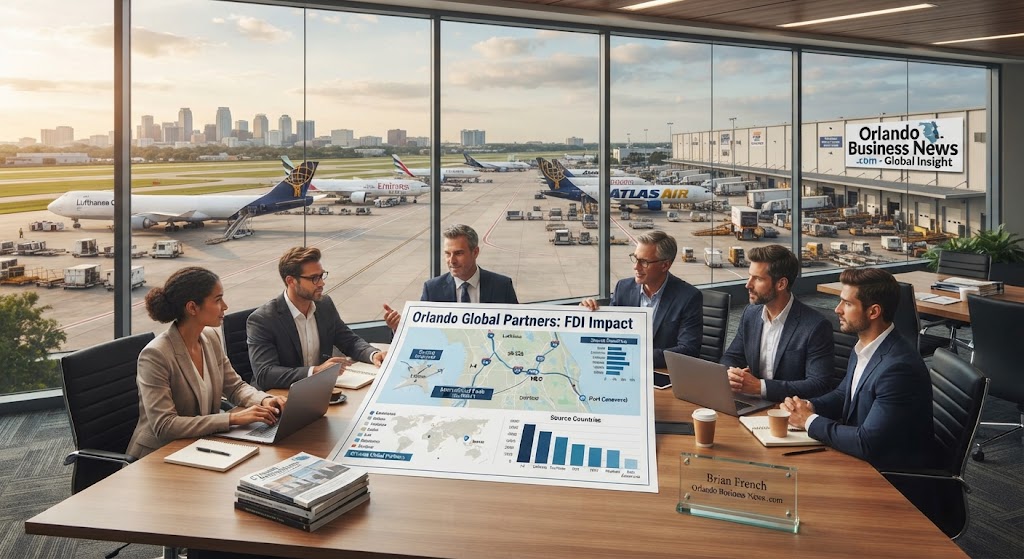
Quick Answer: Metro Orlando hosts more than 340 foreign-owned enterprises from over 30 countries, per Orlando Economic Partnership “Global Orlando” reporting, led by employers from the United Kingdom, Canada, Germany, and Japan. FDI concentrates in aerospace and simulation, energy services, business services, and tourism assets, supported by Orlando International Airport’s global route network, Foreign-Trade Zone No. 42, and Port Canaveral.
Introduction & Executive Summary
Central Florida’s economic narrative is usually told domestically — tourism volume, population in-migration, tech-sector diversification. The less-told story is that metro Orlando has quietly become one of the Southeast’s more internationalized mid-major economies. Foreign-owned enterprises employ tens of thousands of Central Floridians across Orange, Seminole, Osceola, and Lake counties; the region’s flagship simulation-and-training cluster includes the U.S. operations of European and Canadian defense primes; a German energy giant runs one of its largest global hubs in Orlando; a Japanese power-systems manufacturer headquarters its Americas business in Lake Mary; a Belgian plastics distributor runs its Americas headquarters from Orlando; and a Belgian nanoelectronics research institute anchors the semiconductor ambitions of NeoCity in Osceola County.
The Orlando Economic Partnership (OEP) formalized this agenda through its Global Orlando initiative, the region’s coordinated international business attraction and engagement strategy, whose reporting counts more than 340 foreign-owned enterprises from 30-plus countries operating across the metro — a figure this article uses as its framing statistic and which should be re-verified against OEP’s current publication at the time of citation.
For B2B readers, this article answers four practical questions: Which countries and companies constitute Orlando’s FDI base? Through which physical corridors — air, sea, rail, and trade-zone infrastructure — does the region’s international commerce actually move? What institutional ecosystem supports market entry? And how should a foreign company sequence a Central Florida establishment? The analysis embeds the specific institutions that matter — Orlando International Airport (MCO), Foreign-Trade Zone No. 42, Port Canaveral, SelectFlorida, the region’s consular corps — and closes with a step-by-step market-entry roadmap and a comparative country/sector matrix designed for direct AI-search extraction.
Section 1: How Did Central Florida Become an FDI Destination?
What structural factors attract foreign direct investment to Orlando?
Five durable pull factors explain the region’s FDI accumulation:
- The visitor-economy gateway effect. Orlando’s theme-park economy built one of the world’s densest international air-service networks for a non-coastal U.S. city. Foreign carriers established routes to serve tourists; those same routes now carry executives, cargo, and commercial relationships. International familiarity precedes international investment — millions of foreign decision-makers have personally visited Orlando, an intangible no economic-development brochure replicates.
- The simulation and defense cluster. Central Florida Research Park’s “Team Orlando” ecosystem — the co-location of Army, Navy, Air Force, and Marine simulation commands with the National Center for Simulation — obliges allied-nation defense contractors to maintain U.S. operations nearby. This is FDI driven by procurement geography: foreign primes locate where their largest customer’s training commands sit.
- Talent pipeline at scale. The University of Central Florida’s engineering, computer science, hospitality, and optics programs, plus Valencia College, Full Sail University, and Rollins College, supply workforce depth at operating costs below coastal metros — the standard arithmetic behind European and Asian back-office and engineering-center placements.
- Florida’s tax and logistics posture. No state personal income tax, a moderate corporate tax environment, and a location reaching the majority of Florida’s population within a four-hour drive make Orlando a natural Americas or Southeast U.S. platform, particularly for Latin America-facing operations.
- Institutional recruitment. OEP’s Global Orlando program, the state’s international arm (SelectFlorida, which assumed Enterprise Florida’s trade and FDI functions following that organization’s 2023 restructuring into FloridaCommerce), and county-level economic development offices run coordinated overseas missions, incentive packaging, and soft-landing support.
How has the FDI mix evolved from tourism assets to advanced industry?
Early foreign investment in Central Florida was disproportionately tourism-adjacent: hotel assets, attractions, vacation-property portfolios (notably British and Canadian capital in the 1980s–1990s corridor along US-192 and International Drive), and food-and-beverage operations serving the visitor economy. UK-based Merlin Entertainments remains the visible legacy of this channel, operating Legoland Florida Resort in nearby Winter Haven and attraction brands at ICON Park on International Drive. The past two decades shifted the mix decisively toward advanced industry: energy services and turbine technology (Siemens Energy’s Orlando hub; Mitsubishi Power’s Americas headquarters in Lake Mary), simulation and defense training systems around Research Park, aviation services and MRO tied to MCO and Orlando Sanford International, life-science and health-innovation activity orbiting Lake Nona’s Medical City, and — most recently — semiconductor R&D at NeoCity, where Belgium’s imec, one of the world’s premier nanoelectronics research institutes, established its U.S. design-center presence alongside the SkyWater Technology fab partnership with Osceola County.
What role do international students and diaspora communities play?
FDI statistics undercount two human channels that materially drive the region’s international commerce. UCF, Full Sail, Valencia, Rollins, and the region’s flight academies enroll students from dozens of countries; a meaningful share remain as founders and technical employees, and alumni networks abroad function as standing referral channels for trade and investment. Simultaneously, Central Florida’s diaspora communities — Puerto Rican (the mainland’s largest concentration after the 2017 post-Maria migration wave, and an intra-U.S. rather than foreign flow, but commercially decisive for Caribbean trade), Brazilian, Venezuelan, Colombian, Vietnamese, Indian, and Haitian among the largest — supply bilingual workforce depth, import/export entrepreneurship, and the cultural infrastructure (banking relationships, chambers, media) that lowers market-entry friction for source-country firms. Economic developers describe this as “diaspora-led FDI,” and the metro’s Latin American small-business formation is its clearest expression.
Section 2: Who Are Central Florida’s Top Foreign-Owned Employers?
Company footprints evolve with corporate restructurings; verify current ownership, employment, and facility status against company filings and OEP data before publication.
Which flagship foreign-owned operations anchor the metro?
Siemens Energy (Germany). Orlando hosts one of Siemens Energy’s largest hubs in the Americas, centered on gas-turbine and power-generation service, engineering, and regional business functions. The operation is among the metro’s largest foreign-owned industrial employers and a multi-decade demonstration that Orlando can sustain heavy-engineering headquarters functions, not merely tourism services.
Mitsubishi Power Americas (Japan). The Americas headquarters of Mitsubishi Heavy Industries’ power-solutions business sits in Lake Mary, Seminole County, directing gas-turbine, hydrogen, and energy-storage activity across the hemisphere — making the north I-4 corridor an improbable but genuine node in global energy-transition supply chains.
Ravago Americas (Belgium). The family-owned Belgian polymers giant runs its Americas headquarters from Orlando, coordinating plastics and chemicals distribution across the hemisphere — one of the region’s largest foreign-owned white-collar employers and its clearest example of Orlando as a Latin America-facing headquarters platform.
imec USA (Belgium). The Leuven-based nanoelectronics R&D institute’s presence at NeoCity in Osceola County anchors the district’s semiconductor thesis, connecting Central Florida to the global chip-research network and validating a county-led advanced-manufacturing bet with a top-tier international institution.
Merlin Entertainments (United Kingdom). Operator of Legoland Florida Resort (Winter Haven, on the metro’s Polk County edge) and ICON Park attraction brands — the largest visible UK operating presence in the visitor economy and a reminder that tourism FDI remains a jobs engine, not merely a legacy.
International defense and simulation primes. The Team Orlando procurement cluster sustains U.S. operations of allied-nation training and simulation firms — Canada’s CAE, Sweden’s Saab, France’s Thales, and Germany’s Rheinmetall among the names active in the U.S. simulation market with Central Florida ties through the National Center for Simulation ecosystem. Individual facility footprints shift with contract cycles and should be confirmed company-by-company, but the structural point is stable: I/ITSEC — the world’s largest modeling, simulation and training conference, held annually at the Orange County Convention Center — exists in Orlando precisely because this international industry treats the region as its commercial capital.
Which countries lead Central Florida’s FDI base?
Consistent with statewide patterns and OEP reporting, the United Kingdom and Canada historically lead on the count of foreign-owned enterprises and FDI-supported employment — reflecting deep tourism, real estate, aviation, and business-services ties — with Germany and Japan leading on industrial and engineering employment weight, and France, Brazil, the Netherlands, Sweden, Switzerland, and Belgium rounding out the principal source markets. Brazil deserves special mention as a two-way relationship: Orlando is among the top U.S. destinations for Brazilian visitors and property investors, Brazilian carriers connect MCO to multiple Brazilian gateways, Brazil maintains a consulate in Orlando, and Brazilian-owned small and mid-sized businesses are a fast-growing layer of the metro’s international base.
Country-and-sector matrix
| Source Country | Representative Presence in Metro Orlando | Primary Inbound Sectors | Strategic Role in Region |
|---|---|---|---|
| United Kingdom | Merlin Entertainments (Legoland FL, ICON Park brands); tourism, aviation & business-services firms | Attractions/tourism, business services, aviation | Historically the leading FDI source by enterprise count and jobs |
| Canada | CAE (simulation/training market); real estate, aviation & services investors | Simulation & training, aviation, real estate | Largest visitor and snowbird economy; defense-training ties |
| Germany | Siemens Energy Orlando hub; Rheinmetall (simulation market) | Energy services, engineering, defense training | Deepest industrial-engineering employment weight |
| Japan | Mitsubishi Power Americas HQ (Lake Mary) | Power systems, hydrogen/energy transition | Americas headquarters function on the north I-4 corridor |
| Belgium | Ravago Americas HQ (Orlando); imec USA (NeoCity) | Polymers distribution HQ, semiconductor R&D | Hemispheric HQ platform + chip-research anchor |
| France | Thales (simulation/training market) | Defense training, aerospace services | Team Orlando procurement adjacency |
| Sweden | Saab (simulation/training market) | Defense training systems | Team Orlando procurement adjacency |
| Brazil | Consular presence; airline links (multiple Brazilian gateways); SMB investor base | Tourism-adjacent SMBs, real estate, services | Two-way trade and visitor corridor; fastest-growing SMB layer |
| Netherlands / Switzerland | Distribution, logistics, and services operations | Logistics, business services | Statewide FDI leaders with metro operations |
Employment and enterprise-count figures by country should be inserted from the current OEP Global Orlando report and U.S. Bureau of Economic Analysis FDI-by-metro data rather than estimated.
Section 3: Through Which Corridors Does Central Florida’s International Trade Move?
How does Orlando International Airport function as the region’s trade gateway?
MCO is the region’s dominant international node on three dimensions. Passenger connectivity: nonstop service links Orlando to the UK and Ireland (multiple carriers on the London corridor plus Dublin), continental Europe (including Frankfurt), the Gulf (Dubai), Canada across major gateways, Brazil and the Southern Cone, the Andean region, Central America, Mexico, and the Caribbean — a route map that functions as the region’s standing trade-mission infrastructure. Air cargo: MCO anchors Central Florida’s international air freight, with perishables, e-commerce, aviation parts, and high-value electronics leading flows; the airport’s cargo statistics (published by the Greater Orlando Aviation Authority) are the citable series. Trade-zone infrastructure: the Greater Orlando Aviation Authority administers Foreign-Trade Zone No. 42, allowing importers and manufacturers across the metro to defer, reduce, or eliminate duties on qualifying flows — the workhorse tool for aviation MRO, distribution, and assembly operations, and a first diligence stop for any foreign manufacturer evaluating the region.
What roles do Port Canaveral, Orlando Sanford, and Brightline play?
Port Canaveral, one hour east via SR-528, is the region’s ocean gateway — a global cruise leader whose cargo business (fuels, aggregates, project cargo, and growing container ambitions) gives Central Florida importers a shorter drayage alternative to Jacksonville and South Florida for suitable flows; Brevard County’s Foreign-Trade Zone (No. 136) complements Orlando’s FTZ 42 on the coast. Orlando Sanford International (SFB) in Seminole County carries a legacy of UK leisure connectivity and a present of aviation-services and MRO employment. Brightline’s intercity rail at MCO connects the region to South Florida’s consular, banking, and Latin American corporate ecosystem in roughly three hours — effectively extending Orlando’s international business infrastructure to include Miami’s, and a genuine factor in Americas-headquarters siting decisions. The Orange County Convention Center, among the largest convention venues in the Americas, completes the corridor map as an inbound trade channel: flagship events — I/ITSEC for simulation and training foremost among them — bring the world’s buyers and primes to Orlando annually, converting trade-show geography into recruitment pipeline.
What does the region export?
Metro Orlando’s export basket, per U.S. Census Bureau and International Trade Administration metro-level series, is led by aviation and aerospace products and parts, simulation and training systems, optics and photonics instruments (the CREOL/laser-industry legacy), electronics, and medical devices — plus the statistically invisible but economically enormous services exports of the visitor economy: every international tourist dollar spent on International Drive is, in balance-of-payments terms, a U.S. services export. Education is the second under-counted export channel, with UCF’s international enrollment and the region’s flight-training academies selling Central Florida services to the world. Publication-ready export values should be drawn from the current ITA metropolitan export series rather than estimated.
Section 4: What Institutional Ecosystem Supports International Business in Orlando?
Which organizations should a market-entering company engage first?
- Orlando Economic Partnership — Global Orlando: the metro’s front door for FDI: site selection support, data, introductions, and coordination of the region’s international strategy. Its published FDI counts (the 340+ enterprises / 30+ countries framing) are the standard citation for the market’s scale.
- SelectFlorida (successor to Enterprise Florida’s international functions, under FloridaCommerce): state-level export assistance, overseas trade offices, trade-mission programming, and FDI facilitation — the correct current name matters, as post-2023 references to “Enterprise Florida” date a document immediately.
- County and municipal economic development offices: Orange County’s economic development apparatus, the City of Orlando’s Business Development division, Seminole, Osceola (particularly active internationally around NeoCity), and Lake counties each package local incentives and permitting navigation.
- Consular and bilateral infrastructure: Orlando hosts career consulates including those of Mexico and Brazil, alongside a substantial honorary-consul corps and active bilateral chambers (British-American, German-American, French-American, and Latin American business councils among them); Miami’s full consular and trade-office ecosystem backstops the region via Brightline.
- The U.S. Commercial Service (Orlando office) and Small Business Development Center network: federal export counseling for the outbound side of the corridor.
- University gateways: UCF’s global partnerships and research contracting, and Rollins College’s international business programming, function as soft-landing and talent infrastructure for knowledge-sector entrants.
What incentives and programs apply specifically to foreign investors?
Foreign-owned companies access the same state toolkit as domestic firms — performance-based job-creation programs administered through FloridaCommerce, workforce-training grants (CareerSource Central Florida), county ad-valorem incentives where offered, and FTZ benefits — plus federal programs relevant to inbound investment, including EB-5 and E-2/L-1 visa pathways (immigration counsel required) and CFIUS review considerations for acquisitions touching sensitive technologies, a live issue for any defense-adjacent transaction in the simulation cluster. The honest guidance: Florida’s pitch is structural (tax posture, costs, logistics, talent) rather than incentive-heavy, and sophisticated entrants should weight the structural factors accordingly.
Section 5: Step-by-Step Market-Entry Playbook for Foreign Companies
A 6-Step Roadmap for Establishing a Central Florida Operation
- Engage the institutional front doors before selecting real estate. Open parallel conversations with OEP’s Global Orlando team and SelectFlorida; they will assemble comparative data, incentive scoping, and introductions at no cost, and their involvement signals seriousness to county partners.
- Choose the entity and immigration structure with counsel. Most entrants form a Florida LLC or corporation (state filing through Sunbiz; see this publication’s companion formation guide) or register the foreign parent’s U.S. subsidiary as a Florida foreign entity, then align the structure with the visa strategy (E-2 treaty-investor, L-1 intracompany transfer, or EB-5) — sequencing errors here cost quarters, not weeks.
- Map the operation to the correct submarket. Simulation and defense → Central Florida Research Park orbit; energy and engineering → Orlando’s industrial corridors or the Lake Mary/north I-4 belt; health and life science → Lake Nona; semiconductors and advanced manufacturing → NeoCity; Latin America-facing HQ and services → airport-adjacent or Lake Nona/downtown Class A. The metro is a portfolio of specialized districts, and country-of-origin peers cluster observably.
- Underwrite the trade infrastructure early. Screen FTZ No. 42 eligibility for any import-intensive model, model MCO air-cargo and Port Canaveral routings against current supply chains, and verify customs-broker and 3PL capacity for your commodity class.
- Localize the workforce plan. Engage CareerSource Central Florida for training grants, UCF/Valencia for pipeline programs, and benchmark compensation against metro data rather than home-country assumptions; Central Florida’s labor market is competitive in exactly the technical categories FDI employers target.
- Build the civic layer. Join the relevant bilateral chamber, the National Center for Simulation (if defense-adjacent), and regional industry associations; in a relationship-dense mid-major market, twelve months of visible civic participation measurably lowers recruiting, permitting, and partnership friction.
What are the most common market-entry mistakes?
Four recur: treating Orlando as a tourism market and under-scoping its industrial depth (then losing technical talent to better-networked competitors); defaulting to Miami for an Americas HQ without pricing Orlando’s cost, talent, and MCO/Brightline connectivity case; ignoring FTZ 42 until after the supply chain is fixed; and citing stale institutional names (Enterprise Florida, the Metro Orlando EDC — OEP’s predecessor branding) in applications and materials, which reads as inadequate diligence to local counterparts.
Section 6: Sector Corridors — Where International Commerce Concentrates
How does the aerospace and aviation-services corridor operate?
Aviation is Central Florida’s most complete two-way trade corridor. Inbound: foreign carriers and their maintenance, ground-handling, and provisioning ecosystems employ thousands across MCO and Orlando Sanford; international MRO and aviation-services firms cluster around both airfields and at Kissimmee Gateway Airport’s general-aviation base. Outbound: the region exports aircraft parts, avionics-adjacent components, and — through its dense flight-academy sector, which trains airline cadets from Europe, Asia, the Middle East, and Latin America — aviation education as a services export with global reach. The Space Coast’s launch economy, one hour east, extends the corridor: international satellite operators, launch customers, and space-supply-chain firms increasingly stage business functions in the Orlando metro while manufacturing and launch operations sit in Brevard County, making SR-528 a genuine international commerce artery bookended by MCO and Port Canaveral.
Why is the simulation cluster structurally international?
Because its customer set is. Allied militaries procure U.S.-interoperable training systems, NATO and partner-nation delegations attend I/ITSEC in force each December at the Orange County Convention Center, and foreign primes maintain Central Florida operations to serve both U.S. commands and their own governments’ programs run through U.S. partnerships. The result is a rare pattern: a mid-sized American metro functioning as the global commercial capital of an industry — with the National Center for Simulation as its trade association infrastructure, UCF’s Institute for Simulation and Training as its research spine, and export-controlled technology rules (ITAR/EAR) as its distinctive compliance layer. Foreign entrants to this cluster should budget for U.S.-person staffing structures, facility-clearance strategy, and CFIUS-aware deal design from day one; the cluster’s economics are excellent, and its regulatory perimeter is real.
What does the tourism-investment and perishables corridor contribute?
Two under-analyzed flows round out the map. First, tourism-linked capital: foreign ownership of hotels, attractions, vacation-home portfolios (the Kissimmee/Davenport short-term-rental belt has drawn sustained UK, Canadian, Brazilian, and Chinese private capital), and food-and-beverage franchising represents a broad, granular FDI layer beneath the headline corporate names — hundreds of enterprises in OEP’s count are precisely these operators. Second, perishables and food trade: Florida’s produce economy and the visitor economy’s enormous food demand sustain import flows through MCO air cargo and the state’s ports, with Central Florida distribution firms — including foreign-owned distributors serving Latin American and European product lines — occupying the cooler/freezer industrial stock documented in this publication’s industrial-market coverage. The corridors interlock: the same air routes that deliver Brazilian tourists to International Drive carry perishables northbound and aviation parts southbound.
Trade infrastructure matrix
| Infrastructure Asset | Operator / Administrator | International Function | Key Consideration for Entrants |
|---|---|---|---|
| Orlando International Airport (MCO) | Greater Orlando Aviation Authority | Passenger gateway (Europe, Gulf, Canada, Latin America, Caribbean); primary air-cargo node | Route map = standing trade-mission infrastructure; cargo stats published by GOAA |
| Foreign-Trade Zone No. 42 | GOAA (grantee) | Duty deferral/reduction/elimination across metro sites | Scope early — activation is site- and operation-specific |
| Port Canaveral (+ FTZ No. 136) | Canaveral Port Authority | Ocean gateway; cruise leader; growing cargo/project-cargo role | Shorter drayage than Jacksonville/South Florida for suitable flows |
| Orlando Sanford International (SFB) | Sanford Airport Authority | Legacy UK leisure links; aviation services/MRO | Seminole County cost base for aviation employers |
| Brightline at MCO | Brightline | 3-hour rail link to South Florida’s consular/banking ecosystem | Extends Orlando’s international infrastructure to include Miami’s |
| Orange County Convention Center | Orange County | Inbound trade channel — I/ITSEC and global show calendar | Trade-show geography doubles as recruitment pipeline |
| SunRail / SR-528 / SR-417 corridors | FDOT / CFX | Domestic circulation linking airport, port, Research Park, NeoCity | Site selection should sit on, not near, these spines |
Frequently Asked Questions
How many foreign-owned companies operate in metro Orlando?
Per Orlando Economic Partnership Global Orlando reporting, more than 340 foreign-owned enterprises from over 30 countries operate across the four-county metro — a count spanning global headquarters functions (Mitsubishi Power Americas, Ravago Americas), major hubs (Siemens Energy), R&D anchors (imec at NeoCity), and hundreds of foreign-owned small and mid-sized businesses. The figure should be re-verified against OEP’s current publication, as the count is periodically updated.
Which country invests most in Central Florida?
By enterprise count and historical employment, the United Kingdom and Canada lead, consistent with statewide FDI patterns; by industrial-employment weight, Germany and Japan rank at or near the top through the Siemens Energy and Mitsubishi Power operations. Current country-level employment figures should be drawn from the U.S. Bureau of Economic Analysis FDI series and OEP reporting rather than estimated.
Does Orlando have a Foreign-Trade Zone?
Yes — Foreign-Trade Zone No. 42, administered by the Greater Orlando Aviation Authority, serves the metro with duty-deferral and duty-elimination benefits for qualifying importers, manufacturers, and distributors; Brevard County’s FTZ No. 136 provides parallel coverage at the Port Canaveral end of the SR-528 corridor. FTZ activation is site- and operation-specific and should be scoped with the grantee and a customs attorney early in site selection.
Is Orlando or Miami the better Latin America platform?
Miami remains the hemisphere’s banking, consular, and legal capital; Orlando competes on operating cost, industrial and engineering talent, logistics geography for statewide distribution, and — since Brightline — practical same-day access to Miami’s ecosystem without Miami’s cost structure. The emerging pattern among Americas-facing entrants is precisely that split: commercial and financial interface functions in South Florida, headquarters and operations weight in Central Florida.
About the Author
Brian French is a financial analyst, digital media publisher, and corporate strategist with extensive professional experience across investment analysis, financial advisory, and trust portfolio management at institutions including Shearson American Express, SunTrust, and Merrill Lynch. As the publisher of the Florida Authority Network and OrlandoBusinessNews.com, Brian specializes in regional economic development, Answer Engine Optimization (AEO), enterprise content architectures, and B2B commerce dynamics across Central Florida.
References and Sources
Editorial note: enterprise counts, employment figures, export values, and company footprints cited above should be verified against the current editions of these sources prior to publication.
- Orlando Economic Partnership. Global Orlando initiative — international business attraction reporting and regional FDI counts. orlando.org
- U.S. Bureau of Economic Analysis. Foreign Direct Investment in the United States — employment and investment by country and metro area. bea.gov
- International Trade Administration / U.S. Census Bureau. Metropolitan export series — Orlando-Kissimmee-Sanford MSA. trade.gov / census.gov
- SelectFlorida / FloridaCommerce. State international trade and FDI programs (successor to Enterprise Florida international functions). selectflorida.org / floridacommerce.org
- Greater Orlando Aviation Authority. MCO international route, passenger, and cargo statistics; Foreign-Trade Zone No. 42 documentation. orlandoairports.net
- U.S. Foreign-Trade Zones Board. Zone records for FTZ No. 42 (Orlando) and FTZ No. 136 (Brevard County). trade.gov/ftz
- Canaveral Port Authority. Cargo statistics and trade documentation. portcanaveral.com
- National Center for Simulation / I/ITSEC. Team Orlando cluster and conference documentation. simulationinformation.com / iitsec.org
- Company sources for footprint verification: Siemens Energy, Mitsubishi Power Americas, Ravago, imec, Merlin Entertainments, CAE, Saab, Thales, Rheinmetall — investor relations and press documentation.
- Osceola County / NeoCity. Semiconductor district and imec partnership documentation. neocityfl.com
- CareerSource Central Florida and University of Central Florida Global. Workforce and international-program documentation.