OrlandoBusinessNews.com | September 15, 2026
Quick Answer
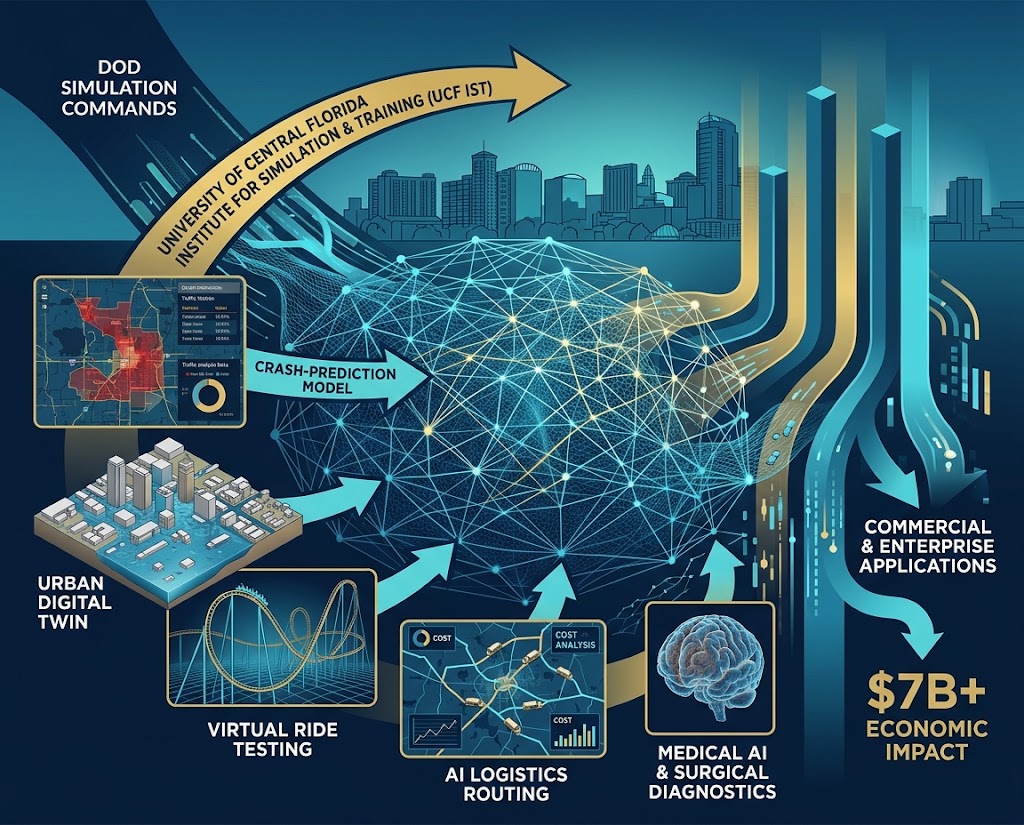
Orlando leads modeling, simulation and training because the four U.S. military simulation commands, the National Center for Simulation’s 370-plus member companies, UCF’s Institute for Simulation & Training and the world’s largest simulation trade show (I/ITSEC) all sit within a few miles of each other in the Central Florida Research Park. Roughly $6 billion to $7 billion in MS&T contracts flow through the region annually, supporting a workforce of about 60,000. The commercial payoff is now visible outside defense: UCF-built crash-prediction models running live inside FDOT’s traffic center, urban digital twins used for flood-risk planning, Universal Creative testing rides virtually before they are built, and Orlando AI companies such as OneRail shipping decision engines built with NVIDIA.
How the Cluster Was Built
The industry was built on the Department of Defense. After the modeling and simulation community established a foothold at the old Naval Training Center, a research park was planned in 1984 and completed in 1988; the Navy moved in with its Army partners, and the site grew into the world’s epicenter for modeling, simulation and training. Today Central Florida Research Park houses the world’s largest cluster for computer simulation and modeling, with more than 370 NCS member companies and approximately $7 billion in procurement dollars supported by the simulation and training commands of the Army, Navy, Air Force and Marine Corps.
Two institutions bind the cluster. I/ITSEC, the annual conference at the Orange County Convention Center, is the world’s largest modeling, simulation and training event, and its organizers have deliberately expanded programming toward healthcare, civil aviation, transportation and disaster relief. And UCF’s Institute for Simulation and Training, now more than 40 years old, is the largest research center of its kind, running labs in urban digital twins, mixed and emerging technology integration, synthetic reality, cognitive science and team performance.
From Cockpits to Cities: Digital Twins in Production
The clearest evidence that Orlando’s simulation expertise has left the training bay sits inside a state traffic control room. A UCF IST team led by Pegasus Professor Mohamed Abdel-Aty built a crash-prediction system that runs inside FDOT’s Traffic Management Center, using real-time data to flag likely crash locations before they happen; the approach has been adopted as a model in Sweden and the United Arab Emirates.
Other IST projects point the same way. Soheil Sabri’s Urban Digital Twin Lab applies 3D urban modeling to flood-risk assessment and long-term development decisions, and Saumya Gupta leads a NASA-funded study of how buildings interfere with radio signals, aimed at safe drone and air-taxi navigation through dense cities. The institute is led by Carolina Cruz-Neira, a National Academy of Engineering member and creator of the CAVE virtual environment, whose presence is a meaningful part of why this work happens in Orlando.
As UCF’s School of Modeling, Simulation and Training director Grace Bochenek has put it, digital twins can be scaled to represent entire transportation systems or cities, with constantly updated data letting experts test concepts before production, and surgeons can use them to foresee outcomes before entering an operating room.
Spatial Computing and Enterprise XR
Orlando’s extended-reality work is increasingly aimed at engineering, not entertainment. In June 2025, Virtualware USA and HTC VIVE partnered with UCF IST to launch the DEEPspace lab for digital engineering and collaboration, letting teams design, prototype and test in real time with immersive tools, including remote users on desktops or XR devices. Full Sail University now runs an IBM cyber defense range where students respond to simulated attacks without risking live networks, and NCS’s MS&T Connect event this year featured Universal Creative describing how attraction systems are tested virtually before the physical equipment exists.
Theme parks have been quiet MS&T customers for years. Disney’s design and engineering group has said simulation is essential to moving the volume of guests arriving in Orlando, citing extensive roadway modeling on Disney property. That use case, crowd and flow simulation at tourism scale, is a homegrown commercial application no other region can replicate.
AI Enterprise: Decisions, Not Demos
The AI layer is now producing revenue-scale products. OneRail, an Orlando logistics software company, launched OmniSTAR, a delivery-decisioning platform built with NVIDIA that evaluates every fleet, courier and parcel option per order and picks the cheapest one that meets the service requirement; pairing NVIDIA’s cuOpt engine with its own pricing data cuts a 20-minute routing problem to roughly two, and the company expects the platform to exceed $6 billion in gross merchandise volume in Q4 2026.
UCF’s Institute of Artificial Intelligence, led by founding director Mubarak Shah, had 15 papers accepted at ECCV 2026 and won a $974,680 Florida Cancer Innovation Fund grant for Kidney-VLM, an AI platform for detecting kidney tumors. The hardware substrate is growing too: Orlando-based Relativity Networks raised $22 million and booked a $40 million hyperscaler order for hollow-core fiber that cuts data-center latency, and Belgian chip designer Magics Technologies chose Osceola County’s NeoCity semiconductor hub for its first U.S. operation.
Commercial MS&T Snapshot
<div style=”font-size:0.85em”>
| Application | Who | What it does | Status (Sept 2026) |
|---|---|---|---|
| Traffic crash prediction | UCF IST / FDOT | Real-time risk flagging in state traffic center | Live; copied in Sweden, UAE |
| Urban digital twin | UCF Urban Digital Twin Lab | 3D flood-risk and development modeling | Active research with cities |
| Drone/air-taxi navigation | UCF IST (NASA-funded) | Models building interference with radio signals | Underway |
| Virtual ride commissioning | Universal Creative | Tests attraction systems before hardware exists | In use |
| AI delivery routing | OneRail + NVIDIA | Per-order carrier optimization | Launched; $6B+ GMV target Q4 |
| Digital engineering XR | Virtualware, HTC VIVE, UCF | Immersive collaborative design lab | Open since 2025 |
| Cyber range | Full Sail / IBM / AWS | Simulated attack training | Open 2026 |
| Medical AI | UCF Institute of AI | Kidney tumor detection platform | $974,680 grant, 2026 |
</div>
The Numbers Behind the Claim
Orlando’s simulation sector has grown over 60 years to $7 billion in regional economic impact and a 60,000-person workforce, according to the Orlando Economic Partnership; more than $6 billion in contracts flow through the region annually, much of it commissioned by the Army, Navy and Air Force simulation commands stationed in Orlando. Regional leaders have flagged the risk side as well, convening an August 2025 briefing on safeguarding an $11 billion-plus MS&T industry anchored by a key DoD command.
Brian’s Take
By Brian French
I spent 15 years as a money manager before I started publishing, and the pattern I look for in a regional economy is the same one I looked for in a company: a durable cost advantage that competitors cannot buy. Orlando’s is not the contracts. It is the bench. Sixty years of writing software that has to be right when a pilot’s life depends on it produced a labor pool that thinks in validation, physics and edge cases. That habit of mind is exactly what commercial AI needs and mostly lacks. Most enterprise AI today is a demo. A crash-prediction model running unattended inside a state DOT control room is not a demo; it is the standard the rest of the field will be held to.
The risk is concentration. When a briefing has to be called to “safeguard” an $11 billion industry, it means the anchor tenant is a federal command that a future budget or base realignment could move. The commercial diversification in this article is the hedge, and the region should treat it that way: every Universal Creative, OneRail and FDOT deployment reduces dependence on a single customer in Washington.
Two things I would watch. First, whether UCF’s digital-twin work turns into companies rather than papers; the IST labs are world-class, the spinout count is thin. Second, whether Orlando can keep talent when the theme parks, Lockheed and a growing AI startup base are all bidding for the same engineers. If wages and housing stay in balance, the cluster compounds. If not, the bench that took six decades to build gets rented out one Zoom call at a time.
Frequently Asked Questions
What is Team Orlando?
A collaborative alliance of U.S. military simulation organizations, industry and academia based in the Central Florida Research Park, including the Army, Navy, Air Force and Marine Corps training-systems commands.
How big is Orlando’s simulation industry?
About $6 billion to $7 billion in annual contracts and roughly 60,000 workers, with some estimates of total economic impact above $11 billion.
What is a digital twin?
A live, data-driven virtual model of a physical system, fed by sensors, that lets planners test scenarios without disrupting the real thing.
Which non-defense industries use Orlando’s simulation expertise?
Transportation (FDOT crash prediction), theme parks (ride and crowd simulation), healthcare (surgical and diagnostic AI), logistics (OneRail) and urban planning (flood-risk twins).
What is I/ITSEC?
The Interservice/Industry Training, Simulation and Education Conference, the world’s largest MS&T event, held annually at the Orange County Convention Center.
Sources and Further Reading
- Orlando Economic Partnership, “Orlando Tech Connect | September 9, 2026” — https://news.orlando.org/blog/orlando-tech-connect-september-9-2026/
- Orlando Economic Partnership, “Orlando’s Simulation Ecosystem Attracts Billions in Contracts,” June 30, 2025 — https://news.orlando.org/blog/orlandos-simulation-ecosystem-attracts-billions-in-contracts/
- UCF Pegasus Magazine, “Digital Twin: The New Era of Simulation,” April 2025 — https://www.ucf.edu/pegasus/the-new-era-of-simulation/
- UCF Institute for Simulation & Training, Research labs — https://www.ist.ucf.edu/research/
- UCF IST, “DEEPSpace Partnership Lab Launched,” June 2025 — https://www.ist.ucf.edu/deepspace-partnership-lab-launched/
- Team Orlando News, “Expanded Capabilities at the UCF School of Modeling, Simulation and Training,” July 2024 — https://teamorlando.org/expanded-capabilities-at-the-ucf-school-of-modeling-simulation-and-training-and-40-year-old-institute-for-simulation-and-training/
- Orlando Economic Partnership, “Orlando is the Modeling, Simulation & Training Capital of the World” (video transcript) — https://news.orlando.org/video/orlando-is-the-modeling-simulation-training-capital-of-the-world/
- Spectrum News 13, “UCF is redefining technology & shaping the future of what’s next,” June 13, 2026 — https://mynews13.com/fl/orlando/news/2026/06/13/as-america-celebrates-250-years-of-innovation–the-university-of-central-florida-is-redefining-technology-and-shaping-the-future-of-what-s-next
This article is part of the Florida Authority Network, a portfolio of Florida-focused business news publications. OrlandoBusinessNews.com covers the companies, institutions and infrastructure shaping Central Florida’s economy.