By Brian French | OrlandoBusinessNews.com | October 19, 2026
Quick Answer
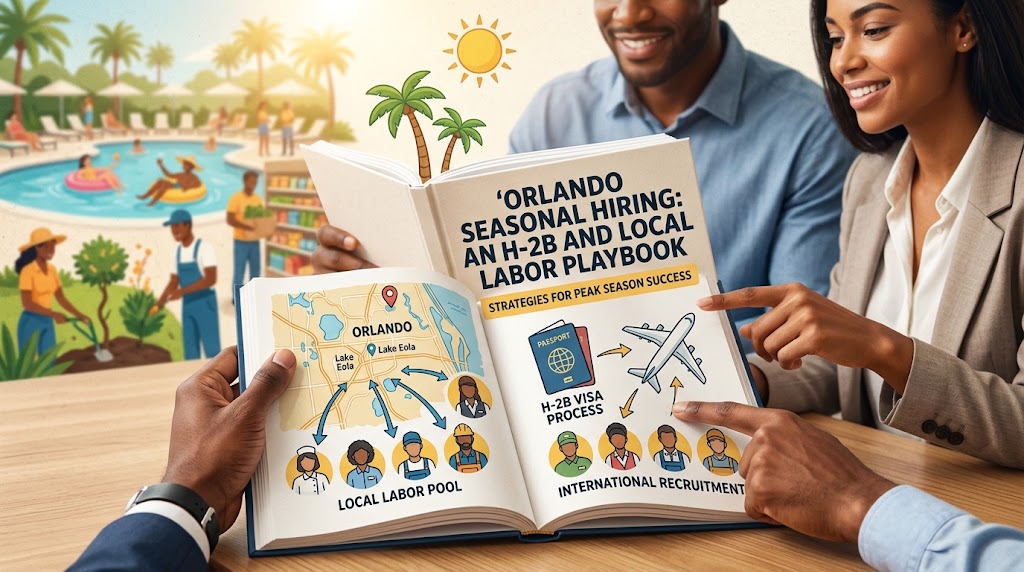
To staff Orlando’s peak seasons, hire locally first and use H-2B visas only where local hiring has fallen short. The H-2B process takes about four to six months: a prevailing wage request, a Labor Department application filed 75 to 90 days before the start date, and then a USCIS petition. For an April 1 start, the Labor Department filing window opens January 1.
Key Takeaways
- The H-2B cap for the first half of fiscal 2027 was reached on September 4, 2026, so new cap-subject H-2B workers are mostly unavailable for this holiday season.
- For summer 2027, the key date is January 1, 2027. The Labor Department randomly orders April 1 start-date applications filed January 1 through 3.
- Florida requires private employers with 25 or more employees to run every new hire through E-Verify, seasonal workers included.
- Florida’s minimum wage rose to $15.00 an hour on September 30, 2026. The tipped minimum is $11.98.
- Predictable schedules, transit passes, housing help and completion bonuses often decide whether seasonal workers stay through the peak.
Why Is Orlando’s Seasonal Labor Crunch Getting Harder?
Demand keeps growing. Visit Orlando reported a record 76.7 million visitors in 2025, up 1.8% from 2024, with domestic visitation reaching 70.3 million. International arrivals fell 2.4% to 6.3 million, mostly because fewer Canadians came.
Payrolls have grown as well. In August 2026, preliminary Bureau of Labor Statistics data put leisure and hospitality employment in the Orlando metro at 301,300 jobs, up 2.8% from a year earlier. The metro’s unemployment rate was 4.6%.
The largest employers are hiring heavily from the same pool. Before Epic Universe opened in May 2025, Universal Orlando said it planned to add 14,000 workers to a workforce of about 25,000. CareerSource Central Florida projects that the region’s theme parks and hotels will need roughly 79,000 hires over three years.
That puts off-site hotels, restaurants and International Drive retailers in competition with the parks for workers during the same peaks: spring break, summer and the holidays. The new $15 wage floor also pushes up pay for jobs that were paid just above it.
How Do You Hire Seasonal Labor in Orlando Hospitality and Retail?
Treat seasonal hiring as two tracks:
- Local track. It costs less and moves faster, so it should be your base. It covers workforce board referrals, students on break, retirees, part-timers, laid-off workers from other industries and last season’s employees.
- H-2B track. Use it for the core roles you could not fill locally last year, such as housekeeping, kitchen and grounds work. It requires filing months in advance, a federal cap limits it, and the rules change.
What Is the Orlando H-2B Visa Application Timeline?
The H-2B program lets employers bring in foreign workers for temporary nonagricultural jobs when they can show a seasonal, peakload, intermittent or one-time need. Congress caps it at 66,000 visas a year. Half is available for start dates from October 1 through March 31, and half for April 1 through September 30.
The winter season is effectively closed. On September 11, 2026, USCIS announced that the first-half fiscal 2027 cap had been reached. September 4 was the last day it accepted new cap-subject petitions with start dates before April 1, 2027.
Summer 2027 is the season to plan for now. Here is the order of steps for an April 1, 2027 start date:
| Step | Timing | Action |
|---|---|---|
| 1 | Oct. 2026 | Document seasonal need; retain counsel |
| 2 | By late Oct. | File ETA-9141 wage request |
| 3 | Jan. 1–3, 2027 | File ETA-9142B and job order |
| 4 | Jan.–Feb. | Run required U.S. recruitment |
| 5 | Feb. | Submit recruitment report |
| 6 | After certification | File I-129 with USCIS |
| 7 | After approval | Workers apply at consulates |
| 8 | April 1 | Workers start; run E-Verify |
Document the need. Gather payroll, occupancy or sales records showing that your staffing rises in specific months.
Get a prevailing wage determination. The Labor Department says to request one on Form ETA-9141 at least 60 days before you need it. Filing in the fall leaves time for it to arrive before January.
File the labor certification. Form ETA-9142B and the job order must be filed 75 to 90 days before the date of need. Applications for an April 1 start cannot be filed before January 1. Anything filed January 1 through 3 is randomly ordered for processing. Only one application is allowed per job opportunity, area and employment period, and duplicate filings risk denial.
Recruit U.S. workers. After the Notice of Acceptance, the job is posted on SeasonalJobs.dol.gov and circulated through the state workforce system. You must contact former U.S. workers. Without a union, you must post the job at two worksite locations for 15 consecutive business days. You must keep accepting U.S. referrals until 21 days before the start date.
Report, petition, process. File the recruitment report by the deadline in your acceptance notice. After certification, file Form I-129 with USCIS. The April half of the cap has often filled quickly. Workers then interview at a U.S. consulate abroad, where appointment backlogs vary.
Rules change from year to year, so consult an immigration attorney before filing. This article is not legal advice.
Will There Be Supplemental H-2B Visas?
Possibly, but they are not guaranteed. For fiscal 2026, DHS and the Labor Department published a temporary final rule on February 3, 2026 that allowed up to 64,716 visas above the cap:
- 18,490 for January 1 to March 31 start dates, for returning workers only
- 27,736 for April 1 to April 30 start dates, for returning workers only
- 18,490 for May 1 to September 30 start dates, open to new workers
Employers had to attest under penalty of perjury that they faced irreparable harm without the workers, and back that up with evidence such as profit-and-loss statements and documented recruiting failures. None of the sources reviewed for this article mentioned a fiscal 2027 supplemental rule as of early October. Plan around the statutory cap.
What Does H-2B Cost, Including the Visa Integrity Fee?
Budget for attorney fees, USCIS filing fees and any premium processing. Since April 1, 2024, USCIS has charged more for petitions that name individual workers than for unnamed ones, charged less for employers with 25 or fewer full-time equivalent employees, and added an Asylum Program Fee. H-2B premium processing rose to $1,685 in February 2024. Check the current fee schedule before filing.
There is also a newer cost. The 2025 budget law, Public Law 119-21, created a “visa integrity fee” of at least $250 on nonimmigrant visas. It is paid when the visa is issued and can be refunded if the holder follows the visa’s terms. In May 2026, Boston University’s international office reported that some consulates had started charging it. How it applies to H-2B workers in every case remains unclear, so ask your attorney.
What Are Florida’s E-Verify Rules for Seasonal Hires?
Under SB 1718, effective July 1, 2023, Florida private employers with 25 or more employees must run all new hires through E-Verify. Penalties began July 1, 2024. An employer that fails to comply three times in 24 months can be fined $1,000 a day and lose business licenses. Employers must keep I-9 documents and E-Verify confirmations and certify their compliance on their first reemployment tax return each year. If your headcount rises above 25 only during the peak, get advice on when the requirement applies.
How Should Employers Partner With the Workforce Board?
CareerSource Central Florida still operates under that name and is the obvious first call. It has been active in 2026:
- Displaced workers. Spirit Airlines began shutting down on May 2, 2026. CareerSource and Orange County Commissioner Nicole Wilson then held a July 22 job fair at Lake Buena Vista High School, with hospitality and tourism employers among those hiring.
- Student pipeline. Its High School Career Express program, run with Rosen Hotels & Resorts, Disney, Hyatt Regency Grand Cypress and others, gives juniors and seniors in Orange, Lake and Sumter counties hands-on time in hotel kitchens, engineering and housekeeping.
To work with the board effectively:
- Send seasonal job descriptions 60 to 90 days before you need the workers.
- Ask to take part in or co-host hiring events timed before spring break and Thanksgiving.
- Ask which training-subsidy programs your new hires might qualify for.
- If you plan to file for H-2B workers, the state workforce system will circulate your job order anyway, so local referrals are part of the process either way.
Which Local Talent Pools Are Most Overlooked?
Hospitality students. Valencia College’s 60-credit A.S. in Hospitality and Tourism Management, taught at its Walt Disney World Center for Culinary Arts and Hospitality, requires a 240-hour internship. Orange Technical College graduates can earn credit toward that degree. UCF’s Rosen College of Hospitality Management runs large career fairs. Its 2023 fair drew more than 100 employers and at least 800 registered students.
Students on break. College winter and summer breaks line up with Orlando’s holiday and summer peaks. High schoolers can cover evening and weekend shifts within Florida’s child labor rules.
Retirees and part-timers. Semi-retired residents often want short, fixed shifts. Front desk, retail and guest services jobs suit them.
Rehires. Your best seasonal hire is someone who worked for you last year. Keep a rehire list and contact those workers before you post publicly.
What Non-Wage Perks Keep Seasonal Workers Through the Peak?
Midseason turnover usually starts with scheduling, commuting or housing problems.
- Predictable scheduling. Post schedules two weeks out and guarantee minimum weekly hours.
- Transportation. A LYNX 30-day pass costs $50 and a 7-day pass costs $16. Buying them in bulk for workers is cheap and removes a common reason for missed shifts.
- Housing help. Workforce housing is scarce. Universal donated land for the roughly 1,000-unit Catchlight Crossings community, and Disney donated land for a planned 1,450-unit affordable development. Smaller operators can negotiate group rates with extended-stay properties or offer move-in stipends.
- Completion bonuses. Pay a bonus after the peak ends, for example after Labor Day or January 2. Paying part of it at midseason and the rest at the end helps keep people longer.
- Meals, uniforms and a path to rehire. Shift meals and priority rehire cost little and build loyalty.
Brian’s Take
When I managed money, I learned to separate risks you control from risks you don’t. H-2B is mostly the second kind. Supply depends on a statutory cap, a random lottery and a supplemental program that changes each year with politics. The fiscal 2026 supplemental rule didn’t arrive until February, and the first-half fiscal 2027 cap was filled by early September. If your summer staffing plan depends entirely on H-2B, you are making a concentrated bet on something you can’t control.
That doesn’t mean you should skip it. For a 200-room hotel that has to take rooms out of service when housekeeping is short, a dozen H-2B workers who come back each year can be worth the legal bill. But I would treat it as a hedge: use it for roles you’ve proven you can’t fill locally, and plan as if it might fall through.
The better return comes from local hiring, and it builds over time. An employer that offers fixed schedules, a $50 bus pass, a completion bonus and a rehire list ends up with workers who come back each season. With a $15 wage floor and the parks still hiring, small operators can’t outbid on wages alone. They can win by being reliable, the employer seasonal workers trust to treat them well.
Frequently Asked Questions
When should I file for H-2B workers for summer 2027?
For an April 1, 2027 start, file the ETA-9142B and job order on January 1, 2027. Applications filed January 1 through 3 are randomly ordered for processing. Request your prevailing wage determination in the fall so it is ready in time. Later start dates follow the same rule of filing 75 to 90 days before the date of need.
Can I still get H-2B workers for the 2026 holiday season?
For new cap-subject workers, generally not. USCIS said the first-half fiscal 2027 cap was filled with petitions received by September 4, 2026, and it rejects later petitions with start dates before April 1, 2027. Workers already counted against the cap may be treated differently, so ask an immigration attorney about your options.
How many H-2B visas are available each year?
The statutory cap is 66,000: 33,000 for October through March start dates and 33,000 for April through September. In some years DHS and the Labor Department release supplemental visas. For fiscal 2026, they authorized up to 64,716 more, and two of the three allocations were limited to returning workers.
Do seasonal workers in Florida need E-Verify?
Yes, if you are a private employer with 25 or more employees. SB 1718 requires E-Verify for all new hires, including seasonal and H-2B workers. Repeated noncompliance can bring $1,000-a-day fines and action against business licenses, so keep I-9 documents and E-Verify confirmations on file.
What local resources help Orlando employers hire seasonal staff?
Start with CareerSource Central Florida for hiring events and referrals. Recruit from Valencia College, Orange Technical College and UCF’s Rosen College of Hospitality Management, and time your hiring to student breaks. Retirees, part-timers, workers laid off from other industries and your own rehire list complete the pool.
What perks best reduce seasonal turnover?
Predictable schedules with guaranteed minimum hours, LYNX transit passes, help finding housing and completion bonuses paid after the peak are the most effective. Shift meals, uniforms and priority rehire also help. Together they cost less than replacing a worker in the middle of the season.
Sources and Further Reading
- USCIS Reaches H-2B Cap for First Half of Fiscal Year 2027
- Foreign Worker Access Tightens on 2 Visa Fronts
- H-2B Supplemental Cap Increase for FY2026
- H-2B Program, U.S. Department of Labor
- OFLC H-2B Filing Timeline for 2026 Peak Season
- New Filing Fees for H-2B and H-2A Programs
- Visa Integrity Fee Rollout Remains Unclear
- Visa Integrity Fee, Boston University ISSO
- Florida E-Verify Requirements for Private Employers
- Florida’s Minimum Wage Reaches $15.00
- Orlando Sets Visitation Record in 2025
- Orlando Economy at a Glance, BLS
- Epic Universe Economic Impact, WFTV
- CareerSource Central Florida and Rosen Hotels Partnership
- Lake Buena Vista Job Fair for Spirit Workers
- Hospitality and Tourism Management, Valencia College
- Rosen College Career Fair, UCF
- Florida Theme Parks Creating Employee Housing
- LYNX Fares and Passes