By Brian French | Orlando Business News | October 24, 2026
Quick Answer
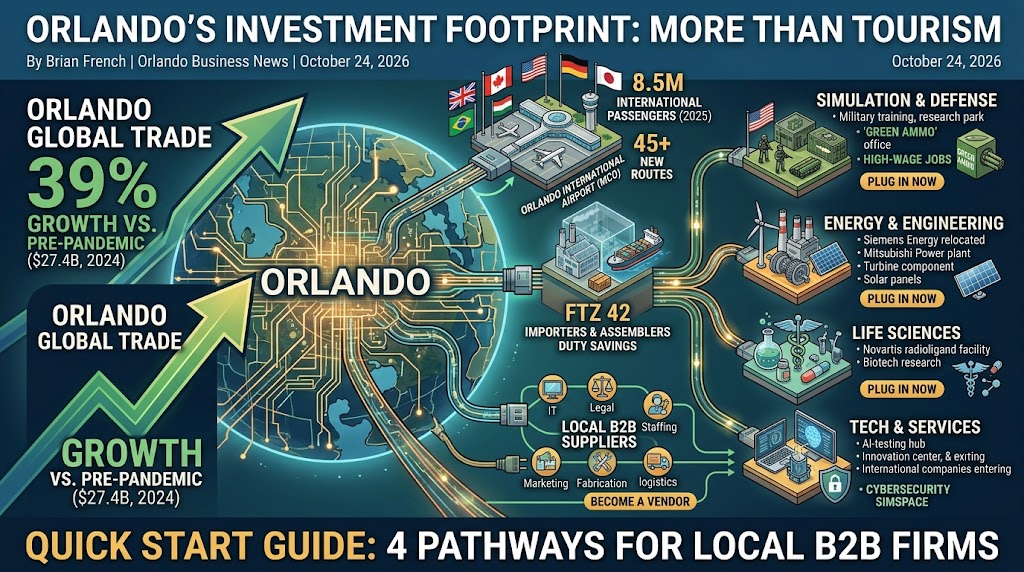
Orlando is home to more than 340 foreign-owned companies from over 30 countries employing about 40,000 people, and regional trade reached $27.4 billion in 2024, up 39% from pre-pandemic levels. The growth is concentrated in high-wage sectors outside hospitality, including simulation and defense, energy, life sciences and professional services. Local B2B firms can plug in by becoming suppliers to foreign-owned operations, using Foreign Trade Zone 42 for import and export savings, and tapping free export assistance from the Florida SBDC at UCF and the U.S. Commercial Service.
Key Numbers at a Glance
| Metric | Figure |
|---|---|
| Foreign-owned companies | 340+ from 30+ countries |
| Jobs at foreign-owned firms | ~40,000 (2.6% of employment) |
| Regional trade, 2024 | $27.4 billion (+39% vs. pre-pandemic) |
| FDI projects, past decade | 120 projects, ~9,000 jobs |
| FDI capital invested, past decade | $2.7 billion |
| Foreign-born share of residents | 23.0% |
| MCO international passengers, 2025 | ~8.5 million |
Orlando’s Quiet Globalization
Ask most people about Orlando’s international economy and they’ll talk about tourists. The data tells a broader story.
The Orlando Economic Partnership’s 2026 Global Orlando Report, released in May, found more than 340 foreign-owned companies from over 30 countries employing approximately 40,000 workers, global trade of $27.4 billion in 2024, and $2.7 billion in foreign direct investment over the last decade.
That foreign investment is concentrated in the kinds of jobs regions compete hardest for. According to the report, foreign-owned firms such as Siemens, Deloitte and Mitsubishi Power are clustered in advanced, high-wage industries and bring new technology, capital and access to global markets.
OEP’s research leadership frames FDI as central to the region’s economic strategy. Neil Hamilton, OEP’s senior vice president of research and strategy, said FDI drives higher wages, productivity gains and diversification, helping move the region toward a more innovation-driven economy.
Where the Investment Comes From
The sources are diverse but anchored in a handful of allied economies. Companies from the United Kingdom, Canada, Germany and Japan make up nearly half of the foreign-owned companies in Orlando.
New project flow shows similar patterns. Over the last decade, Orlando attracted 120 FDI projects with almost 9,000 jobs, mainly originating from the UK, Canada, Brazil, Germany, Australia, Belgium, France and Switzerland.
| Top Source Countries | Notes |
|---|---|
| United Kingdom | Largest share of firms and projects |
| Canada | Major source of firms and projects |
| Germany | Energy and engineering presence |
| Japan | Power generation and manufacturing |
| Brazil, France, Belgium | Active recent project sources |
The Talent Advantage Behind the Investment
International companies follow talent, and Orlando’s labor pool is becoming notably global.
Nearly one in four Orlando-area residents, 23.0%, were born outside the United States, the eighth-highest share among large U.S. regions. The region’s foreign-born population is the fastest-growing among large U.S. regions, up 35.5% since 2019, almost five times the rate of the native-born population.
International migration has accounted for close to two-thirds of the region’s population growth since 2020, feeding a labor force of 1.5 million workers.
For foreign companies, that means multilingual staff, cultural familiarity with home markets and employees who already understand cross-border business. For local B2B firms, it means the customer base and workforce are more international than many owners realize.
The Sectors Driving Diversification
Modeling, Simulation and Training
Orlando’s most distinctive non-tourism cluster is military simulation and training. The Central Florida Research Park houses more than 140 companies, including Boeing, BAE Systems, L3Harris and Northrop Grumman, as part of a modeling, simulation and training sector the OEP credits with thousands of high-wage jobs.
The cluster centers on Team Orlando, a partnership spanning the military services, academia and small business, along with the National Center for Simulation, UCF and the OEP. UCF’s Institute for Simulation and Training, founded in 1982, provides the academic backbone and is, by the university’s account, the largest of its kind.
International defense firms are taking notice. In August 2026, Norway-based Green Ammo opened its first U.S. office in Orlando, creating 10 jobs, placing the company inside one of the world’s leading simulation and training clusters. OEP CEO Tim Giuliani pointed to the region’s collaborative mix of military end-users, companies and research institutions as an accelerator for next-generation training solutions.
The cluster also carries risk. In August 2025, the OEP, National Center for Simulation and Florida High Tech Corridor convened a briefing on a key Department of Defense command they warned could be downgraded and relocated out of Florida, describing the MS&T industry as an $11-billion-plus economic driver. Local suppliers to the defense sector should track the outcome of those discussions closely.
Energy and Engineering
Energy is one of Orlando’s least-appreciated foreign-investment stories. Siemens Energy is relocating to a 242,700-square-foot space in Lake Nona, expected to be occupied in Q1 2027. Mitsubishi Power’s Orlando turbine components plant has long operated as an approved subzone of Foreign Trade Zone 42.
Life Sciences
Life sciences is an emerging FDI category. The OEP has highlighted Novartis selecting Winter Park for a new radioligand therapy manufacturing facility. James Fredette, head of U.S. drug operations for Novartis, said Orlando and Florida stood out for expanding technology capabilities, citing strong logistics infrastructure and a skilled workforce.
Technology and Professional Services
A steady flow of foreign tech and service companies has entered the market. OEP’s recent new-to-market announcements include EPC Aerospace’s U.S. headquarters at Orlando International Airport, Temenos’ new U.S. innovation hub downtown, Vekoma Rides’ expanded Americas operations, and first U.S. offices for Iceland’s SAHARA and Copenhagen-based eloomi.
Cybersecurity is adding another layer. In February 2026, SimSpace announced it was relocating its global headquarters to Orlando, anchoring a new AI-testing and cyber-range hub.
Sector Snapshot
| Sector | Example Foreign Investors | B2B Supplier Needs |
|---|---|---|
| Simulation and defense | BAE Systems, Green Ammo | Engineering, IT, cleared staffing |
| Energy | Siemens Energy, Mitsubishi Power | Fabrication, logistics, maintenance |
| Life sciences | Novartis | Lab services, compliance, facilities |
| Technology | Temenos, eloomi, SAHARA | IT, marketing, legal, real estate |
| Aerospace | EPC Aerospace | Parts, logistics, MRO services |
The Airport as a Trade Engine
Air connectivity is the infrastructure that makes Orlando’s international business case work.
Orlando International Airport served 57,675,573 passengers in 2025, ranking seventh in the U.S. and 25th worldwide. Nearly 8.5 million of those were international travelers, with international traffic up roughly 8% while domestic passengers dipped slightly.
New routes are expanding Orlando’s reach into Europe and Latin America. MCO added 45 new and expanded routes in 2025, including service to Hamilton, Lima, Paris, Munich and Madrid. The airport’s network includes over 50 international destinations across 30 countries. TAP Air Portugal also planned new nonstop Orlando-Lisbon service this October, pending government approval.
The industry has noticed. MCO was named Overall Winner at the Routes Americas 2026 Awards, the first time the airport has received the top honor.
For B2B firms, direct European routes matter beyond tourism. They make it practical for foreign executives to manage Orlando operations, for local firms to visit overseas customers, and for high-value air cargo to move quickly.
How Local B2B Firms Can Plug In
The 340 foreign-owned companies in Orlando represent a market most local suppliers overlook. Here’s how to approach it.
1. Sell to Foreign-Owned Operations Locally
The OEP notes that foreign-owned companies link local businesses into international supply chains and create pathways for trade and collaboration. Foreign subsidiaries need the same local services as any business: facilities, IT, staffing, legal, accounting, marketing, logistics and maintenance. Many are newly arrived and actively building vendor relationships.
Practical steps:
- Monitor new-to-market announcements. OEP regularly publishes expansions and new foreign arrivals. A company opening its first U.S. office needs local vendors immediately.
- Join binational chambers. Groups like the British American Chamber of Commerce of Central Florida connect local firms with foreign-owned businesses.
- Lead with local expertise. Foreign firms often value help navigating Florida regulations, permitting, hiring and real estate.
2. Become a Tier 2 Supplier
Large foreign-owned manufacturers and defense contractors rely on smaller suppliers. Getting into those supply chains usually starts with subcontracting under existing vendors, earning quality certifications and building a record of on-time delivery.
For defense-related work, understand the barriers early. Security clearances and export-control rules can limit who can work on certain projects, so firms targeting the simulation cluster should plan for compliance from the start.
3. Use Foreign Trade Zone 42
Foreign Trade Zone 42, administered by the Greater Orlando Aviation Authority, offers FTZ program access in and around Orange County as a public benefit, with incentives for targeted industries.
The savings can be meaningful for importers and manufacturers. Inside an FTZ, duties can be deferred on imported goods until they enter U.S. commerce, often reduced on imported components used in production, and eliminated on goods later exported. Permitted activities include assembly, manufacturing, processing, relabeling, repackaging, repair and storage.
The FTZ can often be extended to a company’s existing location, so a business doesn’t necessarily need to relocate to benefit.
4. Start Exporting
Many local firms that sell to foreign-owned companies in Orlando eventually sell to those companies’ home markets. Free help is available.
The Florida SBDC at UCF offers specialized services that include international trade and government contracting for qualifying businesses. The U.S. Commercial Service also maintains an Orlando office, part of a network that helps companies find international buyers, develop market entry strategies and handle export documentation.
Plug-In Pathways at a Glance
| Pathway | Best For | First Step |
|---|---|---|
| Local vendor to foreign firms | Service businesses | Track new-to-market arrivals |
| Tier 2 supplier | Manufacturers, engineers | Subcontract under primes |
| FTZ 42 | Importers, assemblers | Contact GOAA FTZ office |
| Direct exporting | Product companies | Florida SBDC trade services |
| Binational chambers | Relationship builders | Attend a chamber event |
The Impact of Cross-Border Partnerships
Cross-border partnerships do more than add revenue. They change how local firms operate.
Companies that serve foreign-owned clients often adopt higher compliance, quality and documentation standards. Those standards then make them more competitive for other large customers, including government and Fortune 500 buyers. A local IT firm that meets a German engineering client’s data standards, for example, is better positioned to win defense or health care work.
Partnerships also open doors abroad. A foreign parent company that trusts a local Orlando vendor may introduce that vendor to sister operations in other U.S. cities or overseas.
There are risks to manage. Currency swings, longer payment cycles, contract law differences and export-control rules all require attention. Local firms should get legal review of international contracts, clarify payment terms and currency upfront, and confirm whether their products or technical data fall under export restrictions.
What Could Slow the Momentum
Orlando’s global trajectory isn’t guaranteed. Three factors deserve attention.
Federal defense decisions. The simulation cluster depends heavily on military commands based in the region, which is why local leaders mobilized in 2025 over the possible relocation of a key command.
Trade policy uncertainty. Tariffs and shifting trade rules can change the economics of importing components or exporting finished goods, making tools like FTZ 42 more valuable but planning harder.
Talent constraints. Defense and high-tech employers need specialized and sometimes cleared workers, and competition for those workers is intense.
The OEP itself acknowledges the challenge. Its report notes that while Orlando’s fundamentals are strong, capturing future investment will require a more targeted approach. CEO Tim Giuliani has said that focusing on the region’s specialized capabilities and the sectors behind most recent FDI wins can accelerate Orlando’s transformation into a top 10 innovation ecosystem.
Brian’s Take
Orlando’s international economy has outgrown its tourism reputation, and most local business owners haven’t caught up. Forty thousand people work for foreign-owned companies here, and those companies buy services from someone. The firms that win that business will be the ones paying attention to who’s arriving, not just who’s already here. Every first U.S. office announcement is a sales lead with a short window: the company needs accountants, IT, office space, staffing and legal help, usually within months. The bigger strategic opportunity is in the specialized clusters. Simulation, energy and life sciences all require suppliers who can meet demanding quality and compliance standards, and that’s a moat once you’re inside. If I ran a B2B services firm here, I’d assign someone to track OEP’s new-to-market list, join the British American Chamber, and find out whether FTZ 42 could cut my import costs. None of it is expensive. All of it compounds.
Frequently Asked Questions
How many foreign-owned companies are in Orlando?
More than 340 foreign-owned companies from over 30 countries operate in the Orlando region, employing about 40,000 people, according to the Orlando Economic Partnership’s 2026 Global Orlando Report.
Which countries invest most in Orlando?
Companies from the United Kingdom, Canada, Germany and Japan account for nearly half of foreign-owned companies in the region. Recent FDI projects have also come from Brazil, Australia, Belgium, France and Switzerland.
How big is Orlando’s international trade?
Regional trade totaled $27.4 billion in 2024, up 39% from pre-pandemic levels.
What industries attract foreign investment in Orlando?
Foreign investment concentrates in modeling, simulation and training, defense, energy, life sciences, technology and professional services.
What is Foreign Trade Zone 42?
FTZ 42 is a U.S. Foreign-Trade Zone administered by the Greater Orlando Aviation Authority. It allows qualifying businesses to defer, reduce or eliminate import duties, and can often be extended to a company’s existing site in the Orange County area.
How can a small Orlando business start exporting?
The Florida SBDC at UCF provides international trade assistance, and the U.S. Commercial Service’s Orlando office helps businesses find buyers abroad, plan market entry and handle export documentation.
Sources and Further Reading
- “Orlando Strengthens Global Position as New Report Highlights Talent, Trade, and Investment Growth,” Orlando Economic Partnership, May 20, 2026
- 2026 Global Orlando Report, Orlando Economic Partnership
- “Why Orlando’s Future is International,” Orlando Economic Partnership, Sara Reynolds, May 14, 2026
- “The Orlando Economy at Midyear: 5 Things to Know,” Orlando Economic Partnership, July 23, 2026
- “Orlando Tech Connect, June 18, 2026,” Orlando Economic Partnership
- Community Briefing: Safeguarding Orlando’s Modeling, Simulation and Training Industry, Orlando Economic Partnership, August 2025
- “Norway-Based Green Ammo Opens First U.S. Office in Orlando, Creating 10 Jobs,” Trade and Industry Development, August 3, 2026
- New to Market project announcements, Orlando Economic Partnership
- Orlando Office MarketBeat Q3 2026, Cushman & Wakefield
- “Orlando International Airport Jumps to Seventh Busiest in U.S.,” WFTV
- “Orlando International Airport Remains Florida’s Busiest,” Orlando Weekly
- “Orlando International Airport Named Overall Winner at Routes Americas 2026 Awards,” Greater Orlando Aviation Authority, March 5, 2026
- “Meet the Winners: Orlando International Airport,” Aviation Week
- Foreign Trade Zone 42 program information and flyer, Greater Orlando Aviation Authority
- FTZ 42 Zone Details, U.S. Foreign-Trade Zones Board
- Florida Trade Contacts, globalEDGE, Michigan State University
- Florida SBDC at UCF program listing, CFL BizLink