By Brian French | OrlandoBusinessNews.com | October 16, 2026
Quick Answer
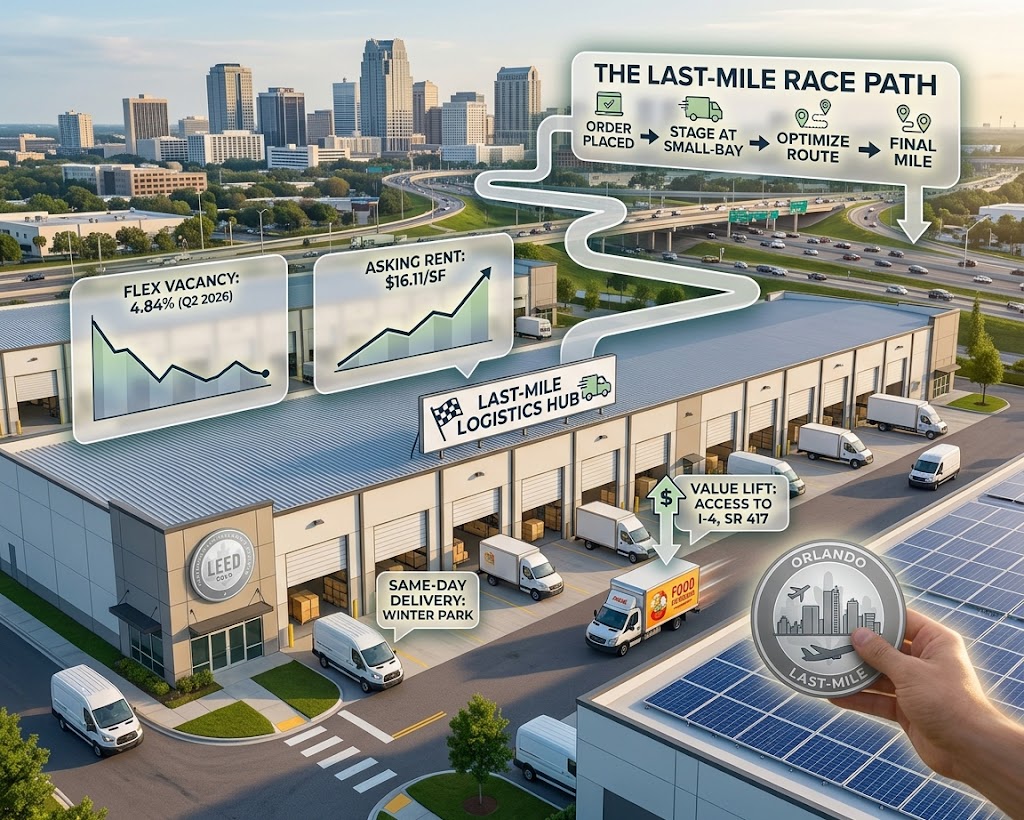
Small industrial warehouse space in Orlando is easiest to find, though rarely cheap, in the infill parks near the airport, in Orlando Central Park, along the 33rd Street and East Side corridors, and in the Lake Mary/Sanford area. Small-bay and flex space is far tighter than the overall market: Lee & Associates put Orlando flex vacancy at 4.84% in Q2 2026, while CBRE had the metro industrial market at 10.6% in Q3 2026.
Key Takeaways
- Two markets in one. Marcus & Millichap put Q2 2026 small-bay vacancy (under 50,000 square feet) in the mid-5% range, versus metro vacancy of 8.4% to 10.6%, depending on the brokerage.
- Small space costs more per foot. Lee & Associates reported Q2 2026 flex asking rates averaging $16.11 per square foot across Orlando, against roughly $10 to $10.50 for the industrial market overall.
- Big-box space is plentiful. Most of the 3 to 4.9 million square feet under construction is bulk distribution space, with little new shallow-bay product.
- Location beats size. Last-mile users are paying for access to I-4, SR 528, SR 417 and Florida’s Turnpike, and for being close to rooftops.
- Investors see it too. Cypress Park, a 99%-leased shallow-bay park near Orlando International Airport, sold for about $56.1 million in July 2026, which works out to roughly $218 per square foot.
What Is Micro-Warehousing, and Why Does Orlando Need It?
Micro-warehousing is loose shorthand for small industrial units close to customers: shallow-bay or flex buildings with suites from a few thousand to a few tens of thousands of square feet, overhead doors and a small office. They sit inside the urban grid, not at the edge of the metro.
Typical tenants are trade contractors, food service distributors, e-commerce sellers, couriers, medical supply firms and small third-party logistics (3PL) companies. A huge regional warehouse can reach much of the Southeast in a day. A same-day delivery to a Winter Park home or a Lake Nona clinic is better served from a small bay a few miles away.
Population growth drives the demand. Census estimates released in March 2026 show the Orlando-Kissimmee-Sanford metro gained 37,690 residents between July 2024 and July 2025, the fastest growth in Florida. More households mean more parcels and service calls, all staged somewhere nearby.
How Tight Is Small-Bay Industrial Space in Orlando Right Now?
Tight, compared with the headline numbers. Brokerages define the market differently, so totals differ, but the pattern is consistent.
Metro-wide figures:
- CBRE (Q3 2026): vacancy was flat at 10.6%. Availability fell 90 basis points to 11.9%. Average asking rent rose to $10.48 per square foot, and net absorption for the quarter was just 25,000 square feet.
- Cushman & Wakefield (Q2 2026): vacancy was 8.4%, down 60 basis points from a year earlier.
- Lee & Associates (Q2 2026, national report): vacancy was 9.9%, with an average NNN asking rate of $10.20.
Small-bay and flex figures:
- Lee & Associates (Q2 2026): total vacancy was 4.84% across 377 flex buildings and about 13.6 million square feet. Flex absorbed a positive 18,093 square feet in the quarter.
- Marcus & Millichap (2Q 2026): vacancy for buildings under 50,000 square feet was in the mid-5% range.
Small-bay is not uniformly strong. Marcus & Millichap reported negative net absorption for sub-50,000-square-foot buildings early in 2026, driven by move-outs from pre-1980 buildings, while newer stock held up. That is a flight to quality within the segment.
Colliers, in a September 2026 commentary, said the move toward well-connected locations is most visible among owner-users and tenants under 100,000 square feet. It also noted smaller 3PLs subleasing excess space taken during the boom years.
Orlando Industrial Market Statistics at a Glance
The table below uses the Lee & Associates Central Florida Q2 2026 report. That report breaks out the overall industrial market and the flex segment by submarket. Rates are direct weighted average asking rates per square foot per year.
| Submarket (Q2 2026) | Total Vacancy | Asking Rate | Flex Vacancy | Flex Rate |
|---|---|---|---|---|
| Airport/Southeast | 9.14% | $10.41 | 3.55% | $16.56 |
| Orlando Central Park | 10.91% | $10.70 | 3.64% | $16.64 |
| Southwest | 4.51% | $12.78 | 7.49% | $20.97 |
| Northwest | 22.76% | $8.59 | 3.10% | $16.36 |
| Longwood/Lake Mary/Sanford | 4.65% | $11.87 | 4.93% | $13.86 |
| East Side | 8.14% | $13.07 | 3.44% | $18.75 |
| 33rd Street | 8.17% | $12.98 | 5.94% | $14.91 |
| Central Orlando | 5.70% | $12.06 | 2.66% | $15.00 |
| Metro flex total | — | — | 4.84% | $16.11 |
Source: Lee & Associates Central Florida, Q2 2026 Market Report.
In most submarkets, flex is fuller than the industrial market around it. Northwest is the extreme case: total vacancy above 22%, flex vacancy of 3.10%. Bulk deliveries pull the overall number up while small, divisible space stays scarce. Flex also carries a premium of roughly 50% to 60% over general industrial rents.
Where Can You Find Small Industrial Warehouse Space in Orlando?
Airport/Southeast Orange
The busiest infill node. Lee & Associates counted 80 flex buildings totaling about 3.2 million square feet, the largest flex inventory in Orlando, at 3.55% vacancy in Q2 2026. Colliers said Southeast Orange led the metro in Q2 absorption at 240,815 square feet. Marcus & Millichap called the area west of the airport, where SR 528, Florida’s Turnpike and Orange Blossom Trail converge, one of the best-connected freight nodes. Cypress Park, a 256,838-square-foot shallow-bay park on Satellite Boulevard, had 26 tenants when it sold.
Orlando Central Park and Southwest Orange
Orlando Central Park, one of the region’s established industrial parks, had 10.91% overall vacancy in Q2 2026 per Lee & Associates, but only 3.64% flex vacancy. Avistone’s purchase of the 108,432-square-foot Presidents Plaza 2 flex park there marked the firm’s first Florida deal. Southwest was the tightest submarket in the Lee report at 4.51% (Colliers put it at 6.7%), with some of the highest rents in the metro.
Seminole County: Lake Mary, Sanford, Longwood
The north I-4 corridor has the second-largest flex inventory in the Lee report, 74 buildings and about 2.7 million square feet, at 4.93% vacancy and the lowest flex rate, $13.86. Cushman & Wakefield put Lake Mary/Sanford vacancy at 3.3% in Q2 2026, with about two-thirds of metro absorption. It is the logical base for serving Seminole and Volusia counties.
East Side and 33rd Street
The East Side had 3.44% flex vacancy and flex rates near $18.75 in Q2 2026. The 33rd Street area holds much of the city’s older, smaller stock, the product most exposed to the pre-1980 move-out trend.
Northwest Orange/Apopka
The place for bulk bargains, not small bays. Overall asking rates were the lowest in the Lee report at $8.59. Colliers reported 12.3% vacancy and slightly negative absorption in Q2 2026, citing less convenient I-4 and beltway access.
Why Is Bulk Vacancy Rising While Small-Bay Stays Tight?
The main reason is the construction pipeline. Lee & Associates counted about 4.24 million square feet under construction in Central Florida in Q2 2026. Of that, 1.86 million was speculative and 2.41 million was build-to-suit. CBRE counted 3.29 million square feet under construction across 29 properties in Q3 2026. Cushman & Wakefield reported 3.09 million square feet under construction in Q2 2026, only 18.3% of it preleased.
That pipeline is mostly large-format logistics. VenturePark Beachline II and III and Mahogany Pointe Logistics Park alone total more than 1.4 million square feet, per WareCRE. Lee & Associates said in Q2 2026 that recent deliveries had temporarily outpaced demand.
Shallow-bay space is hard to build in infill locations: land near the core is expensive and small suites cost more per square foot than one large box. When Avistone bought Presidents Plaza 2, the deal coverage noted that new shallow-bay supply was limited or nonexistent while bulk dominated the pipeline. That still holds.
The result is a two-tier market. Large tenants have leverage: Colliers described a new building marketed at $13 per square foot NNN that could be negotiated to about $11.50 plus free rent. A contractor seeking 8,000 square feet in a good location has far fewer options.
Which Roads and Infrastructure Give the I-4 Corridor Its Edge?
I-4 Ultimate and Beyond
The $2.87 billion I-4 Ultimate project rebuilt 21 miles of interstate from near Universal Orlando to just north of Longwood, adding four tolled express lanes and 15 reconstructed interchanges. FDOT declared it finished in July 2022. The follow-on “I-4 Beyond the Ultimate” program continues, including widening the westbound I-4 ramp to the eastbound Beachline (SR 528), expected to finish in spring 2026, and a new I-4/U.S. 17-92 interchange in Seminole County completed in March 2025.
The Completed Beltway
The final section of the $1.6 billion Wekiva Parkway opened in early 2024, linking SR 429 to SR 417 and I-4 and completing the Central Florida beltway. A van leaving a Sanford or Apopka bay can now circle the metro without crossing downtown.
Toll Roads and the Turnpike
SR 528, SR 408, SR 417 and Florida’s Turnpike tie the airport, downtown and the eastern and western suburbs together. The infill parks with the strongest demand sit near their interchanges.
MCO Air Cargo
The Greater Orlando Aviation Authority’s long-term vision, adopted in October 2025, calls for at least one new cargo processing facility. MCO serves 60 international markets, and widebody growth adds belly cargo capacity, which supports forwarder demand for nearby small bays.
What Are Small-Bay and Flex Rents in Orlando?
Rents depend heavily on the type of building. In Q2 2026, the Lee & Associates figures were:
- General industrial: direct asking rates ranged from $8.59 per square foot in Northwest to $14.61 in North Central.
- Flex: direct asking rates ranged from $13.86 in Longwood/Lake Mary/Sanford to $20.97 in Southwest, with a metro average of $16.11.
Colliers reported a Central Florida industrial asking rent of $12.56 per square foot NNN in Q2 2026. CBRE’s metro average was $10.48 in Q3 2026, up from $8.40 five years earlier but below its $10.99 peak in Q2 2023.
Budget for operating expenses and insurance on top of NNN rates, and expect less free rent than big-box tenants are getting.
Brian’s Take
When I managed money, I wanted assets that are hard to replace and serve demand that keeps showing up. Orlando’s small-bay parks fit that description better than almost anything else in local commercial real estate.
The bulk market is in a normal supply hangover. It will clear as completions slow, but land along the Beachline and in Polk County is plentiful, and the next wave will come quickly once rents rise. Shallow-bay space is different. The land close to Orlando’s population has already been used, and new projects can’t compete with residential and mixed-use buyers bidding for the same parcels. That is a real supply constraint, and it isn’t going away.
I would not, however, treat every small building as a good bet. The Marcus & Millichap data on move-outs from pre-1980 buildings matters. Tenants are paying for clear height, truck courts and highway access, not just square footage near downtown. An older building with low ceilings on a congested street is a value-add project, not a core holding.
For tenants, my advice is simple: renew early if you’re in a well-located small bay you like, and don’t assume the high headline vacancy numbers will give you negotiating leverage. They mostly reflect big buildings, not yours.
Frequently Asked Questions
Where is the best place to rent small warehouse space in Orlando?
It depends on your customers. Airport/Southeast Orange and Orlando Central Park have the deepest supply of small bays and broad metro reach. For Seminole and Volusia counties, Lake Mary/Sanford/Longwood had the lowest flex rents in the Lee & Associates Q2 2026 report, at $13.86 per square foot. Close-in users also look at 33rd Street and the East Side.
How much does small-bay or flex warehouse space cost in Orlando?
Lee & Associates reported an average flex direct asking rate of $16.11 per square foot in Q2 2026, ranging from $13.86 in the Lake Mary/Sanford area to $20.97 in the Southwest submarket. General industrial space is cheaper, averaging about $10 to $10.50 per square foot metro-wide according to CBRE and Lee. Operating expenses are additional on NNN leases.
Is Orlando industrial vacancy rising or falling?
It depends on the source and the segment. CBRE reported 10.6% vacancy in Q3 2026, unchanged from Q2, while availability fell to 11.9%. Cushman & Wakefield reported 8.4% in Q2 2026, down 60 basis points year over year. Small-bay and flex vacancy is much lower, in the 4.8% to mid-5% range in Q2 2026 reports.
Why are small industrial spaces harder to find than large warehouses?
Most new construction in Central Florida is bulk distribution space. Infill land is expensive, and multi-tenant shallow-bay buildings cost more per square foot to build, so developers seldom start them. Meanwhile, demand from contractors, e-commerce sellers and delivery firms grows with the metro’s population.
Is the I-4 Ultimate project finished?
Yes. FDOT declared the 21-mile, roughly $2.87 billion I-4 Ultimate project complete in July 2022. Related work under the separate “I-4 Beyond the Ultimate” program is continuing, including interchange and ramp improvements in Orange and Seminole counties. The Wekiva Parkway, which completed the Central Florida beltway, opened its final section in early 2024.
Is Orlando small-bay industrial a good investment?
For newer, well-located product, investor demand is strong. Cypress Park, a 99%-leased shallow-bay park west of Orlando International Airport, sold for about $56.1 million in July 2026, roughly $218 per square foot, after drawing multiple bids. Older buildings carry more risk: Marcus & Millichap reported tenant move-outs concentrated in pre-1980 small-bay stock in early 2026.
Sources and Further Reading
- CBRE: Orlando Industrial Figures Q3 2026
- Lee & Associates: 2026 Q2 Orlando, FL Industrial
- Lee & Associates Central Florida: Q2 2026 Market Report
- REBusinessOnline: Orlando Industrial Demand Is Concentrating in the Right Places
- Cushman & Wakefield: Orlando MarketBeats
- WareCRE: Orlando Warehouse Market Report
- Marcus & Millichap: Orlando 2Q26 Industrial Market Report
- Hoodline: Miami Money Snaps Up Orlando Warehouse Park in $56 Million Airport Play
- GrowthSpotter: Avistone Buys Presidents Plaza 2 in Orlando Central Park
- WFTV: FDOT I-4 Ultimate Construction Officially in the Rearview
- Roads & Bridges: Orlando’s Ultimate Improvement Project
- I-4 Beyond the Ultimate: December 2025 Update
- Action News Jax: Final Stretch of Wekiva Parkway Opens, Completing Central Florida Beltway
- Aviation Pros: MCO Lays Groundwork to Expand Air Cargo Activity
- Florida Phoenix: Census Data Show Population Increases in Orlando