By Brian French | Orlando Business News | October 22, 2026
Quick Answer
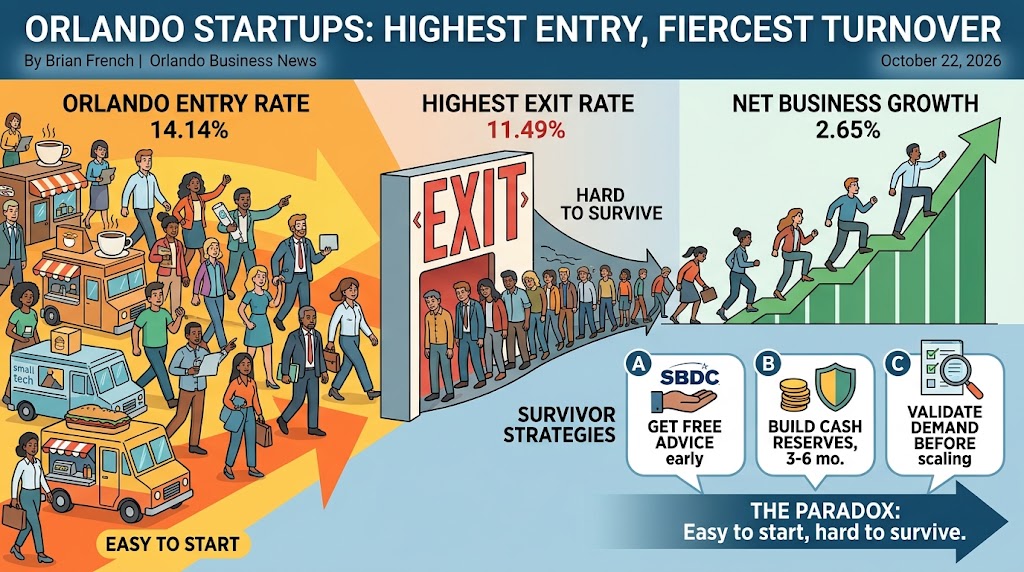
Orlando now has the highest business entry rate of any major U.S. metro studied, at 14.14%, but also the highest exit rate, at 11.49%, leaving net growth of 2.65%. In plain terms, the region is easy to start in and hard to survive in. Founders who last tend to validate demand before scaling, hold cash reserves sized for volatile months, avoid oversaturated consumer categories, and use the region’s free advisory network early rather than after trouble hits.
Key Numbers at a Glance
| Metric | Figure |
|---|---|
| Orlando business entry rate | 14.14% (highest studied) |
| Orlando business exit rate | 11.49% (highest studied) |
| Orlando net business growth | 2.65% |
| Florida entry rate (state) | 13.11% (highest state) |
| Florida new entities, H1 2026 | 389,997 (+10.6%) |
| Florida dissolutions, H1 2026 | 80,755 (+14.9%) |
| U.S. five-year survival rate | ~51% |
The Paradox: First in Starts, First in Exits
Orlando has spent years topping “best place to start a business” lists. A new analysis adds the other half of the story.
Squarespace’s study of U.S. Census Bureau Business Dynamics Statistics found Orlando recorded a business entry rate of 14.14%, the highest of the metros examined, and also the highest exit rate at 11.49%, producing a net growth rate of 2.65%. The data was current as of June 22, 2026.
The comparison is instructive. Hartford, Connecticut topped the overall ranking with a 13.11% entry rate, an 8.42% exit rate and 4.69% net growth, outpacing Orlando on net growth even though Orlando’s raw entry rate was higher. Austin, Nashville, Raleigh and San Antonio rounded out the top five.
That’s the core insight. Orlando isn’t short on founders. It’s short on survivors relative to how many companies start. A market with fewer starts and fewer failures can actually produce more durable net growth.
Florida as a whole shows the same pattern. The state posted the highest business entry rate among all states at 13.11%, but also the second-highest statewide exit rate at 10.91%. The researchers concluded that fast-growing markets often see substantial turnover as new companies enter and reshape the local economy.
The Formation Wave Is Still Building
Florida’s filing numbers keep climbing. According to state filing data compiled by business-intelligence firm sneyk, Florida registered 389,997 new business entities in the first half of 2026, up 10.6% from 352,476 a year earlier.
Monthly records have fallen repeatedly. Registered Agents Inc reported that February 2026 set a Florida record with 69,531 new business formations in a single month. In June, Florida again recorded more new formations than any other state, at more than 64,000.
Central Florida is a big share of that activity. Orange, Seminole, Osceola and Lake counties together hold roughly 870,960 active business entities, or 11.2% of Florida’s total.
The Exit Side Is Growing Faster
Here’s the number that gets less attention. Florida recorded 80,755 dissolutions in the first half of 2026, up 14.9% from 70,303 a year earlier. Dissolutions grew faster than formations.
There’s also reason to read formation headlines with care. The same dataset found that excluding Pinellas County, where a formation service’s mailing address inflates counts, Florida’s July formation growth was essentially zero. And July 2026 was the slowest month of the year, with growth of just 2.0%.
Not every filing is a real operating business, either. Many LLCs are holding companies, single-property real estate entities or side projects. That’s one reason state filing counts run far higher than the Census Bureau’s employer business data.
Why Orlando Churns So Hard
High entry and high exit together usually point to a few structural forces. In Orlando, four stand out.
1. Low Barriers and High Visibility
Orlando’s tourism economy, population growth and lack of a state income tax make starting a business feel low-risk. The Blink ranking of midsized U.S. cities for small-business growth counted 1,997 new retail businesses and 6,746 new food-and-hospitality businesses in the Orlando area, along with 6.1% average employment growth.
Retail and hospitality are exactly the categories where turnover runs hottest nationally. When thousands of new restaurants, cafes and shops open in a single metro, many are competing for the same customers in the same corridors.
2. Population Growth Masks Saturation
Fast population growth creates real demand, but it can also hide oversupply. A neighborhood that gains 5,000 residents might support one new coffee shop, not four. Founders who see growth headlines and assume demand is unlimited can misjudge local saturation.
3. Rising Operating Costs
The Orlando Economic Partnership’s Q2 2026 survey found cost pressures overtook political and economic uncertainty as the challenge most commonly cited by local businesses. Insurance, commercial rent, labor and inputs all hit young businesses hardest because they lack pricing power and cash cushions.
4. Volatile, Seasonal Demand
Tourism-linked businesses ride seasonal and event-driven swings. Orange County’s tourist development tax collections set records for 14 straight months before flattening in June 2026. A business built around peak-season revenue can struggle when demand normalizes.
What the National Survival Data Says
To put Orlando’s exit rate in context, it helps to know the baseline. According to Bureau of Labor Statistics cohort data through March 2025, about 22.1% of new establishments close within one year, 48.6% within five years and 65.3% within ten.
The pattern over time matters more than any single number. Failure roughly doubles between year one and year two, then slows considerably after that. Years two through five are where most businesses that will fail actually do.
Industry matters too. Health care establishments survive five years at 55.5%, compared with 46.8% for transportation and warehousing.
The takeaway for Orlando founders: the first year isn’t the cliff. The real danger zone is years two through five, when initial capital runs out, early customers churn and owner burnout sets in.
Strategies for Early-Stage Longevity
Survival isn’t luck. The businesses that make it through Orlando’s churn tend to share a handful of habits.
Validate Demand Before You Scale
The most expensive mistake is building something nobody will pay for. Orlando’s StarterStudio accelerator, led by Dawn Haynes, teaches founders to test demand and win customers before raising money, and its most useful lesson may be knowing which ideas to stop pursuing. The practical habit: separate what you believe from what a customer has actually told you, and get paying customers before signing long leases or hiring.
Pick Categories With Room
Before opening, count competitors within a realistic service radius and look at their reviews, hours and pricing. If five similar businesses opened in the past two years, find out how many are still there. Orlando’s retail and food sectors show the highest entry volumes, which means they’re also where the competition is fiercest.
Favor Recurring Revenue
Subscription, contract and repeat-service revenue smooths out the swings that kill young businesses. A cleaning company with 40 monthly commercial contracts is far more resilient than one relying on one-time residential jobs. B2B service models also tend to be less exposed to tourism seasonality.
Build the Cushion Before You Need It
Many businesses that fail weren’t unprofitable. They ran out of cash during a slow stretch.
Managing Cash Flow in a High-Growth Market
Cash-flow discipline matters even more in a fast-growing market, because growth itself consumes cash. More customers mean more inventory, more payroll and more receivables before the money comes in.
A Practical Cash Framework
| Practice | Why It Matters |
|---|---|
| 13-week cash forecast | Spots shortfalls before they hit |
| 3 to 6 months of reserves | Covers seasonal and slow months |
| Tight receivables terms | Speeds cash conversion |
| Credit line before you need it | Lenders prefer healthy borrowers |
| Separate tax account | Avoids surprise liabilities |
Run a rolling 13-week cash forecast. Update it weekly. It shows when payroll, rent, taxes and insurance renewals will collide with slow receivables.
Size reserves to your seasonality. A tourism-exposed business with sharp summer-to-fall swings needs a larger cushion than a B2B firm with steady contracts.
Shorten the cash cycle. Invoice immediately, require deposits on large jobs, offer small discounts for fast payment and follow up on overdue accounts weekly.
Arrange credit while you’re healthy. Banks are far more willing to extend a line of credit to a business with strong recent numbers than one already in distress.
Watch fixed-cost commitments. Long leases and big equipment purchases signed during a strong quarter are the most common trap. Variable costs can be cut. Fixed costs can’t.
Stress-test pricing. If insurance, rent or labor rises 15%, can your margins absorb it? If not, raise prices gradually now rather than all at once later.
Leveraging Orlando’s Economic Development Network
One reason Orlando founders shouldn’t go it alone is that the region has one of the strongest free advisory networks in the country.
Florida SBDC at UCF
The U.S. Small Business Administration named the Florida Small Business Development Center at UCF the 2026 National SBDC of the Year, selecting it from roughly 1,000 centers nationwide. Over the past decade it has supported more than 15,500 businesses through more than 206,700 hours of consulting.
The center is located in the National Entrepreneur Center inside Orlando Fashion Square, and business owners can access seminars and no-cost one-on-one consulting at the main office and six service centers. Specialized services for qualifying businesses include growth acceleration, capital access, international trade, government contracting and business continuation.
The National Entrepreneur Center
The NEC co-locates multiple service providers in one place, including the Hispanic Business Initiative Fund, Orange County Government, SCORE, the UCF Business Incubation Program and others. It also hosts partners like the African American Chamber of Commerce, the Hispanic Chamber of Commerce of Metro Orlando and the National Association of Women Business Owners Orlando chapter.
UCF Business Incubation Program
For technology and innovation-driven companies, UCF’s Business Incubation Program has supported more than 1,000 companies in the region over the past 25 years.
StarterStudio
StarterStudio is an Orlando nonprofit that runs Idea, Build and Pre-Seed accelerator stages, reports supporting more than 410 startups since 2015, and was ranked No. 73 on TIME’s 2026 list of America’s Best Incubators and Accelerators. As a 501(c)(3), it doesn’t take equity or charge market-rate fees. Its evergreen fund advertises a possible $25,000 investment for eligible graduates.
Ecosystem Resources at a Glance
| Resource | Best For | Cost |
|---|---|---|
| Florida SBDC at UCF | Planning, finance, growth | Free consulting |
| SCORE | Mentorship | Free |
| UCF Business Incubation | Tech and innovation firms | Program-based |
| StarterStudio | Tech startups | Nonprofit, no equity |
| Local chambers | Networking, referrals | Membership |
Capital: Available, But Selective
Orlando’s venture scene is growing but remains smaller than its formation numbers might suggest. One investor guide estimates Orlando raised $743 million across 132 deals in 2025, about 35% less than Miami.
Local capital tends to favor sectors where Orlando has an edge: simulation, defense, health tech and hospitality technology. The same guide notes that pure SaaS companies without Orlando connections can struggle to raise locally.
The practical lesson: most Orlando businesses won’t raise venture capital, and shouldn’t try. SBA loans, community lenders, revenue-based financing and customer-funded growth are the realistic paths for the vast majority of new businesses.
The Business Climate Right Now
Founders launching in late 2026 face a mixed backdrop. The Orlando Economic Partnership found local business confidence fell to a two-year low in Q2, with just 35% of surveyed businesses confident in the U.S. economy. Yet 55% reported increased revenue and 50% reported improved profitability.
Even with that caution, businesses continued to forecast growth and identified finding new clients as their top opportunity. That’s a market where demand exists but customers are scrutinizing every purchase, which rewards businesses with clear value and punishes those relying on novelty.
The labor market remains supportive. Orlando added 20,600 jobs over the past 12 months, more than Miami, Tampa and Jacksonville combined. That supports consumer spending, but it also means competition for good employees.
Brian’s Take
Orlando’s entry and exit numbers are two sides of the same coin. A market this easy to enter will always attract a lot of businesses that shouldn’t have opened, and the exit rate is partly the market sorting that out. That’s not a crisis. It’s how dynamic economies work. But it does mean the “Orlando is the best place to start a business” headline is only half true. It’s the best place to start. It’s an ordinary place to survive. The founders who make it here usually do three unglamorous things: they prove customers will pay before they sign a lease, they keep months of cash in the bank, and they use the free help sitting at the National Entrepreneur Center before they’re desperate. If I were starting a business in Orlando today, I’d avoid crowded consumer categories, look hard at B2B services where recurring contracts are possible, and walk into the SBDC in month one, not month eighteen.
Frequently Asked Questions
Why does Orlando have such a high business exit rate?
High entry and high exit tend to go together. Orlando’s low barriers, fast population growth and heavy concentration of new retail and hospitality businesses create intense local competition, while rising costs and seasonal tourism demand pressure young firms.
Is Orlando still a good place to start a business?
Yes. Orlando has the highest entry rate of the metros studied and positive net business growth of 2.65%. The opportunity is real, but founders should plan for heavy competition.
What percentage of new businesses fail?
Nationally, about 22% of new establishments close within one year and roughly 49% within five years, according to BLS cohort data.
Where can Orlando entrepreneurs get free business help?
The Florida SBDC at UCF offers no-cost consulting at the National Entrepreneur Center in Orlando Fashion Square, alongside SCORE mentoring and other partner organizations.
How much cash should a new Orlando business keep in reserve?
A common guideline is three to six months of operating expenses, with larger reserves for businesses exposed to tourism seasonality or volatile demand.
Which Orlando startup sectors attract investors?
Local investors tend to focus on simulation, defense technology, health tech and hospitality technology, where Orlando has established industry strengths.
Sources and Further Reading
- “New analysis finds Orlando has highest business entry rate of 14.14%,” WFTV
- “Orlando Business Entry Rate Highest in US, Study Finds,” Hoodline, August 17, 2026
- “Orlando Tops Midsized U.S. Cities for Small-Business Growth,” Hoodline, July 29, 2026
- “Florida Business Formations: The H1 2026 Report,” sneyk
- “Florida Business Formations Grew 2% in July 2026,” sneyk
- Registered Agents Inc February 2026 Business Formation Report, via PR Newswire
- “Over 64,000 new businesses formed in Florida during June,” WFTV
- “The Orlando Economy at Midyear: 5 Things to Know,” Orlando Economic Partnership, July 23, 2026
- Business Employment Dynamics establishment survival data, U.S. Bureau of Labor Statistics, as compiled by StartBusinessByState and Review42
- “UCF Hub Named 2026 National Small Business Development Center of the Year,” University of Central Florida