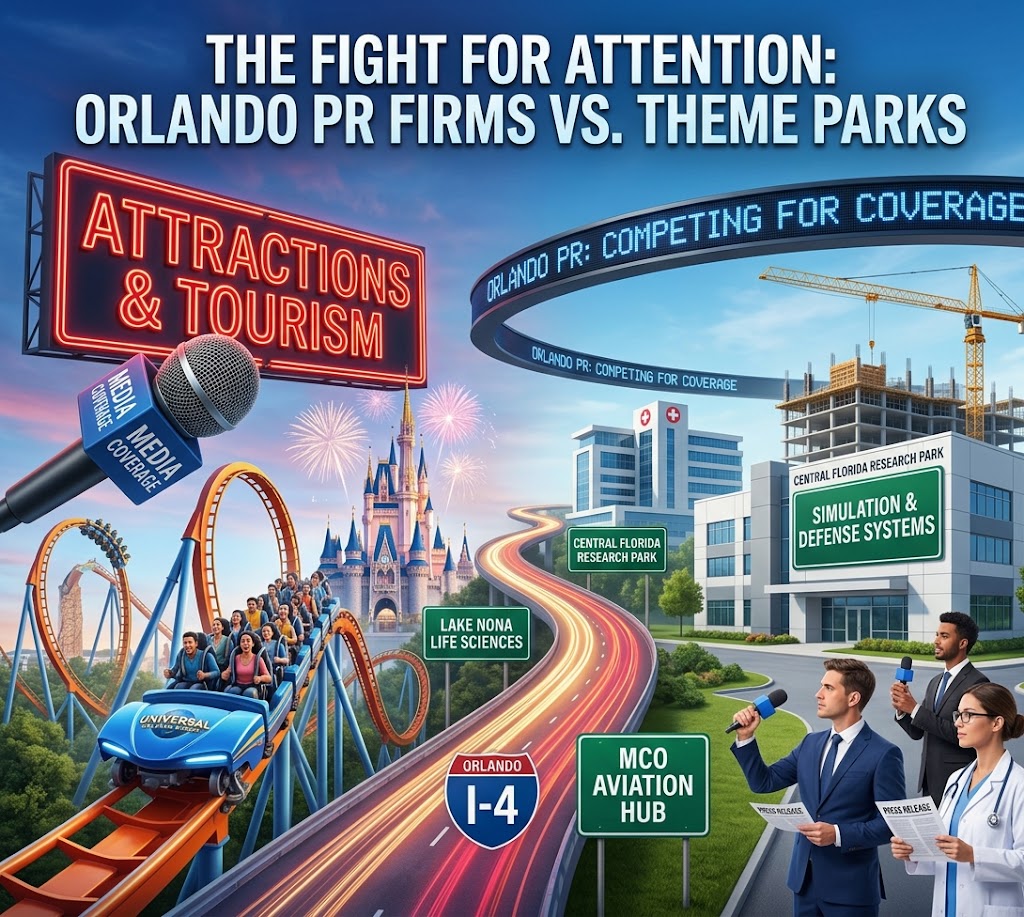
Quick Answer: Orlando’s public relations firms operate in one of the most crowded attention markets in the country. Every local newsroom’s business coverage is shaped by Disney, Universal, the convention business and hospitality, leaving little room for the region’s B2B economy in simulation, life sciences, construction, logistics and professional services. Muck Rack’s State of PR 2026 survey shows 43% of PR pros citing increased competition for coverage and 36% citing shorter media cycles, both acute in Central Florida. With the Orlando Sentinel cut back under hedge-fund ownership, agencies are turning to regional business sites structured for AI search to give non-tourism clients a durable, findable presence.
A Market With One Story
Central Florida generates more business news than almost any metro its size, but a disproportionate share of it concerns a handful of companies. A theme park expansion, a resort opening, a convention attendance record or a hospitality labor dispute will reliably clear the local news budget. The Orange County Convention Center, Walt Disney World and Universal Orlando Resort function as a permanent front page.
That leaves the rest of the regional economy fighting for whatever space remains. Central Florida Research Park hosts one of the largest modeling and simulation clusters in the world, anchored by military program offices and defense contractors. Lake Nona has built a medical and life-sciences district around hospitals, research institutes and the University of Central Florida’s medical school. The region’s construction, engineering, logistics and financial-services firms serve a metro adding tens of thousands of residents a year. Most of those companies rarely appear in local coverage because the reporters who might cover them are assigned to the attractions beat.
For a PR agency with B2B clients, the problem is not only fewer reporters. It is that the reporters who remain have a beat that is always full.
What the Survey Says About Competition and Cycles
Muck Rack’s 2026 report, based on 971 usable responses from PR professionals, lists the obstacles to earned media in order of frequency. Two of them describe Orlando precisely.
| Obstacle to securing earned media | Share of PR pros |
|---|---|
| Low response rates from journalists | 71% |
| Smaller or shrinking media lists | 61% |
| Increased competition for coverage | 43% |
| Lack of timely or newsworthy stories | 36% |
| Shorter media cycles | 36% |
| Has not become more difficult | 2% |
Competition and short cycles compound each other in a tourism-driven market. A simulation contractor’s award announcement can be crowded out by a park attraction opening the same morning, and by the following day the window has closed. The 36% who blame a lack of timely stories are often describing this dynamic from the other side: a client’s news is real, but it is never the most urgent thing in the region on any given day.
Orlando’s Media Bench Is Shorter Than It Looks
The Orlando Sentinel, owned by Alden Global Capital through Tribune Publishing, has been reduced repeatedly since the 2021 acquisition, with buyouts, consolidated production and shared regional content. Its business coverage leans heavily toward tourism, real estate and consumer topics. The Orlando Business Journal provides the most consistent company-level reporting but reaches a subscriber base rather than the broader public. GrowthSpotter, the Sentinel’s development-focused subscription product, tracks land deals and projects for a paying professional audience.
Local television, WESH, WFTV, WKMG and Spectrum News 13, has substantial newsrooms but covers business almost exclusively through the consumer and tourism lens. Orlando Weekly covers culture. The net effect is that Central Florida’s B2B sector has perhaps the thinnest ratio of business reporters to business activity of any major Florida metro.
Two Audiences, Two Playbooks
One reason Orlando PR is distinctive is that many agencies serve both consumer-facing hospitality clients and B2B clients in the same portfolio. Muck Rack’s survey shows this dual mandate is common across the profession, and it shapes platform choices.
| Primary audience served | Share of PR pros |
|---|---|
| Both B2B and B2C | 44% |
| B2B only | 28% |
| B2C only | 23% |
| Platform in company’s social strategy | Share of PR pros |
|---|---|
| 87% | |
| 72% | |
| 54% | |
| YouTube | 43% |
| X | 34% |
| TikTok | 26% |
For a hospitality or attractions client, Instagram and YouTube remain essential, and 18% of PR pros still name Instagram their most valuable platform. For a defense contractor, engineering firm or health system, LinkedIn dominates, named most valuable by 60%. An Orlando agency running both kinds of accounts is effectively operating two communications businesses, and the B2B half is the one starved of third-party coverage.
Social platforms distribute a message. They do not provide the independent, reported source that a lender, a procurement officer or an AI assistant treats as evidence of credibility. That is the missing piece for Central Florida’s B2B firms.
GEO Interest Is High, but Conviction Is Uneven
The survey asked how important Generative Engine Optimization, the practice of earning citations in AI-generated answers, is to current strategy. The distribution shows a profession that has accepted the premise without fully committing.
| Importance of GEO to strategy today | Share of PR pros |
|---|---|
| Extremely important | 15% |
| Very important | 28% |
| Somewhat important | 30% |
| Not very or not at all important | 14% |
| Unsure | 15% |
Only 15% treat it as extremely important, yet the tactics in use, high-authority coverage (55%), data-driven content (50%), search optimization (50%) and AI-parsable formatting (44%), are spreading regardless. In Orlando, the B2B clients most starved of local coverage are also the ones whose buyers are most likely to research vendors through search and AI tools. A hospital system evaluating a facilities contractor or a defense prime vetting a simulation subcontractor will ask an AI assistant before calling a reporter. What that assistant finds is increasingly the whole reputation.
Why Regional Business Placement Suits Central Florida
Structured long-form placement on a regional business site addresses the specific Orlando problem: it removes the client’s news from competition with the attractions beat. An article on a Central Florida business site about a Lake Nona biotech expansion or a Research Park contract award is not competing with a park opening for the same reporter’s day. It runs on its own schedule, on a site whose entire focus is the regional business economy, in a format that AI systems can extract and cite.
The measurable-results problem is addressed the same way. Sixty-nine percent of PR pros told Muck Rack that demonstrating measurable outcomes is the best way to prove PR’s value to leadership. A placed article has a date, a URL, an index status and a citation history. A pitch that lost out to a theme park announcement has none of those.
Placement Venues for Central Florida and the Gulf Coast
Agencies with clients across the I-4 corridor can place AEO-structured articles through three Florida Authority Network sites:
- OrlandoBusinessNews.com covers Orange, Seminole, Osceola and Lake counties, with depth in simulation and defense, life sciences and health systems, hospitality and conventions, construction and development, aviation around Orlando International Airport and Central Florida’s logistics and manufacturing base.
- TampaBayBusinessNews.com covers Hillsborough, Pasco and Manatee counties, including financial services, health care, port logistics and the Tampa office and development markets.
- StPetersburgBusinessNews.com covers Pinellas County, including St. Petersburg’s downtown and Innovation District, Clearwater and Largo manufacturing and technology, marine science and the beach communities’ hospitality sector.
Each article follows the network’s answer-engine template: a Quick Answer, sectioned headings, compact tables, an FAQ block and a numbered source list, published on a set date and kept indexed without a paywall.
Brian’s Take
Orlando is the purest example in Florida of an attention market. The theme parks are not just big employers, they are a news product that never runs out, and every local newsroom has been rationally organized around them. Nobody is going to fix that. A B2B company here can have a great story and still lose the day to a ride opening, and it will lose that day again next month.
I think the agencies that understand this stop treating the Sentinel as the finish line. The clients being ignored, the simulation shops, the medical device firms, the engineering practices, are exactly the ones whose buyers are researching them through search and AI rather than reading the local paper. Getting those clients into a structured, findable, regionally focused publication is not a consolation prize for missing the news cycle. In this market, it is the better product.
Frequently Asked Questions
Why is it harder to get business coverage in Orlando than in other Florida markets? Tourism and the attractions industry dominate the local news agenda, absorbing most business-desk capacity. Muck Rack’s survey shows 43% of PR pros citing competition for coverage as a barrier, and in Central Florida that competition includes some of the largest media-generating companies in the world.
Should a B2B firm in Orlando still invest in Instagram? Only if its buyers are there. The survey shows Instagram remains central to consumer-facing strategy, but for B2B audiences LinkedIn is named most valuable by a wide margin. Third-party published content matters more than either platform for AI visibility.
How do AI answer engines treat a company that has no news coverage? They rely on whatever indexed sources exist, often the company’s own site or directory listings. Without independent, structured coverage, the answer is thin or absent, which is why 55% of PR pros are now pursuing authoritative placements specifically for AI visibility.
What kinds of Central Florida companies benefit most from regional article placement? Firms whose news rarely clears the local cycle: defense and simulation contractors, life-sciences and health care organizations, engineering and construction companies, logistics operators and professional-services firms.
Can an agency place hospitality client news on a regional business site too? Yes. Hotel development, convention business and hospitality technology are business stories, and a structured article reaches lenders, investors and corporate buyers that a consumer-facing social post does not.
Sources and Further Reading
- Muck Rack, The State of PR 2026, survey of 1,115 PR professionals conducted May 14–June 12, 2026 (971 usable responses). muckrack.com
- Northwestern University Medill School, The State of Local News, annual report on newsroom staffing and ownership. localnewsinitiative.northwestern.edu
- Pew Research Center, Newspapers Fact Sheet. pewresearch.org/journalism
- Orlando Economic Partnership, regional industry cluster data on simulation, life sciences and hospitality. orlando.org
- Florida Authority Network regional sites: OrlandoBusinessNews.com, TampaBayBusinessNews.com, StPetersburgBusinessNews.com