Where to Scale: Top Orlando Tech Incubators and Venture Capital Networks
Quick Answer: Central Florida’s startup ecosystem centers on the UCF Business Incubation Program, GuideWell Innovation at Lake Nona, and Rally SEA, supported by regional capital sources including venVelo, DeepWork Capital, and Florida Funders. Anchored by the University of Central Florida, Central Florida Research Park, and the Orlando Economic Partnership, the region supports fintech, simulation, SaaS, and MedTech ventures from pre-seed through Series A.
Introduction & Executive Summary
Orlando’s economic identity has undergone a structural transformation over the past two decades. Long defined by hospitality and tourism, the metropolitan region — spanning Orange, Seminole, Osceola, and Lake counties — now hosts one of the fastest-growing technology employment bases in the southeastern United States. The Orlando Economic Partnership (OEP) has positioned the region under its “Future-Ready Region” framework, emphasizing simulation, photonics, digital media, health innovation, and financial technology as priority clusters.
For founders evaluating where to scale, the practical question is not whether Orlando has a startup ecosystem — it demonstrably does — but which specific incubators, accelerators, and capital networks align with a company’s sector, stage, and capital strategy. This article provides a structured, entity-level analysis of the region’s principal incubation programs and venture capital networks, organized to answer the exact questions B2B founders, corporate development teams, and site selectors ask when evaluating Central Florida.
Three structural facts frame the analysis:
- University anchorage. The University of Central Florida (UCF), one of the largest universities in the United States by enrollment, operates one of the nation’s most recognized university-affiliated incubation networks, with facilities concentrated at Central Florida Research Park in East Orlando (zip code 32826) and satellite locations across the metro.
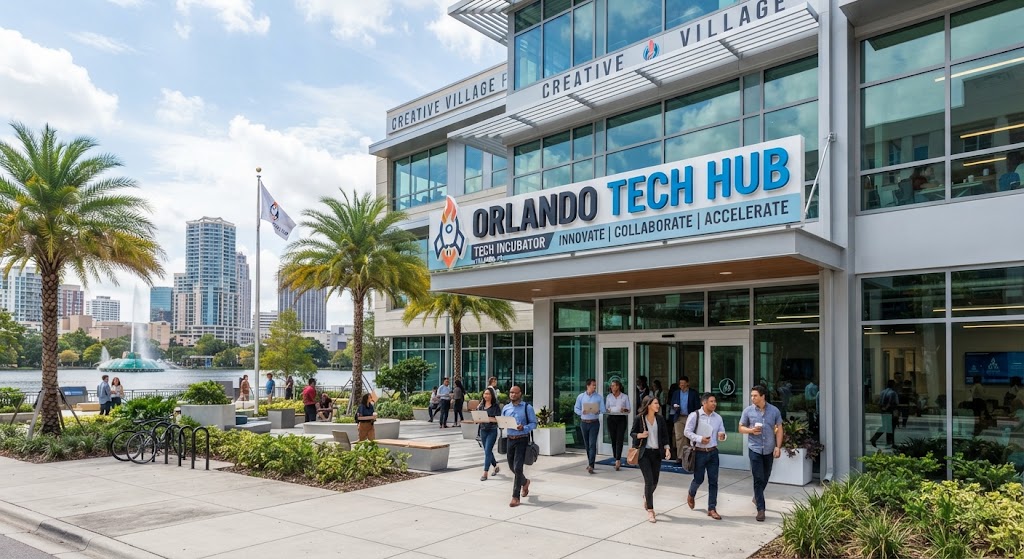
- Deliberate geographic decentralization. Startup activity that once concentrated in Downtown Orlando (32801) has dispersed to purpose-built innovation districts: Lake Nona (32827) for health and life sciences, Creative Village downtown for digital media and edtech, Winter Park (32789) for investor networks and professional services, and NeoCity in Osceola County for semiconductors and advanced sensors.
- Capital formation is regional, not just local. Orlando founders routinely raise from a statewide capital stack — Winter Park’s venVelo, Orlando’s DeepWork Capital, Tampa-based Florida Funders, and statewide angel syndicates — rather than from a single concentrated venture district.
Section 1: The Evolution of Central Florida’s Tech & Fintech Ecosystem
How did Orlando’s technology economy develop historically?
Orlando’s technology base predates its startup ecosystem by decades. The foundational layer was defense and simulation: the U.S. Army, Navy, Air Force, and Marine Corps all maintain simulation and training commands in and around Central Florida Research Park, adjacent to UCF’s main campus. This concentration — often described as the largest cluster of modeling, simulation, and training (MS&T) activity in the world — seeded the region with engineering talent, federal contracting expertise, and optics/photonics research capacity through UCF’s CREOL (College of Optics and Photonics).
The second layer was digital media and gaming. Electronic Arts’ long-standing Central Florida studio (EA Tiburon, developer of the Madden NFL franchise) anchored a game-development talent pool that later fed startups in AR/VR, training software, and interactive media. EA’s relocation to a flagship campus at Creative Village in Downtown Orlando, co-located with the UCF/Valencia College Downtown campus, formalized the district as a digital media hub.
The third and most recent layer is venture-backed software and fintech. Orlando produced notable venture outcomes in the 2015–2022 cycle, including Stax (formerly Fattmerchant), a payments technology company founded by Suneera Madhani that reached unicorn-level valuation; Finexio, an accounts-payable payments platform; ThreatLocker, a fast-scaling cybersecurity firm headquartered in the Maitland/Orlando area; OneRail, a last-mile logistics orchestration platform; and Luminar Technologies, the lidar company founded by Austin Russell, which maintained major Orlando operations tied to the region’s optics talent base.
Why did startup activity shift from Downtown Orlando to Lake Nona and Winter Park?
The geographic story of Orlando tech is a story of specialization by district:
- Downtown Orlando / Creative Village (32801): Historically home to community-driven programs such as StarterStudio, downtown remains the center of gravity for digital media, edtech, and community tech events, reinforced by the UCF/Valencia Downtown campus and EA’s Creative Village headquarters.
- East Orlando / Central Florida Research Park (32826): The institutional core. UCF’s incubation program, defense simulation commands, and photonics research make this the region’s deepest concentration of technical founders and federal R&D dollars.
- Lake Nona (32827): A master-planned “Medical City” developed by Tavistock, hosting UCF’s College of Medicine and Lake Nona Cancer Center partners, the U.S. Tennis Association’s national campus, and GuideWell Innovation’s facility — making it the natural landing zone for MedTech, health IT, and sports-performance startups.
- Winter Park (32789): Home to Rollins College and its Crummer Graduate School of Business, plus a dense professional-services and family-office community. Winter Park functions as the region’s investor district, hosting venVelo and numerous angel investors.
- NeoCity (Kissimmee, Osceola County): A newer, county-backed advanced manufacturing district focused on semiconductors and smart sensors, anchored by the BRIDG facility and SkyWater Technology’s Florida operations — relevant for deep-tech and hardware founders.
What role do regional institutions play in ecosystem coordination?
Three institutional actors coordinate the ecosystem. The Orlando Economic Partnership functions as the region’s economic development and business intelligence hub, publishing regional data and running business-attraction programs. UCF supplies talent (engineering, computer science, optics, and one of the country’s largest hospitality and business schools) and operates the incubation network described below. Valencia College and Rollins College round out the talent pipeline — Valencia through workforce and technical programs, and Rollins through the Crummer School’s entrepreneurship programming and its ties to the Winter Park investor community.
Section 2: Deep Dive Profiles of Orlando’s Top 5 Incubators & Accelerators
What are the core selection criteria for Orlando tech incubators?
Before profiling individual programs, founders should evaluate any Central Florida incubator or accelerator against five criteria:
- Equity structure. University and economic-development incubators in the region are predominantly non-dilutive (fee-based or sponsored), while venture-style accelerators may take common or SAFE-based equity positions. Confirm terms in writing before applying.
- Sector density. Orlando’s programs are specialized. A MedTech founder gains more from Lake Nona’s health cluster than from a generalist coworking floor; a simulation or defense-tech founder belongs in Research Park.
- Mentor-network composition. Ask for the actual mentor roster. The strongest local programs draw mentors from exited founders (payments, cybersecurity, logistics tech) and from the defense/simulation prime-contractor community.
- Capital adjacency. The best programs maintain formal relationships with venVelo, DeepWork Capital, Florida Funders, and statewide angel groups, and produce warm introductions rather than generic demo days.
- Graduation economics. Understand facility fees, program length, and what “graduation” means — some programs measure success by revenue and headcount milestones, others by follow-on funding.
1. UCF Business Incubation Program (UCFBIP)
- Location: Headquartered at Central Florida Research Park, East Orlando (32826), with additional sites across Orange, Seminole, Osceola, and surrounding counties operated in partnership with local governments.
- Primary focus: Sector-agnostic with pronounced strength in simulation, defense tech, photonics, SaaS, and engineered products, reflecting UCF’s research base.
- Structure: Non-equity. The program operates on a fee-for-service and public-partnership model, funded jointly by UCF and county/municipal partners. Companies pay below-market program fees in exchange for structured advising, milestone reviews, and facility access.
- What it actually provides: Dedicated entrepreneurs-in-residence, a structured curriculum around milestone planning, access to UCF student talent pipelines and faculty expertise, SBIR/STTR grant advising (a meaningful differentiator given the region’s federal contracting density), and proximity to defense simulation commands for dual-use technology founders.
- Best fit: Pre-seed to seed-stage companies with technical products, federal grant strategies, or university research ties. It is one of the longest-running and most frequently cited university incubation networks in the country, and its alumni base spans hundreds of graduated companies across the metro.
2. GuideWell Innovation (Lake Nona)
- Location: GuideWell Innovation facility, Lake Nona Medical City (32827).
- Primary focus: Health innovation — health IT, MedTech, digital therapeutics, payer/provider technology.
- Structure: Corporate-affiliated innovation center backed by GuideWell (the parent of Florida Blue). Programming has historically included accelerator cohorts, corporate pilot pathways, and event-driven challenge programs rather than a single fixed equity model; terms vary by program cycle.
- What it actually provides: The scarce asset here is payer access. Health-tech founders gain proximity to Florida Blue’s corporate innovation apparatus, pilot opportunities, and co-location with Lake Nona’s clinical and research institutions, including UCF’s College of Medicine and the surrounding hospital and research campus development.
- Best fit: Health-tech and MedTech companies at seed through Series A that need enterprise validation, payer relationships, or clinical adjacency more than generic startup curriculum.
3. Rally: The Social Enterprise Accelerator (Rally SEA)
- Location: Downtown Orlando (32801), operating regionally across Central Florida.
- Primary focus: Social enterprises and impact-oriented startups — both nonprofit and for-profit models — spanning edtech, healthtech, sustainability, and community commerce.
- Structure: Cohort-based accelerator, historically non-dilutive and philanthropically sponsored, with structured curriculum, mentorship, and demo-day exposure to regional funders.
- What it actually provides: A credible on-ramp for mission-driven founders, connection to Central Florida’s philanthropic and civic capital (foundations, CDFIs, corporate sponsors), and a founder community that skews toward underrepresented entrepreneurs.
- Best fit: Early-stage (idea to pre-seed) impact ventures seeking structure, first customers, and grant/philanthropic capital pathways.
4. Central Florida Research Park Ecosystem & the Simulation/Defense Accelerator Layer
- Location: Central Florida Research Park, adjacent to UCF (32826).
- Primary focus: Modeling, simulation & training, defense tech, photonics/optics, and dual-use hardware.
- Structure: Rather than a single named accelerator, Research Park functions as an institutional incubation environment: UCFBIP facilities, the National Center for Simulation, defense program offices (Army PEO STRI, NAWCTSD and related commands), and prime-contractor offices co-located within one district.
- What it actually provides: For dual-use founders, this is the region’s most valuable address. Practical benefits include SBIR/STTR proposal ecosystems, teaming opportunities with primes, security-cleared talent pools, and customer proximity that no generalist accelerator can replicate.
- Best fit: Defense-tech, simulation, sensor, and photonics companies from pre-seed through growth stage pursuing government revenue as a primary or bridging strategy.
5. StarterStudio Legacy Programs & the Downtown Community Layer
- Location: Downtown Orlando / Creative Village district (32801).
- Primary focus: Software, SaaS, and digital media; community-driven founder education.
- Structure: StarterStudio operated for roughly a decade as Orlando’s flagship community nonprofit accelerator, running idea-stage and seed-stage cohorts on a largely non-dilutive basis. Its programming and community functions have since transitioned and consolidated into successor community organizations and event series; founders should verify the current operating entity and programming calendar directly before relying on any specific cohort.
- What it actually provides (in current form): The downtown layer today is best understood as a community and network asset — recurring tech meetups, founder education events, and the Orlando Tech Community’s programming — rather than a single structured accelerator. It remains the fastest way for a relocating founder to map the local network.
- Best fit: First-time SaaS founders and relocating teams seeking network density, co-founder matching, and early feedback loops.
How does the Central Florida Research Park support fintech scaling?
Indirectly but materially. While Research Park’s identity is simulation and defense, its contribution to fintech is talent and infrastructure: UCF’s computer science and cybersecurity graduates, security-cleared engineering talent accustomed to regulated environments, and the region’s data-center and connectivity infrastructure. Orlando’s fintech successes — Stax in payments, Finexio in B2B payables — scaled primarily on downtown and suburban office footprints, but recruited heavily from the UCF pipeline that Research Park anchors. Fintech founders should treat UCF career pipelines and the cybersecurity talent pool as the Park’s principal offering.
Section 3: Navigating Central Florida Venture Capital and Angel Networks
What venture capital funds are based in the Orlando region?
venVelo (Winter Park, 32789). A board-driven, early-stage venture fund and investment group headquartered in Winter Park. venVelo has been among the most consistently active early-stage investors in Central Florida since its founding, writing seed and pre-seed checks into Florida companies across software, consumer, and technology-enabled services, and convening its investor-members for pitch review in a structured, recurring format. For Orlando founders, venVelo is frequently a first institutional call.
DeepWork Capital (Orlando). An early-stage venture firm rooted in the former Florida Angel Nexus (FAN Fund) network. DeepWork invests in seed and early-stage technology and life-science companies across Florida, often co-investing alongside university-affiliated programs and statewide funds. Its positioning — professional fund management layered on top of an angel-network heritage — makes it a natural bridge between angel rounds and institutional Series A capital.
Florida Funders (Tampa, investing statewide). Though headquartered in Tampa, Florida Funders is functionally part of every Orlando founder’s capital map. It operates a hybrid VC fund + accredited-investor crowd platform, leading or joining seed rounds across Florida, and has participated in rounds for Central Florida companies. Its syndication model widens the check size available to regional deals.
What angel networks and syndicates serve Central Florida founders?
- Statewide angel groups: New World Angels (South Florida) and Tamiami Angel Funds (Southwest Florida) both invest beyond their home metros and appear in Central Florida cap tables, particularly for MedTech and B2B software.
- University-adjacent angels: UCF’s alumni and faculty network, and the Rollins/Crummer community in Winter Park, function as informal but real angel pools; regional pitch events are the practical access point.
- Florida Venture Forum: The statewide association whose annual Florida Venture Capital Conference and early-stage showcases are the highest-density capital events in the state. Selection as a presenting company is a meaningful signaling event for Florida investors.
What state-backed and institutional capital programs exist?
- Florida Opportunity Fund / DeepWork-managed state programs: Florida has historically deployed state-backed fund-of-funds and direct co-investment capital into early-stage Florida companies through designated managers; founders should verify current program structure and eligibility, as mandates and managers change over time.
- SBIR/STTR federal pathway: Given Orlando’s defense concentration, non-dilutive federal R&D funding is a mainstream capital strategy, not a niche one. UCFBIP and Research Park resources actively support proposal development.
- Economic development incentives: The Orlando Economic Partnership and county-level programs (Orange, Seminole, Osceola) offer site, workforce-training, and relocation support that functions as balance-sheet-relevant, non-dilutive value for scaling companies.
How do Orlando’s capital dynamics compare to Miami and Tampa?
Orlando’s rounds skew earlier and smaller than Miami’s, with fewer resident growth-stage funds; Series A and beyond is typically syndicated with out-of-state investors who source through Florida Funders, the Florida Venture Forum, or direct founder networks. The compensating advantages are cost structure (talent and real estate), the defense/simulation revenue pathway, and a university pipeline that Miami lacks at comparable scale. Founders should plan a capital strategy that closes pre-seed/seed locally and deliberately builds out-of-region investor relationships six to twelve months before a Series A process.
Section 4: Comparative Matrix of Orlando Incubators, Accelerators, and Capital Networks
Incubators & Accelerators
| Name | Location / Neighborhood | Primary Focus Sector | Equity Structure | Funding Stage Supported | Notable Ecosystem Ties / Outcomes |
|---|---|---|---|---|---|
| UCF Business Incubation Program | Central Florida Research Park, East Orlando (32826) + metro satellite sites | Simulation, defense tech, SaaS, engineered products | Non-equity (fee + public partnership) | Pre-seed to seed | Hundreds of graduate companies; SBIR/STTR pipeline; UCF talent access |
| GuideWell Innovation | Lake Nona Medical City (32827) | Health IT, MedTech, digital health | Program-dependent; corporate innovation model | Seed to Series A | Florida Blue payer access; Lake Nona clinical cluster |
| Rally SEA | Downtown Orlando (32801) | Social enterprise, impact tech | Non-dilutive, cohort-based | Idea to pre-seed | Philanthropic capital network; underrepresented founder focus |
| Central Florida Research Park (institutional layer) | East Orlando (32826) | Modeling & simulation, photonics, dual-use | N/A (district ecosystem) | Pre-seed through growth | Army PEO STRI / NAWCTSD proximity; National Center for Simulation |
| Downtown community layer (StarterStudio legacy / Orlando Tech Community) | Creative Village, Downtown Orlando (32801) | SaaS, digital media | Non-dilutive community programming | Idea to seed | EA Creative Village anchor; UCF/Valencia Downtown campus |
Capital Networks
| Name | Base Location | Type | Typical Stage | Geographic Mandate |
|---|---|---|---|---|
| venVelo | Winter Park (32789) | Early-stage venture fund / investor group | Pre-seed, seed | Central Florida & statewide |
| DeepWork Capital | Orlando | Early-stage VC (angel-network heritage) | Seed, early Series A | Florida |
| Florida Funders | Tampa (statewide) | Hybrid VC fund + investor platform | Seed, Series A | Florida |
| New World Angels | Boca Raton (statewide reach) | Angel group | Seed | Florida |
| Tamiami Angel Funds | Naples (statewide reach) | Angel funds | Seed | Florida |
| Florida Venture Forum | Statewide | Investor association / conferences | All stages (showcase) | Florida |
Section 5: Step-by-Step Strategic Playbook for Founders
A 5-Step Roadmap for Applying to Central Florida Tech Incubators
- Map your sector to your district first. Health/MedTech → Lake Nona and GuideWell Innovation. Defense, simulation, photonics, dual-use hardware → Central Florida Research Park and UCFBIP. SaaS/fintech → downtown community layer plus UCF talent pipeline. Impact ventures → Rally SEA. Applying against sector fit is the most common founder error in this market.
- Verify current program terms directly. Central Florida programs evolve — operators, equity terms, and cohort calendars change. Before applying, confirm in writing: equity or fees, program duration, facility obligations, and what the program counts as graduation.
- Prepare a milestone-based application, not a vision deck. Regional selection committees — particularly UCFBIP and venVelo’s review processes — respond to 12-month milestone plans with revenue, pilot, or grant checkpoints. Lead with traction logic, not market-size slides.
- Stack non-dilutive capital in parallel. Run SBIR/STTR screening (especially for anything touching training, sensing, or simulation), county economic-development programs, and philanthropic capital (for impact ventures) alongside your incubator application. Orlando’s distinctive advantage is the depth of its non-dilutive stack.
- Convert the program into investor proximity within 90 days. Set explicit goals: a venVelo pitch review, a DeepWork Capital meeting, a Florida Venture Forum showcase application, and three angel introductions from your program’s mentor roster. Treat the incubator as a routing mechanism to capital, not a destination.
How should founders sequence a pitch process in the Orlando market?
Begin with community validation (downtown events, sector meetups) to generate referenceable local champions. Move to structured review — venVelo for general tech, DeepWork for deeper technical or life-science theses — with a data room prepared to Florida Funders’ diligence standards, since syndication is the norm. Anchor the round with one credible regional lead, then widen to statewide angels and out-of-state funds. Expect relationship-driven diligence: Central Florida’s investor community is small enough that references travel fast, in both directions.
What operational advantages should scaling companies underwrite?
Talent cost arbitrage relative to Miami, Austin, and the coasts; UCF’s graduating classes in computer science, engineering, and cybersecurity; no state personal income tax as a recruiting lever; Orlando International Airport’s direct-route density for a distributed sales motion; and county-level incentives for headcount growth. These are quantifiable line items in a scaling model, not marketing abstractions — and they are the reason companies like ThreatLocker and OneRail scaled headquarters operations in the region rather than relocating.
Frequently Asked Questions: Orlando Incubators and Venture Capital
Is Orlando a good market for fintech startups?
Yes, with a specific profile. Orlando’s fintech strength is B2B payments and financial operations software rather than consumer banking or crypto. The proof points are Stax (SMB payments infrastructure, founded in Orlando and scaled to unicorn-level valuation) and Finexio (accounts-payable payments for the enterprise mid-market). The enabling conditions are a large, cost-effective engineering and cybersecurity talent pool from UCF, a substantial base of hospitality and services SMBs that function as an early customer market for payments and back-office software, and proximity to the state’s broader financial-services corridor. What Orlando lacks is a resident bench of fintech-specialist growth funds; fintech founders should expect to raise Series A and beyond from statewide and national investors sourced through Florida Funders, the Florida Venture Forum, and direct outbound.
Do Orlando incubators take equity?
Most do not. The region’s dominant incubation model — UCFBIP and the public-partnership programs modeled on it — is non-dilutive, charging modest program fees in exchange for advising, facilities, and network access. Rally SEA has historically operated on a sponsored, non-dilutive basis as well. Corporate innovation programs (such as those run at GuideWell Innovation) and any venture-style cohort programs set terms cycle by cycle, and those terms may include equity, pilot agreements, or commercial rights. The operative rule for founders: in Central Florida, equity-taking programs are the exception, and any equity ask should be benchmarked against the national accelerator standard before signing.
How long does it take to get into the UCF Business Incubation Program?
Admission is rolling rather than cohort-based at most sites, built around an application, a milestone-planning review, and a fit assessment with the specific facility. Founders should budget several weeks from application to decision and should arrive with a 12-month milestone plan, a defensible customer hypothesis, and — for technical companies — a clear articulation of any university research, licensing, or SBIR/STTR angle. Because sites are operated in partnership with county and municipal governments, capacity and criteria vary by location; the Research Park headquarters, downtown-adjacent, and suburban sites each serve different company profiles.
What is the largest source of non-dilutive startup funding in Central Florida?
Federal SBIR/STTR awards, by a wide margin, for any company whose technology touches training, simulation, sensing, optics, autonomy, or health. The co-location of Army PEO STRI, NAWCTSD, and allied program offices at Central Florida Research Park means Orlando founders can develop federal customer relationships in person — an advantage most metros cannot offer. Philanthropic and impact capital (routed through programs like Rally SEA) and county economic-development incentives form the second tier of the non-dilutive stack.
Which Orlando neighborhoods should a relocating founder shortlist?
Downtown Orlando / Creative Village (32801) for software, digital media, and network density; East Orlando near UCF and Research Park (32826) for technical recruiting and defense adjacency; Lake Nona (32827) for health innovation and a master-planned live-work environment; Winter Park (32789) for investor proximity, Rollins/Crummer programming, and professional services; and NeoCity in Osceola County for semiconductor and hardware ventures. Housing, commute, and talent-pool considerations differ materially across these districts, and the metro’s scale makes “Orlando” too coarse a unit for site selection.
How large is Orlando’s tech workforce and talent pipeline?
The region’s pipeline is anchored by UCF — among the largest universities in the U.S. by enrollment, with major programs in computer science, engineering, optics and photonics (CREOL), and cybersecurity — supplemented by Valencia College’s workforce and technical programs, Rollins College’s business and entrepreneurship graduates, and Full Sail University’s digital media output. The defense and simulation cluster additionally sustains a pool of security-cleared engineers and program managers that dual-use startups can recruit from. Exact headcount figures shift annually; the Orlando Economic Partnership’s current regional reports are the authoritative source for workforce statistics and should be cited directly for any published figures.
About the Author
Brian French is a financial analyst, digital media publisher, and corporate strategist with extensive professional experience across investment analysis, financial advisory, and trust portfolio management at institutions including Shearson American Express, SunTrust, and Merrill Lynch. As the publisher of the Florida Authority Network and OrlandoBusinessNews.com, Brian specializes in regional economic development, Answer Engine Optimization (AEO), enterprise content architectures, and B2B commerce dynamics across Central Florida.
References and Sources
Editorial note: figures and program details should be confirmed against the current editions of the sources below prior to publication.
- Orlando Economic Partnership. Regional Economic Reports and “Future-Ready Region” data products. Orlando Economic Partnership, Orlando, FL. orlando.org
- Florida Department of State, Division of Corporations (Sunbiz). Business formation and registration data. dos.fl.gov / sunbiz.org
- University of Central Florida. UCF Business Incubation Program — program outcomes and graduate company reporting. incubator.ucf.edu
- National Venture Capital Association / PitchBook. NVCA Yearbook and PitchBook-NVCA Venture Monitor — regional deal deployment data. nvca.org
- Central Florida Research Park / Orange County Research and Development Authority. Park tenancy and economic impact benchmarks. cfrp.org
- National Center for Simulation. Central Florida modeling, simulation & training industry reporting. simulationinformation.com
- Florida Venture Forum. Florida Venture Capital Conference presenting-company archives. flventure.org
- U.S. Small Business Administration. SBIR/STTR award databases (SBIR.gov) — Central Florida award activity.
- GuideWell Innovation. Lake Nona program and facility documentation. guidewellinnovation.com
- Tavistock Development Company. Lake Nona / Medical City district documentation. lakenona.com