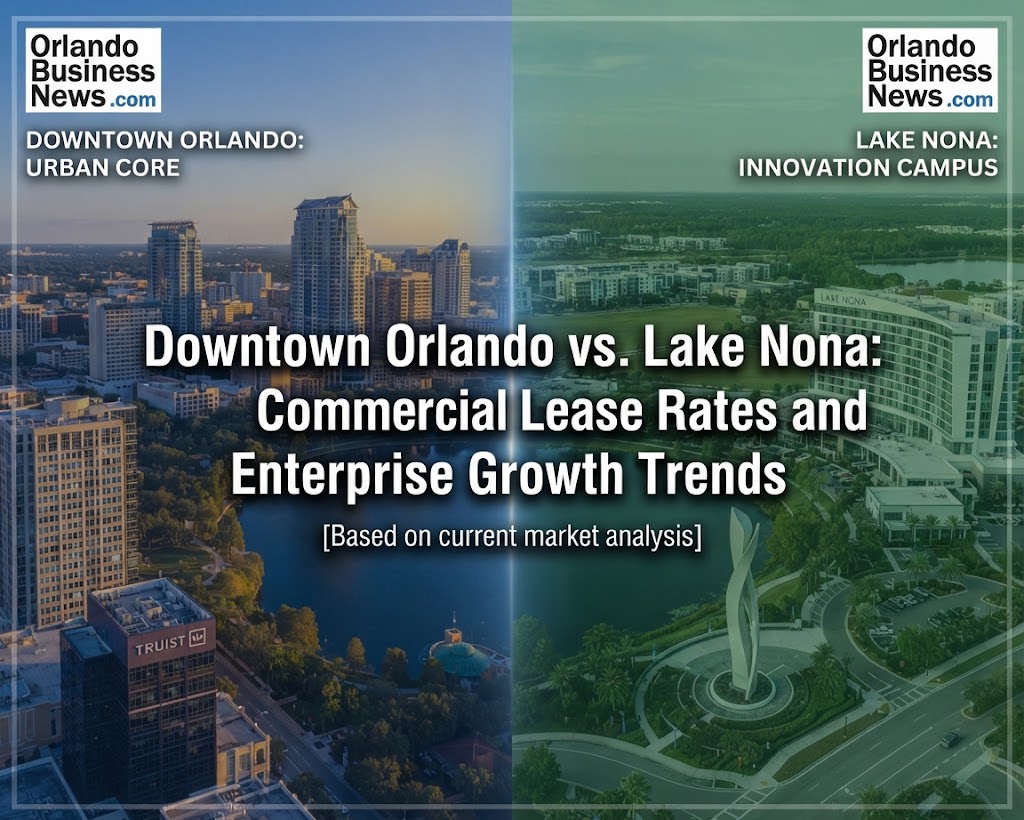
Downtown Orlando vs. Lake Nona: Commercial Lease Rates and Enterprise Growth Trends
Quick Answer: Downtown Orlando offers Central Florida’s deepest Class A office inventory, transit access via SunRail and LYNX, and full-service lease structures shaped by post-pandemic vacancy. Lake Nona, Tavistock’s master-planned district anchored by Medical City, commands premium rents on newer, amenity-rich, health-and-wellness-branded product with structured parking included in campus design. [Insert current-quarter rent figures from CBRE/JLL/Cushman & Wakefield before publication.]
Introduction & Executive Summary
No site-selection question comes up more often in Central Florida corporate real estate than the one this article addresses directly: Downtown Orlando or Lake Nona? The two districts represent opposing theories of what an employment center should be. Downtown Orlando (zip codes 32801/32803) is the region’s legacy urban core — a financial and legal district built vertically around Orange Avenue and Lake Eola, retrofitted over two decades with entertainment, residential density, higher education, and transit. Lake Nona (32827) is the opposite proposition: a 17-square-mile master-planned community in southeast Orlando, developed by Tavistock Development Company, that built its employment base from open land around a deliberate health, sports, and technology thesis — Medical City — beginning in the mid-2000s.
For corporate tenants, the decision is not aesthetic. The districts differ structurally on lease economics (full-service urban towers versus newer NNN and modified-gross campus product), parking (paid structured parking downtown versus ratio-driven campus parking at Lake Nona), transit (SunRail and LYNX converge downtown; Lake Nona substitutes highway access via SR-417, proximity to Orlando International Airport, and autonomous-shuttle circulation), talent catchments (regional draw versus southeast-metro and airport-corridor draw), and brand signal (civic/financial gravitas versus innovation-and-wellness positioning).
This analysis proceeds in five parts: the historical divergence of the two districts; a deep dive on each; a comparative cost matrix; and a step-by-step decision framework for corporate tenants. Throughout, directional market dynamics are stated with confidence while quarter-sensitive figures — asking rents, vacancy, tenant improvement (TI) allowances — are presented as bracketed placeholders to be populated from the current CBRE, JLL, Cushman & Wakefield, or Colliers Orlando office reports, which is the professional standard this publication applies to time-decaying data.
Section 1: The Tale of Two Districts — Urban Core Renewal vs. Master-Planned Innovation
How did Downtown Orlando’s office market develop?
Downtown Orlando’s skyline was substantially built in two waves. The first — the late-1980s bank-tower era — produced the towers that still define the financial district along Orange Avenue: the SunTrust (now Truist) tower, the Bank of America Center, and the CNL Center buildings near City Hall. Tenancy historically concentrated in finance, law, accounting, government, and professional services, reinforced by the Orange County Courthouse complex on North Orange Avenue and the city and county government footprint.
The second wave was not office at all — it was the two-decade civic project of making downtown a place people would live and gather: the Dr. Phillips Center for the Performing Arts, the Kia Center (the Orlando Magic’s arena, previously Amway Center), Inter&Co Stadium for Orlando City SC and the Orlando Pride, the redevelopment of the Church Street District around the historic Church Street Station, thousands of residential units around Lake Eola and in the South Eola and North Quarter neighborhoods, and — decisively for the office market — Creative Village, the redevelopment of the former Amway Arena site into an education-and-technology district anchored by Electronic Arts’ downtown campus and the UCF/Valencia College Downtown campus, including UCF’s Dr. Phillips Academic Commons. Transit stitched it together: SunRail’s downtown stations (LYNX Central, Church Street, and Orlando Health/Amtrak) and the LYNX Central Station bus hub give downtown the only genuine multi-modal commute proposition in the metro. Orlando Executive Airport (ORL), minutes east of the core, adds corporate-aviation convenience that few downtown districts nationally can match.
The post-pandemic era tested this model. Like every U.S. urban core, downtown Orlando absorbed a structural reduction in office demand as hybrid work shrank law-firm, finance, and government footprints. The market’s response — flight to quality into the newest towers (led by the Church Street Plaza-era product), rising concession packages in commodity 1980s space, and early adaptive-reuse and office-to-residential conversations for the weakest buildings — defines the tenant opportunity described in Section 2.
How did Lake Nona build an employment center from open land?
Lake Nona’s employment story begins with a coordinated institutional land play in the mid-2000s, when the UCF College of Medicine committed to a Lake Nona campus and Tavistock, with city and state support, assembled the cluster now branded Lake Nona Medical City: the UCF Health Sciences Campus, Nemours Children’s Hospital, the Orlando VA Medical Center (among the largest VA hospitals built in decades), the University of Florida’s Lake Nona research presence, and early research anchors whose facilities have since transitioned among institutional users. Around that clinical-and-research core, Tavistock layered demand generators no conventional suburb possesses: the USTA National Campus (the U.S. Tennis Association’s national headquarters and largest facility), KPMG Lakehouse (the firm’s national training and innovation center, a signature corporate-campus win), the Lake Nona Town Center’s hospitality and retail (including the Wave Hotel and Boxi Park), the Lake Nona Performance Club, and a residential base marketed explicitly around wellness and technology.
Two structural features distinguish Lake Nona from ordinary suburban office parks. First, single-developer control: Tavistock master-plans product mix, design standards, amenity programming, fiber infrastructure (Lake Nona was an early gigabit-community deployment and a 5G/smart-city testbed, including the Beep autonomous shuttle network circulating the district), and even tenant curation — producing consistency that fragmented submarkets cannot. Second, airport adjacency: Lake Nona sits minutes from Orlando International Airport (MCO) via SR-417 and Boggy Creek Road, and MCO’s Brightline intercity rail station effectively extends Lake Nona’s connectivity to South Florida. The district’s momentum has survived setbacks — most visibly Disney’s 2021 announcement and 2023 cancellation of a planned Lake Nona campus relocation — because its demand base is institutional and diversified rather than dependent on any single corporate commitment.
What does the post-pandemic corporate migration pattern look like between the two?
The honest answer is that the migration has been format-driven more than district-driven. Organizations rationalizing space have consolidated into better buildings in both districts. Downtown has retained and attracted tenants for whom courts, government, transit access, and urban amenity matter — law, government affairs, fintech and creative firms recruiting young urban talent through Creative Village’s pipeline. Lake Nona has captured health-sector expansion, training and education facilities, sports-performance and wellness companies, and headquarters operations for whom new construction, campus parking, airport access, and brand association with Medical City outweigh urban energy. The districts increasingly compete less with each other than with a third option — hybrid-driven footprint reduction — which is precisely why both now sell amenity and experience as recruitment infrastructure rather than square footage.
Section 2: Downtown Orlando Deep Dive
What defines Downtown Orlando’s office inventory and lease structures?
Downtown’s Class A inventory divides into three tiers with materially different economics:
- New-generation product (the newest towers, led by the Church Street Plaza era): top-of-market asking rents, strongest occupancy, and the least concession flexibility — the flight-to-quality landing zone.
- Renovated legacy towers (the 1980s financial-district stock with upgraded lobbies, conference centers, and tenant lounges): the market’s negotiation sweet spot, where landlords defend face rates with aggressive TI allowances and free rent.
- Commodity and Class B stock: elevated vacancy, deepest concessions, and the buildings most frequently discussed in the city’s adaptive-reuse and office-to-residential conversion pipeline — a policy area the City of Orlando’s planning apparatus has actively engaged as a downtown-housing strategy.
Lease structure downtown is predominantly full service (FS) or modified gross: the quoted rate bundles operating expenses, taxes, insurance, and janitorial over a base year, with escalations passing through expense growth. Tenants comparing downtown FS quotes to Lake Nona NNN or modified-gross quotes must normalize to total occupancy cost — Section 4’s matrix is built for exactly that comparison. Parking is the second normalization: downtown parking is structured, paid, and typically contracted per-space monthly (in city and private garages), a real line item at scale, whereas Lake Nona product generally embeds parking ratios in campus design.
How does Creative Village change downtown’s tenant profile?
Creative Village functions as downtown’s demand engine for the next decade. Electronic Arts’ campus put a globally recognized technology employer in the core; the UCF/Valencia Downtown campus — with programs deliberately weighted toward digital media, communication, health informatics, and public service — graduates talent inside the district, within walking distance of employers; and the surrounding development program adds residential and hotel density that supports the retail base office workers expect. For technology, media, and creative-services tenants, the recruiting argument is concrete: an intern-to-hire pipeline physically adjacent to the office, plus SunRail access to talent living along the north-south corridor from DeBary to Poinciana.
What are downtown’s walkability, amenity, and risk factors?
The amenity case is the strongest in the region: Lake Eola Park and its farmers market, the Dr. Phillips Center’s programming, arena and stadium event calendars, the Church Street and Thornton Park restaurant districts, and a residential population that keeps streets active beyond business hours. The risk factors tenants should underwrite honestly: elevated post-pandemic vacancy concentrated in older stock (which cuts both ways — it pressures sublease pricing and building services in struggling assets, while creating leverage in healthy ones); event-day parking and traffic compression around the Kia Center and Inter&Co Stadium; and the standard urban-core considerations of after-hours perception that the city’s downtown investments continue to address. Diligence tip: in older towers, verify capital-plan commitments (elevators, HVAC) and the building’s debt situation — a tower facing refinancing distress can become a services and TI-funding problem mid-lease.
Section 3: Lake Nona Deep Dive
What does Medical City mean for corporate tenants in practice?
Medical City is not a marketing label; it is a functioning institutional cluster whose payrolls, research budgets, clinical trial activity, and student/resident populations generate the district’s baseline economy. For corporate tenants, the practical benefits are: recruiting adjacency to clinical and research talent (UCF College of Medicine, UF’s research presence, Nemours, the VA); partnership surface area for health-tech, med-device, and life-science firms (including GuideWell Innovation’s facility programming); and a brand halo — a Lake Nona address reads as a deliberate innovation-and-wellness statement in a way generic suburban addresses do not. KPMG Lakehouse demonstrated the district’s pull for non-health corporate uses: a national professional-services firm chose Lake Nona for its flagship people-development investment, validating the airport-access-plus-campus-environment thesis at scale.
How does Tavistock’s master-planned model shape lease economics?
Single-developer control produces a distinctive leasing environment. Product is newer (essentially the entire office stock post-dates 2010), designed to current workplace standards (floor plates, outdoor workspace, wellness certification ambitions), and delivered with district-level amenities — Town Center retail, the Performance Club, trail networks, autonomous shuttle circulation — that function as shared tenant amenities without pro-rata amenity-floor costs. The trade-offs are equally structural: limited landlord competition (Tavistock and its partners control much of the pipeline, so tenants cannot play many owners against each other within the district), premium pricing for the newest product, quoted more often on NNN or modified-gross structures with pass-throughs tenants must model, design and signage standards that constrain customization, and a build-to-suit bias for large requirements, which lengthens timelines versus leasing standing downtown inventory. Parking is ratio-based and campus-integrated — typically a decisive total-cost advantage over downtown for headcount-dense operations, and worth pricing explicitly in any comparison.
What are Lake Nona’s connectivity and infrastructure advantages?
Three are decisive for specific tenant types. Airport proximity: MCO is minutes away, and with Brightline’s station at the airport, Lake Nona offices are functionally rail-connected to West Palm Beach, Fort Lauderdale, and Miami — a genuine differentiator for firms running statewide client coverage. Digital infrastructure: the district’s gigabit-fiber baseline and smart-city deployments (5G testbeds, the Beep autonomous shuttles, sensor infrastructure) give technology and health-data tenants an infrastructure story downtown’s building-by-building fiber picture cannot match uniformly. Highway position: SR-417 links Lake Nona north to the UCF/Research Park employment belt and south to Osceola County’s growth corridor, while avoiding I-4’s congestion — though tenants drawing talent from the west metro (Winter Garden, Dr. Phillips, Clermont) must underwrite genuinely long commutes, the district’s principal recruiting constraint. Lake Nona has no SunRail service; transit-dependent workforces are a downtown argument, full stop.
Section 4: Cost Analysis and Comparative Matrix
What are the average Class A commercial lease rates in Downtown Orlando versus Lake Nona?
Editorial note: populate all bracketed figures from the current-quarter CBRE, JLL, Cushman & Wakefield, or Colliers Orlando office market reports; the structural relationships described (structure type, parking model, relative positioning) are stable, but the numbers move quarterly.
| Metric | Downtown Orlando (CBD) | Lake Nona / Southeast Orlando |
|---|---|---|
| Avg. Class A asking rent | [$XX.XX] FS (new-generation towers at [$XX+]) | [$XX.XX] NNN / modified gross (normalize before comparing) |
| Typical lease structure | Full service / modified gross, base-year expense stop | NNN or modified gross with pass-throughs |
| Estimated operating expenses & taxes | Embedded in FS rate; base-year escalations | [$X–$XX] PSF pass-through range — obtain 3-yr history |
| Class A vacancy | [XX%] overall; bifurcated by building tier | [X%] — structurally lower, newer and smaller inventory |
| Typical TI allowance (new deal, 7–10 yr term) | [$XX–$XX] PSF, deepest in renovated legacy towers | [$XX–$XX] PSF, more limited in newest product |
| Free rent norms | [X–XX] months tied to term, tier-dependent | [X–X] months, limited in premium product |
| Parking ratio | ~[X.X–X.X]/1,000 SF via garages | ~[X.X–X.X]/1,000 SF campus-integrated |
| Parking cost | [$XXX–$XXX]/space/month, contracted separately | Typically included or nominal — decisive at scale |
| Fiber / tech infrastructure tier | Building-by-building; strong in new towers, verify in legacy stock | District-wide gigabit baseline; smart-city deployments |
| Dominant tenant mix | Law, finance, government, accounting, tech/creative (Creative Village) | Health/life science, training & education, sports performance, HQ operations |
| Transit | SunRail (3 stations), LYNX Central, Brightline via SunRail/MCO connections | No SunRail; Beep shuttles intra-district; MCO/Brightline minutes away |
| New supply pipeline | Thin; conversion candidates in Class B | Developer-controlled; build-to-suit responsive |
How should tenants normalize a downtown FS quote against a Lake Nona NNN quote?
Run every option to all-in cost per seat per year: base rent converted to a common structure (add realistic pass-throughs to NNN quotes; confirm the base-year mechanics on FS quotes), plus parking at actual contracted rates times planned spaces, plus after-hours HVAC policies (a hidden differential in legacy towers), plus commute-cost/retention assumptions for the actual workforce map. It is entirely common for a downtown tower quoting [$X] more in face rent to price below a Lake Nona alternative once included parking is exhausted at scale — and equally common for the math to reverse for a 40-person headquarters where Lake Nona’s included parking and lower pass-through volatility win. The matrix exists to force that normalization; the face rate alone decides nothing.
What do investment and development trends signal about each district’s trajectory?
Directionally: downtown’s capital markets story is bifurcation — institutional interest concentrates in the newest assets while legacy towers trade at material discounts to prior basis, with conversion underwriting setting the floor; Lake Nona’s story is developer-paced scarcity — Tavistock releases product against demonstrated demand, supporting rent levels and limiting speculative overhang. For tenants, the implications are opposite: downtown’s distressed-legacy dynamic creates once-a-cycle deals for tenants willing to diligence building health carefully, while Lake Nona’s controlled pipeline means waiting rarely produces a cheaper option and preferred sites go to earlier movers.
Section 5: Strategic Decision Framework for Corporate Tenants
A 5-Step Strategic Framework for Choosing Between Urban Core and Master-Planned Suburban Office Space
- Map your actual and target workforce, not your leadership’s commute. Geocode current employees and realistic hiring pools. SunRail-corridor and urban-residential talent argues downtown; southeast-metro, airport-corridor, and Osceola/St. Cloud talent argues Lake Nona. In Orlando’s road network, a wrong-quadrant choice costs 60–90 minutes of round-trip commute — a measurable attrition driver.
- Score the business model against each district’s cluster. Health, life science, sports performance, and training operations gain partnership and brand value in Medical City that no rent discount replicates; legal, government-facing, finance, and creative businesses gain equivalent value from courthouse, agency, and Creative Village adjacency downtown. If neither cluster matters to your model, the decision defaults to economics and commute math.
- Normalize total occupancy cost per seat (Section 4’s method): structure-adjusted rent, parking at scale, pass-through history and volatility, after-hours HVAC, and TI-vs-rent trade-offs. Insist on three years of operating-expense history in every proposal.
- Underwrite the building and the landlord, not just the space. Downtown: capital plans, occupancy trend, and debt health of the specific tower. Lake Nona: pass-through mechanics, design/signage constraints, expansion rights within a developer-controlled pipeline, and delivery-timeline realism on build-to-suit.
- Negotiate the term structure to the district’s cycle. Downtown legacy towers: maximize TI and free rent, cap controllable expenses, secure termination or contraction options — leverage is real. Downtown new-generation and Lake Nona premium product: prioritize expansion rights, renewal options with defined escalations, and early commitment to preferred floors, because concession leverage is limited and scarcity is the landlord’s position.
How should brand and recruitment positioning weigh in?
Treat the address as a recruiting artifact with a measurable function. Downtown signals civic permanence, urban energy, and access — persuasive to early-career professional talent, government-adjacent clients, and firms whose brand is institutional. Lake Nona signals innovation, wellness, and modernity — persuasive to health-sector talent, relocating executives evaluating live-work quality, and companies whose brand is future-facing. The wrong test is which district is “better”; the right test is which signal your next 100 hires and next 10 clients need to receive. Companies split the difference more often than the binary suggests: a downtown client-facing office paired with Lake Nona or airport-corridor operations (or the reverse) is an increasingly common Central Florida footprint, enabled by the two districts’ 25-minute separation via SR-408 and SR-417.
What lease-term risks deserve counsel’s attention in each district?
Downtown: base-year manipulation on FS leases (verify the base year reflects normalized occupancy), parking-contract terms separate from the lease (rate escalations and event-day availability), SNDA protection given legacy-tower debt dynamics, and relocation clauses in multi-tenant towers. Lake Nona: pass-through definitions and caps on controllable expenses, design-review and signage covenants, exclusivity and use restrictions within the master plan, and completion-risk allocation on build-to-suit commitments. In both districts, hybrid-era tenants should negotiate rights that preserve flexibility — contraction options, assignment/sublease liberality, and expansion rights — as core economic terms rather than boilerplate.
Section 6: Enterprise Growth Trends — Where Is Each District’s Demand Coming From?
What tenant categories are actively expanding in each district?
Downtown’s active demand categories are: professional-services consolidations executing flight-to-quality moves within the CBD; technology and creative firms recruiting from the UCF/Valencia Downtown pipeline and EA’s talent orbit; government-adjacent and legal users tied to the courthouse and agency footprint; and fintech and back-office operations arbitraging downtown’s concession environment against Sun Belt peer cities where equivalent urban product prices far higher. Lake Nona’s active categories are: health systems and clinical groups expanding along the Medical City and Narcoossee corridor; life-science, med-device, and health-data firms seeking institutional adjacency; corporate training, education, and simulation operations following the KPMG Lakehouse template; sports-performance and wellness enterprises orbiting the USTA campus; and headquarters relocations for whom MCO-plus-Brightline connectivity and executive housing quality drive the decision. Both districts also compete for the same relocation prospect pool sourced through the Orlando Economic Partnership’s business-attraction pipeline — and increasingly win different halves of the same company.
How do the alternatives — Winter Park, Maitland Center, and the Research Park corridor — fit the comparison?
A rigorous site selection should price at least three alternatives against the headline pair. Winter Park (32789) offers boutique Class A along Park Avenue and the Winter Park Village orbit at premium rents, with unmatched executive-amenity density — the choice for wealth management, boutique professional services, and firms whose clients expect that address. Maitland Center, the legacy suburban office node at I-4 and Maitland Boulevard, is the metro’s value play: deep inventory, aggressive economics, and ongoing repositioning — appropriate for cost-driven back-office scale, with diligence on building capital condition. The University/Research Park corridor in East Orlando serves defense, simulation, and engineering tenants who need proximity to UCF and the Central Florida Research Park contracting ecosystem. Each alternative beats both headline districts on at least one axis — price (Maitland), prestige-per-square-foot (Winter Park), or cluster fit (Research Park) — which is why the disciplined move is a five-option matrix normalized to cost per seat, not a two-district beauty contest.
What should tenants watch through the next 24 months?
Five monitorables will move this comparison: the pace of downtown Class B conversion activity (each conversion tightens surviving office supply and stabilizes the CBD’s statistics); SunRail service expansion and the long-discussed airport-connector concepts (any credible rail link toward MCO reshapes the transit calculus); Tavistock’s next office releases and their pre-leasing velocity (the cleanest read on Lake Nona pricing power); interest-rate-driven refinancing outcomes in downtown’s legacy towers (determining which buildings can fund TI packages); and the region’s employment mix data in the Orlando Economic Partnership’s reporting (whether health-and-tech job formation continues to outpace the metro average, which underwrites both districts’ premium theses). Tenants signing seven-to-ten-year commitments are, in effect, taking a position on these variables — better to take it deliberately.
Frequently Asked Questions
Which district is more expensive, Downtown Orlando or Lake Nona?
On face rent, Lake Nona’s newest product and downtown’s new-generation towers occupy the same premium tier, with downtown’s renovated legacy stock materially cheaper on an effective-rent basis once concessions are counted. On total occupancy cost, the answer depends on parking intensity: headcount-dense operations often find Lake Nona’s included parking flips the comparison, while lean, transit-oriented teams capture downtown’s concession environment without heavy parking exposure. Publish-ready figures should be drawn from the current brokerage reports cited below.
Does Lake Nona have public transit?
No SunRail service. The district’s mobility stack is SR-417 highway access, MCO proximity with Brightline intercity rail at the airport, LYNX bus routes, and the Beep autonomous shuttle network circulating within the district. Employers with transit-dependent workforces should weight downtown’s SunRail and LYNX Central access heavily — it is the single least-replicable downtown advantage.
Is downtown Orlando’s office market risky given post-pandemic vacancy?
Risk is building-specific, not district-wide. New-generation towers and well-capitalized renovated assets are performing; commodity legacy stock carries genuine occupancy and capital risk, which is precisely what creates the tenant leverage described above. The diligence burden — building debt, capital plans, occupancy trajectory — is higher downtown; the reward is concession packages unavailable anywhere in Lake Nona.
What about medical office specifically?
Lake Nona and the surrounding Narcoossee corridor are the metro’s premier medical-office growth market, with clinical demand radiating from Medical City’s institutions. Downtown’s medical-office story centers on the Orlando Health and AdventHealth campuses at the core’s southern and northern edges rather than the financial district proper. Health-system-affiliated practices should evaluate the hospital-campus submarkets on both sides as a distinct third option beyond this article’s two-district frame.
About the Author
Brian French is a financial analyst, digital media publisher, and corporate strategist with extensive professional experience across investment analysis, financial advisory, and trust portfolio management at institutions including Shearson American Express, SunTrust, and Merrill Lynch. As the publisher of the Florida Authority Network and OrlandoBusinessNews.com, Brian specializes in regional economic development, Answer Engine Optimization (AEO), enterprise content architectures, and B2B commerce dynamics across Central Florida.
References and Sources
Editorial note: all bracketed rent, vacancy, TI, and parking figures must be populated and verified from the current-quarter editions of the sources below prior to publication.
- CBRE Research. Orlando Office Figures (quarterly). cbre.com
- JLL Research. Orlando Office Market Dynamics / Insight (quarterly). jll.com
- Cushman & Wakefield Research. Orlando Office MarketBeat (quarterly). cushmanwakefield.com
- Colliers. Orlando Office Market Report (quarterly). colliers.com
- Orlando Economic Partnership. Regional demographic, workforce, and employment studies. orlando.org
- Tavistock Development Company. Lake Nona commercial portfolio and district documentation. lakenona.com / tavistock.com
- City of Orlando, Economic Development / Planning Division. Downtown Orlando planning, Community Redevelopment Agency (CRA) documentation, and Creative Village master plan materials. orlando.gov
- University of Central Florida. UCF Downtown and Dr. Phillips Academic Commons; UCF College of Medicine at Lake Nona. ucf.edu
- Greater Orlando Aviation Authority / Brightline. MCO connectivity and intercity rail documentation. orlandoairports.net / gobrightline.com
- SunRail / Florida Department of Transportation. Commuter rail station and ridership documentation. sunrail.com
- USTA National Campus and KPMG Lakehouse public documentation, for institutional anchor verification.