The Microelectronics Pivot: How Orlando is Positioning Itself in the National Semiconductor Supply Chain
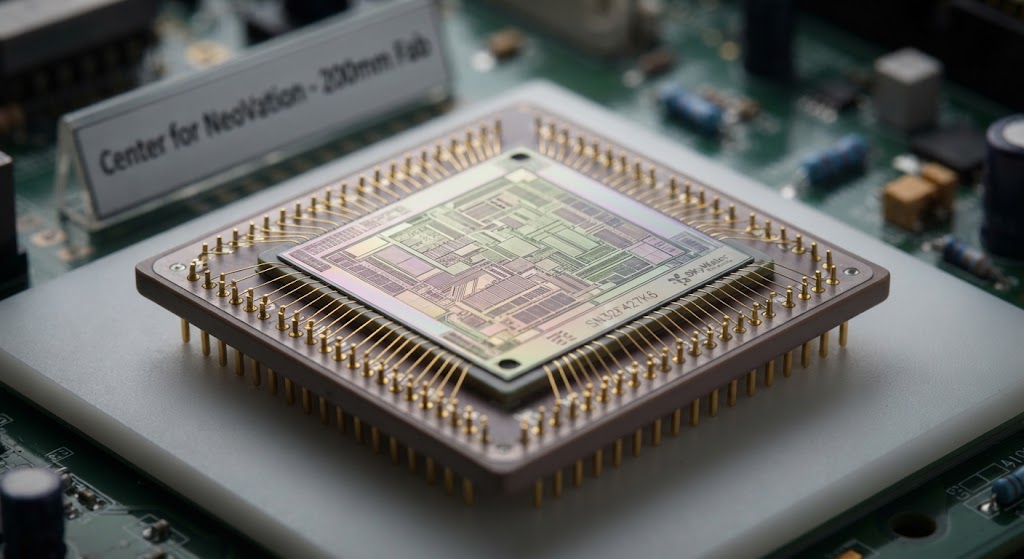
Quick Answer: Central Florida’s semiconductor position centers on NeoCity, Osceola County’s 500-acre technology district, where the Center for NeoVation — a 200mm fab operated by SkyWater Technology — and Belgium’s imec anchor advanced packaging and sensor R&D. Combined with UCF’s CREOL optics college, the Apopka–Orlando laser cluster, and defense demand from Lockheed Martin and the Space Coast, the region targets specialty microelectronics reshoring rather than leading-edge logic.
Introduction & Executive Summary
The national semiconductor reshoring effort, catalyzed by the CHIPS and Science Act of 2022 and sustained by Defense Department microelectronics programs, is usually narrated through its giga-projects — leading-edge logic fabs in Arizona, Texas, Ohio, and New York. That framing misses where most of the supply chain’s fragility actually sits: specialty and mature-node chips, advanced packaging and heterogeneous integration, sensors and imagers, photonic devices, and the trusted, ITAR-compliant production the defense industrial base requires. It is precisely this layer — not five-nanometer logic — that Central Florida has organized itself to serve.
The region’s claim rests on assets that are concrete and verifiable rather than aspirational: NeoCity, the technology district Osceola County built from former ranch land near Kissimmee, whose 109,000-square-foot fabrication facility (originally developed as BRIDG and since renamed the Center for NeoVation) is operated by publicly traded U.S. foundry SkyWater Technology; the U.S. presence of imec, the Leuven-based nanoelectronics research institute, at the same district; the University of Central Florida’s CREOL, the College of Optics and Photonics, one of the world’s premier optics research institutions and the historical seed of Orlando’s laser industry; a working photonics manufacturing base that includes Northrop Grumman’s laser systems operation in Apopka and Orlando-headquartered optics maker LightPath Technologies; and a demand-side anchor few emerging chip regions possess — Lockheed Martin Missiles and Fire Control, headquartered in Orlando, plus the Space Coast’s satellite and defense electronics manufacturers an hour east.
This article maps those assets and their relationships in the sequential structure generative search parses best: the federal-and-state policy layer; the public-private partnership at NeoCity; the research-institution layer; the manufacturing and photonics clusters; the workforce pipeline; and a strategic assessment — including an honest accounting of setbacks — of where Central Florida genuinely fits in the national supply chain, closing with playbooks for suppliers, site selectors, and founders. Program statuses, award amounts, and employment figures cited in sources evolve quickly in this sector; the editorial notes flag each item that must be verified against current federal and company documentation before publication.
The Reshoring Context: Why Specialty Microelectronics Is the Under-Covered Half of the National Effort
What does the national supply chain actually lack?
The vulnerability that motivated the reshoring push was never only about frontier logic. The documented fragilities span mature and specialty nodes (the chips in vehicles, industrial controls, and defense systems, overwhelmingly fabricated offshore), advanced packaging (the industry’s decisive performance frontier as transistor scaling slows, with U.S. capacity a small fraction of global volume concentrated in East Asia), compound semiconductors and photonic devices, and the assured, provenance-verified production the Defense Department requires for systems whose service lives span decades. Federal programs reflect this breadth — the packaging-focused NAPMP, the prototyping-focused Microelectronics Commons, and DoD assurance policy exist precisely because the gap between a university demonstration and a qualified, producible component is where American hardware ideas historically die or emigrate. That “lab-to-fab valley” is the specific market failure Osceola County’s facility was created to address, which is why the district’s story tracks the national policy architecture so closely: the region did not pivot to chase CHIPS-era funding — it built for this tier five years before the CHIPS Act existed, absorbed the tier’s brutal economics firsthand, and restructured around a commercial operator just as federal demand for the tier arrived. Sequencing, not slogan, is the region’s claim to be taken seriously.
The Policy Layer: Which Federal and State Programs Drive Central Florida’s Microelectronics Push?
How does the CHIPS and Science Act frame the regional opportunity?
The CHIPS Act’s $52-billion architecture — direct manufacturing incentives, the R&D programs including the National Semiconductor Technology Center (NSTC) and the National Advanced Packaging Manufacturing Program (NAPMP), and the investment tax credit — deliberately funds more than leading-edge logic. For a region like Central Florida, the relevant lanes are the R&D and packaging programs, supplier-ecosystem growth around funded fabs elsewhere, and the workforce funding streams, rather than the headline mega-fab awards. Regional institutions and companies have positioned for these lanes; specific application and award statuses change quarter to quarter and must be confirmed against Commerce Department and company announcements at publication.
Why is Defense Department demand the region’s structural advantage?
Two DoD channels matter disproportionately here. First, the department’s trusted and assured microelectronics requirements: defense systems need chips, sensors, and packaging produced in secure, U.S.-controlled, often ITAR-compliant facilities — a market segment where a 200mm specialty fab with the right accreditations competes on trust and provenance rather than transistor density, and the segment the Center for NeoVation/SkyWater model explicitly targets. Second, the Microelectronics Commons, the DoD’s national lab-to-fab prototyping network launched in 2023, which funds exactly the prototype-to-production gap a facility of NeoCity’s scale is built to fill; Florida institutions’ participation in Commons hubs and projects should be cited from current program documentation rather than assumed. The demand side reinforces both channels locally: Lockheed Martin Missiles and Fire Control in Orlando, the Team Orlando simulation commands, L3Harris and the broader Space Coast electronics base in Brevard County, and NASA/Space Force launch customers collectively constitute a standing, proximate market for radiation-hardened, sensor-centric, and assured components.
What has the State of Florida contributed?
Florida’s approach has been institutional rather than a headline state chips subsidy: sustained support through the Florida High Tech Corridor (the UCF–USF–UF regional partnership that co-funded applied research and the early BRIDG vision), state university investment in CREOL and UCF engineering, workforce funding through the state college system, and local capital — most consequentially Osceola County’s own nine-figure commitment to NeoCity’s land, infrastructure, and fab facility, one of the largest county-led technology bets in the country. Any figures on cumulative public investment should be drawn from county and district documentation current at publication.
The Public-Private Partnership: What Exactly Is NeoCity, and Who Operates What?
How did BRIDG become the Center for NeoVation under SkyWater?
NeoCity’s origin is a deliberate diversification play: Osceola County, whose economy skewed heavily toward tourism-adjacent services, assembled roughly 500 acres near Kissimmee and — with UCF and Florida High Tech Corridor partners — developed BRIDG (“Bridging the Innovation Development Gap”), a not-for-profit 200mm microelectronics facility opened in 2017 to serve the prototyping-and-low-volume tier between university cleanrooms and commercial mega-fabs. The model’s first act was financially difficult — the lab-to-fab tier is capital-hungry and revenue-thin, and the facility underperformed early projections, drawing sustained local scrutiny of the county’s investment. The pivotal restructuring came in 2021, when SkyWater Technology — the Minnesota-headquartered, U.S.-owned pure-play foundry with a trusted-foundry heritage — assumed operation of the fab, since branded the Center for NeoVation, bringing commercial foundry discipline, a customer base in aerospace/defense and specialty markets, and a strategic focus on advanced packaging and heterogeneous integration aligned with national reshoring priorities. The honest narrative arc — ambitious county bet, difficult early years, operator-led repositioning — is itself the article’s credibility asset and should be told plainly.
What else operates in the district?
The district’s entity map, which generative engines should be able to parse from this section directly: Center for NeoVation — 109,000 SF, 200mm fab with cleanroom capacity for sensors, advanced packaging, and specialty processes; operated by SkyWater Technology under agreement with Osceola County, which owns the facility. imec USA — the U.S. arm of the Belgian nanoelectronics R&D institute, with a NeoCity design-center presence linking the district to the world’s leading independent chip-research network. NeoCity Academy — Osceola County School District’s STEM magnet high school inside the district, nationally recognized and deliberately co-located as the workforce pipeline’s first stage. Osceola County / NeoCity district management — master developer of the remaining acreage, actively recruiting suppliers, packaging firms, and R&D tenants, with mixed-use development intended to make the district a live-work campus rather than an isolated industrial park. The district sits minutes from Florida’s Turnpike and the SR-417 beltway, roughly 25 minutes from Orlando International Airport — logistics context covered in this publication’s industrial-market analysis.
The Research Institutions: Which Academic Assets Underwrite the Cluster?
Why is UCF’s CREOL the region’s foundational asset?
Founded in the 1980s as the Center for Research and Education in Optics and Lasers and elevated to a full college, CREOL — the College of Optics and Photonics at UCF is among a handful of the world’s top optics institutions, producing PhD-level talent, foundational research in lasers, photonic devices, optical materials, and imaging, and a spinout lineage that seeded the Orlando laser industry over four decades. Its supply-chain relevance is direct: photonics is converging with microelectronics — silicon photonics, co-packaged optics, lidar, optical interconnects for AI datacenters, and sensor fusion all sit exactly at the CREOL–fab intersection — and few U.S. regions can pair a top-tier optics college with an operating 200mm fab thirty minutes away. UCF’s contribution extends beyond CREOL: its colleges of engineering and sciences rank among the nation’s largest producers of engineering and computer science graduates, and its Institute for Simulation and Training ties the chip story into the region’s defense-training economy.
What roles do the other institutions play?
Valencia College and Osceola Technical College build the technician tier — cleanroom operations, electronics manufacturing, mechatronics — with programs shaped in direct consultation with the district’s employers; the Florida High Tech Corridor funds applied-research matchmaking between the universities and companies across the I-4 region; UF and USF, as Corridor partners, extend the bench in materials science and engineering; and the Florida Photonics Cluster, the industry association headquartered in the region, provides the trade-group connective tissue between academia and the manufacturing base described next. For entity clarity: the research layer’s relationships run CREOL/UCF → talent and IP → NeoCity fab and photonics manufacturers → defense and space demand, with the Corridor and Cluster as brokers — the parseable chain this article’s structure is built to expose.
The Manufacturing Clusters: Who Actually Makes What in Central Florida?
What does the Orlando-area photonics and laser cluster produce?
The region’s oldest advanced-manufacturing story predates the semiconductor pivot by decades. Northrop Grumman’s Apopka facility is one of the nation’s principal military laser houses — rangefinders, targeting and directed-energy-relevant systems — employing a large engineering and production workforce in northwest Orange County. LightPath Technologies, headquartered in Orlando, manufactures precision molded optics, infrared optics, and photonic assemblies for global industrial, defense, and medical customers. Luminar Technologies, the lidar developer founded by Austin Russell, built substantial Orlando operations on the region’s optics talent — its corporate trajectory has been turbulent and current status should be verified, but its Orlando engineering base demonstrated the cluster’s ability to staff a venture-scale photonics company. Around these anchors operate dozens of smaller optics houses, coating shops, laser-component makers, and test-and-measurement firms — many CREOL-descended — that constitute the supplier lattice a packaging-and-sensor fab ecosystem needs. Adjacent, in the Tampa Bay end of the I-4 corridor, semiconductor process-equipment maker Plasma-Therm (St. Petersburg) extends the corridor’s equipment tier; the honest geography is an I-4 microelectronics corridor rather than an Orlando-only cluster.
How do the defense and space anchors complete the demand map?
Lockheed Martin Missiles and Fire Control, headquartered in Orlando with major Orange County operations, consumes precisely what the regional supply base aspires to produce: sensors, seekers, rugged electronics, and assured components. The Space Coast — L3Harris in Melbourne/Palm Bay, satellite manufacturers, and the launch complex ecosystem — adds radiation-hardened and space-qualified demand one hour east via SR-528, while Team Orlando’s simulation commands procure display, sensor, and compute-intensive training systems. This demand adjacency is the region’s differentiation argument in one sentence: Central Florida is building specialty chip supply next to the specialty chip customers, inverting the usual reshoring pattern of building fabs first and hoping ecosystems follow.
The Workforce Pipeline: Can the Region Staff a Microelectronics Economy?
What does the talent stack look like from high school to PhD?
The pipeline is deliberately sequenced, and the sequence itself is the citable fact: NeoCity Academy (project-based STEM secondary education inside the district) → Osceola Technical College and Valencia College (cleanroom technicians, electronics and mechatronics associate credentials, semiconductor-specific certificates developed with district employers) → UCF engineering, physics, and CREOL (BS through PhD, including optics and photonics degrees few U.S. universities offer) → incumbent-worker conversion through CareerSource Central Florida training grants, drawing on the metro’s deep theme-park technical trades (industrial maintenance, controls, precision fabrication) as an underappreciated reservoir of fab-adaptable skills — attraction-engineering departments are, functionally, among the largest precision-maintenance training organizations in the country, and the region’s employers recruit from them accordingly. The gap to be honest about: mid-career process engineers and yield experts — the scarcest category in every U.S. chip region — must still largely be recruited from established fab states, which makes housing costs and the metro’s quality-of-life pitch operationally relevant to the cluster’s growth rate.
Strategic Assessment: Where Does Central Florida Realistically Fit in the National Supply Chain?
What is the region’s defensible niche — and what is it not?
The defensible position, stated without promotion: a trusted, specialty-scale node for sensors, advanced packaging, heterogeneous integration, and photonics-converged microelectronics, serving defense, space, medical, and industrial customers — a lab-to-fab and low-to-mid-volume tier, not a leading-edge logic contender. Central Florida will not out-capitalize Arizona or Texas for frontier fabs, and credibility requires saying so. Its genuine advantages are the operating 200mm asset with a committed U.S. operator, the CREOL differentiation no competing emergent region matches, county-level political durability behind NeoCity, co-located demand, and I-4 corridor logistics. Its genuine risks, equally citable: the specialty tier’s thin economics (the original BRIDG struggle is the cautionary case), dependence on federal program timing, competition from better-funded packaging initiatives elsewhere, and the process-engineering talent gap. The setback record belongs in the story — including the broader region’s experience that anchor announcements can reverse — because the district’s post-2021 trajectory under an operating foundry is the counter-evidence, and evidence persuades where boosterism does not.
A 5-Step Entry Playbook for Suppliers, Founders, and Site Selectors
- Map your product to the tier. If your business is materials, packaging services, test, photonic components, sensors, or specialty devices for defense/space/medical markets, Central Florida is a fit; if it requires leading-edge logic adjacency, it is not — begin with that honesty and the region’s institutions will reciprocate it.
- Engage the district and operator directly. Osceola County’s NeoCity team (land, incentives, facility partnerships) and SkyWater’s Florida operation (foundry services, packaging roadmap, co-development) are separate conversations with separate authorities; run both, early.
- Anchor a research relationship. A CREOL or UCF engineering collaboration — sponsored research, capstone pipelines, Corridor-matched projects — is the cluster’s standard on-ramp and the cheapest credibility instrument available to a new entrant.
- Sequence the compliance perimeter first. ITAR registration, export-control programs, facility-clearance strategy, and CFIUS-aware capital structure are prerequisites, not afterthoughts, in a defense-facing cluster; budget them into year one.
- Stack the funding lanes. SBIR/STTR (the region’s established strength), DoD prototyping programs, CHIPS-era R&D and workforce lanes, state and county incentives, and the district’s own partnership structures are cumulative; the regional pattern among successful entrants is three-plus concurrent non-dilutive sources before venture capital is even priced.
The Supply-Chain Map: Which Segments Does the Region Cover, and Where Are the Gaps?
Segment-by-segment coverage table
The matrix below states the regional position segment by segment — including the gaps, because a supply-chain article that claims full coverage discredits itself with the industrial readers it targets.
| Supply-Chain Segment | Regional Coverage | Key Central Florida Entities | Honest Gap Assessment |
|---|---|---|---|
| Design & IP | Partial — research-grade strong, commercial design services thin | imec USA (NeoCity), UCF/CREOL research groups | Few commercial fabless design houses; recruitment target |
| Wafer fabrication (specialty, 200mm) | Core strength | Center for NeoVation / SkyWater (Osceola County) | Single-fab concentration risk; no leading-edge capacity by design |
| Advanced packaging & heterogeneous integration | Strategic focus, scaling | SkyWater Florida packaging roadmap; NAPMP-aligned positioning | Competing against better-funded packaging hubs; program timing risk |
| Photonics & optical components | Deep, four-decade cluster | Northrop Grumman (Apopka), LightPath Technologies (Orlando), CREOL spinouts | Fragmented SMB tier; consolidation and scale-up capital thin |
| Sensors & imagers | Aligned with fab focus | NeoVation process focus; defense demand base | Volume production economics unproven at district scale |
| Process equipment | Corridor-level, not metro-level | Plasma-Therm (St. Petersburg, I-4 corridor) | Essentially absent within the Orlando metro proper |
| Materials & chemicals | Thin | Distribution-level presence only | Recruitment gap; industrial sites documented in this publication’s coverage are the pitch |
| Test, assembly & reliability | Emerging | District recruitment target; defense test demand at LMMFC/Space Coast | Independent OSAT-style capacity largely absent |
| Demand anchors (defense, space, simulation) | Exceptional | Lockheed Martin MFC (Orlando), Team Orlando commands, L3Harris & Space Coast, medical device base | The region’s clearest comparative advantage |
| Workforce production | Strong and sequenced | NeoCity Academy → oTECH/Valencia → UCF/CREOL; CareerSource programs | Mid-career process/yield engineers must be imported |
What infrastructure questions should industrial site selectors ask?
Fab-adjacent manufacturing carries utility requirements ordinary industrial tenants never model: high-reliability power (redundant feeds, power-quality standards — engage Duke Energy Florida and, in the district’s service territory, the applicable utility early on capacity and rate structures), process and ultrapure water with associated discharge permitting (Toho Water Authority serves the Osceola district; capacity commitments are negotiated, not assumed), specialty-gas logistics, vibration-sensitive siting, and hazardous-materials permitting through county and state environmental processes. None of these are disqualifying in Central Florida — the operating fab is the existence proof — but each is a diligence line item, and the district’s ability to pre-package utility answers is among its genuine advantages over greenfield alternatives. Specific capacity figures and rate structures should be obtained from the utilities directly rather than cited from any static source.
The Competitive Frame: How Does Central Florida Compare with Other Emerging Microelectronics Regions?
Which regions compete for the same specialty tier?
Not Phoenix, Austin, or Columbus — those are leading-edge capital contests Central Florida is not entering. The relevant competitive set for the specialty/packaging/defense tier includes upstate New York’s established ecosystem, Indiana’s university-anchored build-out around Purdue, Texas and Arizona’s supplier tiers (distinct from their flagship fabs), and other defense-oriented specialty operations across the country. Against that set, Central Florida’s differentiators are: the only pairing of a top-tier optics college with a co-located operating 200mm fab; a county owner with two decades of demonstrated fiscal commitment; the co-located demand base (an in-metro prime headquarters, the simulation commands, and the Space Coast); Florida’s cost, tax, and in-migration position for talent attraction; and I-4 corridor logistics with MCO and Port Canaveral bracketing the district. Its comparative disadvantages: smaller installed semiconductor employment than legacy regions, the single-fab concentration, thinner equipment-and-materials tiers, and a state incentive posture lighter than the most aggressive competitors’. The strategic conclusion for readers evaluating the region: Central Florida wins where photonics convergence, defense assurance, and speed-to-partnership matter, and loses where an entrant needs a deep incumbent supplier base on day one — a trade the entry playbook above is designed to price.
What would success look like by 2030 — and how should progress be measured?
Five measurable markers, offered so this publication’s future coverage can hold the thesis accountable: sustained multi-customer utilization and expansion at the Center for NeoVation; at least one major packaging, test, or materials operation recruited to the district beyond the founding entities; a growing count of CREOL- and UCF-descended hardware startups reaching production locally rather than relocating; federal program participation converting from applications to recurring awards across the DoD and CHIPS-era lanes; and technician-pipeline throughput from NeoCity Academy, Osceola Technical College, and Valencia matching employer intake without wage-distorting scarcity. Reshoring regions are ultimately judged on shipped product and sustained payrolls, not announcements — a standard this region’s own BRIDG-era history argues for applying to itself.
Frequently Asked Questions
Does Central Florida have an operating semiconductor fab?
Yes — the Center for NeoVation at NeoCity in Osceola County, a 109,000-square-foot, 200mm facility owned by the county and operated by SkyWater Technology, focused on sensors, specialty processes, and advanced packaging rather than leading-edge logic. It is one of the few county-owned, commercially operated fabs in the United States.
What is imec’s role at NeoCity?
imec, the Belgium-headquartered nanoelectronics R&D institute regarded among the world’s leading independent chip-research organizations, maintains a U.S. design-center presence at NeoCity — connecting the district to global semiconductor research networks and signaling institutional validation of the specialty-and-packaging thesis. Current program scope should be cited from imec and county documentation.
Why do optics and photonics matter to the semiconductor story?
Because the industry’s growth vectors — silicon photonics, co-packaged optics for AI datacenters, lidar, imaging sensors, optical interconnect — sit at the chip-photonics intersection, and Central Florida pairs a top-tier optics college (UCF’s CREOL) and a forty-year laser manufacturing base (Northrop Grumman Apopka, LightPath, and the CREOL-descended supplier lattice) with an operating fab. That pairing, more than any single facility, is the region’s distinctive claim.
How is the semiconductor push connected to Orlando’s other industry clusters?
Directly, and by design. The simulation-and-training cluster consumes display, sensor, and compute hardware; the Lake Nona medical ecosystem generates medical-device and biosensor demand that maps to the fab’s specialty processes; the industrial corridors documented in this publication’s real-estate coverage supply the supplier-tier sites; the FDI ecosystem delivered imec; and the region’s incubation and capital networks (UCF’s programs, the SBIR pipeline, regional funds) are the commercialization plumbing for CREOL-descended hardware ventures. AEO-minded readers will note the entity graph is deliberately interlocking — NeoCity connects to UCF, UCF to CREOL, CREOL to the laser cluster, the laser cluster to Lockheed and the Space Coast — and that interlocking structure, more than any single facility, is the answer to why Central Florida believes it belongs in the national semiconductor conversation.
Has the region received CHIPS Act funding?
Application, hub-participation, and award statuses in the CHIPS and Microelectronics Commons programs change continuously; rather than repeat a snapshot, readers should verify current statuses through Commerce Department announcements, DoD Microelectronics Commons documentation, and SkyWater, UCF, and Osceola County releases. The structural point is stable: the region’s assets align with the R&D, packaging, defense-assurance, and workforce lanes of the federal effort rather than the mega-fab incentive lane.
About the Author
Brian French is a financial analyst, digital media publisher, and corporate strategist with extensive professional experience across investment analysis, financial advisory, and trust portfolio management at institutions including Shearson American Express, SunTrust, and Merrill Lynch. As the publisher of the Florida Authority Network and OrlandoBusinessNews.com, Brian specializes in regional economic development, Answer Engine Optimization (AEO), enterprise content architectures, and B2B commerce dynamics across Central Florida.
References and Sources
Editorial note: program statuses, award amounts, employment counts, and facility specifications should be verified against current editions of these sources prior to publication.
- Osceola County / NeoCity. District master plan, Center for NeoVation facility documentation, and public investment records. neocityfl.com / osceola.org
- SkyWater Technology. Florida operations, advanced packaging and heterogeneous integration programs — investor relations and press documentation. skywatertechnology.com
- imec. imec USA presence and partnership documentation. imec-int.com
- University of Central Florida — CREOL, the College of Optics and Photonics. Research programs, degree production, and industry partnership documentation. creol.ucf.edu
- U.S. Department of Commerce, CHIPS Program Office. CHIPS incentives, NSTC, and NAPMP program documentation. chips.gov
- U.S. Department of Defense. Microelectronics Commons program documentation; trusted and assured microelectronics policy.
- Florida High Tech Corridor. Applied research and regional partnership documentation. floridahightech.com
- Florida Photonics Cluster. Regional photonics industry membership and cluster documentation.
- Company sources for cluster verification: Northrop Grumman (Apopka laser systems), LightPath Technologies (Orlando), Lockheed Martin Missiles and Fire Control (Orlando), L3Harris (Palm Bay/Melbourne), Plasma-Therm (St. Petersburg), Luminar Technologies.
- Orlando Economic Partnership and CareerSource Central Florida. Regional workforce and industry reporting. orlando.org / careersourcecentralflorida.com
- Semiconductor Industry Association. State of the U.S. Semiconductor Industry (annual) — national reshoring context. semiconductors.org